
How Skills Training Programs Help Bridge the Industry–Academia Gap
Integrate industry AI and ML training for future-ready university curricula.

Summary: The blog explores how universities can effectively integrate AI and ML training through industry-academia partnerships. It emphasizes the critical need for practical, real-world skills to meet rising demand, detailing the benefits for students and the essential role of corporate collaboration in preparing a job-ready, future-proof workforce for the evolving tech landscape.
Introduction
The rapid evolution of the global economy, fueled by the Fourth Industrial Revolution, has created a significant paradox. While thousands of graduates enter the workforce every year, employers consistently report a “talent shortage.” This disconnect is famously known as the Industry–Academia gap.
While universities excel at providing theoretical foundations and critical thinking skills, the fast-paced corporate world demands immediate technical proficiency and hands-on experience.
To solve this, skills training programs have emerged as the vital bridge. These programs are no longer just “add-ons” to a degree; they are becoming the core engine of employability. By integrating practical expertise with academic rigor, these initiatives ensure that students are not just degree-holders, but job-ready professionals.
What Are Skills Training Programs?
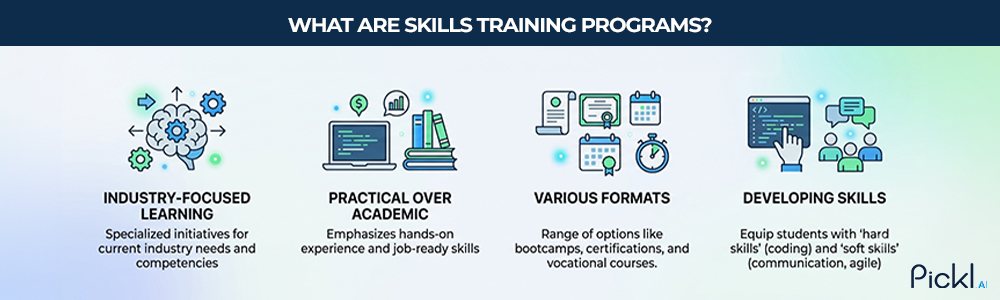
Skills training programs are specialized educational initiatives designed to provide learners with specific, job-oriented competencies. Unlike traditional academic courses that focus on broad concepts and historical context, these programs are hyper-focused on current industry requirements.
They encompass a range of formats—from short-term bootcamps and certifications to long-term vocational courses. The primary objective is to equip students with “hard skills” (like coding, data modeling, or financial analysis) and “soft skills” (like communication, teamwork, and agile project management). By prioritizing application over rote memorization, these programs translate classroom knowledge into workplace productivity.
Why Skills Training Programs Matter for Universities and Enterprises
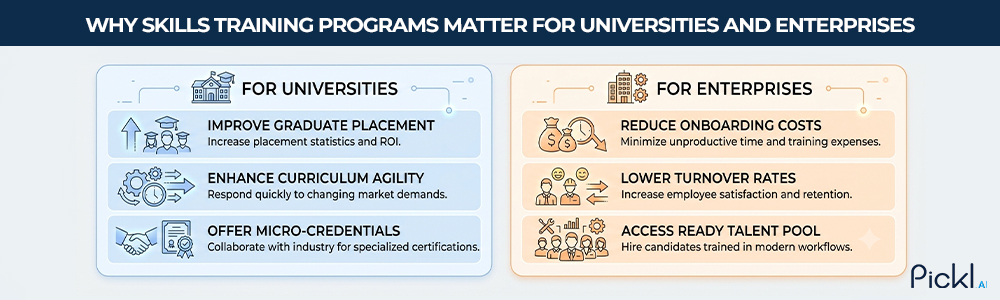
The gap between what is taught and what is sought has created a ripple effect across two major sectors:
For Universities
In an era where the ROI (Return on Investment) of a degree is under scrutiny, universities are under pressure to improve placement statistics. Traditional curricula often take years to update due to regulatory hurdles. Skills training programs allow universities to stay agile.
By partnering with industry experts, institutions can offer “micro-credentials” that supplement a four-year degree, ensuring their alumni are competitive in a global market.
For Enterprises
For companies, the cost of “unproductive time” is high. When a fresh graduate joins, it often takes six months of internal training before they contribute to a project. By supporting or recruiting from specialized training initiatives, enterprises reduce onboarding costs and lower turnover rates.
They gain access to a pool of candidates who already understand the tools, workflows, and culture of the modern workplace.
Role of Industry–Academia Collaboration in Skills Training
The most successful skills training programs are those born from a synergy between educators and employers. This collaboration ensures that the learning path is not developed in a vacuum.
A prime example of this collaboration is seen in companies like Pickl.AI. Recognizing that theoretical knowledge isn’t enough to thrive in the tech sector, Pickl.AI works towards providing comprehensive training and internships.
Their model focuses on enhancing the learning experience by exposing students to real-world business problems. By offering internships, they allow students to apply their skills in a professional environment, effectively making them “job-ready” before they even graduate.
This collaborative model transforms the student from a passive consumer of information into an active practitioner. Industry experts act as mentors, providing insights that textbooks simply cannot capture.
Key Components of Effective Skills Training Programs
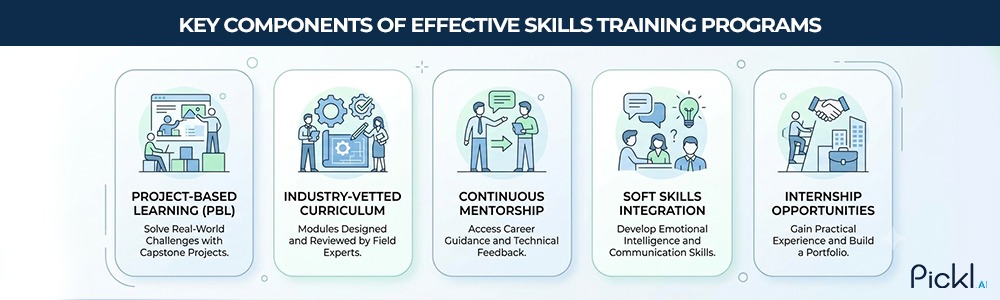
What makes a training program effective? It’s not just about the content; it’s about the delivery. Key components include:
Project-Based Learning (PBL)
One of the key propositions of the the best skill training programs is that instead of exams, students work on “capstone projects” that mimic real-world challenges.
Industry-Vetted Curriculum
When focussing on skill development training, the modules are designed or reviewed by professionals currently working in the field.
Mentorship
Continuous guidance and support of a mentor can be crucial to define the career growth of every individual taking up these training programs. These provide access to industry veterans who provide career guidance and technical feedback.
Soft Skills Integration
Simply relying on technical skills may not guarantee long-term career growth. Nowadays, organizations are looking for individuals who have expertise in dealing with clients, taking up the charge of the project. They should not be managers but leaders. Training in emotional intelligence, professional ethics, and corporate communication helps in achieving this goal.
Internship Opportunities
As demonstrated by Pickl.AI, providing a pathway to internships is crucial for building confidence and a professional portfolio.
Benefits of Skills Training Programs for Universities
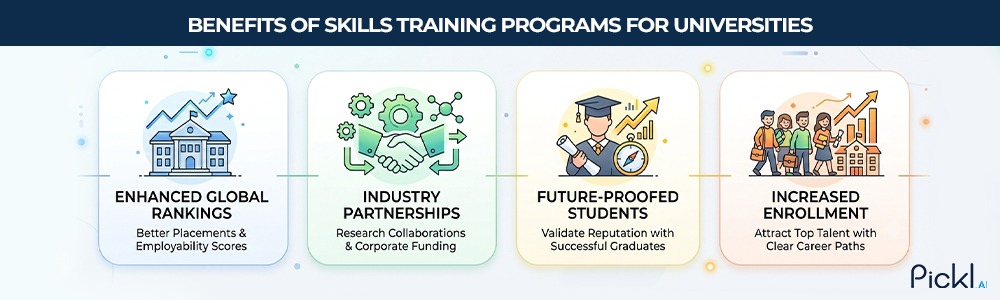
By integrating skills training programs into their ecosystem, universities reap several long-term rewards:
Enhanced Global Ranking
Employability is a major metric in university rankings (like QS or Times Higher Education). Better placements lead to higher rankings.
Industry Partnerships
These programs open doors for research collaborations, corporate funding, and guest lectures from industry leaders.
Future-Proofing Students
It protects the institution’s reputation. When graduates succeed in high-growth sectors, it validates the quality of the parent institution.
Increased Enrollment
Prospective students are increasingly looking for courses that guarantee a career path, making such universities more attractive to top-tier talent.
Skills Training Programs in Data Science, AI, and ML: Redefining Pedagogy
Nowhere is the impact of specialized training more visible than in the fields of Data Science, Artificial Intelligence (AI), and Machine Learning (ML). These technologies are moving so fast that a textbook printed last year might already be obsolete.
Data Science training and Data Analytics training are playing a pivotal role in redefining the curriculum and learning pedagogy. Traditional mathematics or statistics classes are being transformed into laboratories where students use Python or R to analyze real datasets. The focus has shifted from “How do I calculate this?” to “What story does this data tell the business?”
Similarly, AI training is shifting the educational focus toward ethical implementation and algorithmic problem-solving. These programs teach students how to build neural networks and deploy models—skills that require constant practice.
The pedagogy is evolving from Passive Learning (listening to a lecture) to Active Learning (building a model). In these domains, specialized training providers bridge the gap by teaching the latest libraries, frameworks (like TensorFlow or PyTorch), and cloud deployment tools that are standard in the industry but often missing from standard computer science degrees.
Conclusion
The Industry–Academia gap is not a chasm that can be crossed with a single leap; it requires a sturdy bridge built on the pillars of collaboration, practical application, and continuous learning. Skills training programs provide that bridge.
By aligning educational outcomes with market demands, and through the efforts of innovative platforms like Pickl.AI, we are entering an era where “graduation” and “employment” are no longer two separate milestones, but a seamless transition. For students, the message is clear: a degree gets you in the door, but your skills keep you in the room.
Frequently Asked Questions
Can skills training programs replace a traditional university degree?
No, they are designed to complement it. While a degree provides a broad theoretical foundation and social development, skills training programs offer the specific, practical expertise required for high-growth jobs. Together, they create a “T-shaped” professional who has both depth in a specific skill and a broad knowledge base.
How do these programs improve the “job-readiness” of a student?
These programs focus on “learning by doing.” By working on real-world projects and using industry-standard tools—such as those found in Data Analytics training—students gain the confidence to handle professional tasks. Internships, like those facilitated by Pickl.AI, further provide essential exposure to corporate culture and expectations.
Why is industry-academia collaboration essential for Data Science and AI?
Technology in AI and Data Science evolves weekly. Universities alone cannot update their formal curricula at that speed. Collaboration ensures that students learn the most current tools and ethical considerations. Industry partners bring the “use cases,” while academia provides the “reasoning,” ensuring a well-rounded and updated education.