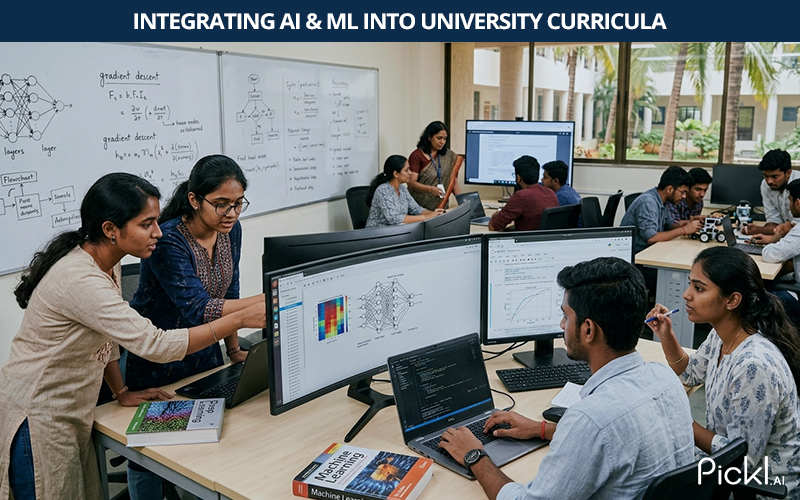

Summary: This article explores a strategic framework for universities to integrate AI and ML training. It advocates for universal literacy, “AI + ML Training” disciplinary models, and industry partnerships. By prioritizing agile curricula, faculty development, and ethics, higher education can produce AI-augmented professionals ready to thrive in a transformative global labor market.
Introduction
The landscape of technology is growing at an unprecedented pace, with Artificial Intelligence (AI) and Machine Learning (ML) at the forefront of this revolution. These transformative technologies are not just buzzwords; they are reshaping industries from healthcare to finance, manufacturing to entertainment.
As the demand for AI and ML specialists skyrockets, universities face a critical challenge and an immense opportunity: how to effectively prepare the next generation of professionals to thrive in this AI-driven world. The answer lies in a proactive and comprehensive integration of AI and ML training into academic curricula, moving beyond theoretical concepts to embrace practical, industry-relevant skills.
This shift is not merely about adding new courses but rethinking the entire educational paradigm to foster innovation, critical thinking, and real-world problem-solving capabilities essential for the AI era.
What Is AI and ML Training in an Industry–Academia Model?
AI and ML training within an industry-academia model represents a collaborative educational approach where academic institutions partner with leading companies in the AI and ML sectors. This model goes beyond traditional internships, aiming for a deeper, more integrated learning experience.
Students aren’t just learning about AI; they’re learning to do AI with real-world tools, datasets, and challenges. This involves curricula co-developed by university faculty and industry experts, ensuring that the skills taught are directly applicable and highly sought after by employers.
For instance, this model might see industry professionals guest lecturing, bringing their current projects and insights directly into the classroom. It could involve students working on capstone projects sponsored and mentored by companies, using proprietary datasets (under non-disclosure agreements) to solve actual business problems.
Think of a scenario where students in a data science program at Carnegie Mellon University collaborate with Google engineers on optimizing search algorithms or developing new recommendation systems, directly applying their AI and ML training in a commercial context. This approach bridges the gap between theoretical knowledge and practical application, providing students with invaluable experience and making them job-ready upon graduation.
Why Universities Need Industry-Backed AI and ML Training
The rapid evolution of AI and ML technologies means that academic curricula, if not regularly updated, can quickly become obsolete. Universities need industry-backed AI and ML training to stay relevant and provide their students with a competitive edge.
According to a report by the World Economic Forum, AI and Machine Learning Specialists consistently ranked among the top emerging jobs, with demand projected to grow by 40% by 2025. This staggering growth underscores the urgent need for a workforce equipped with cutting-edge skills.
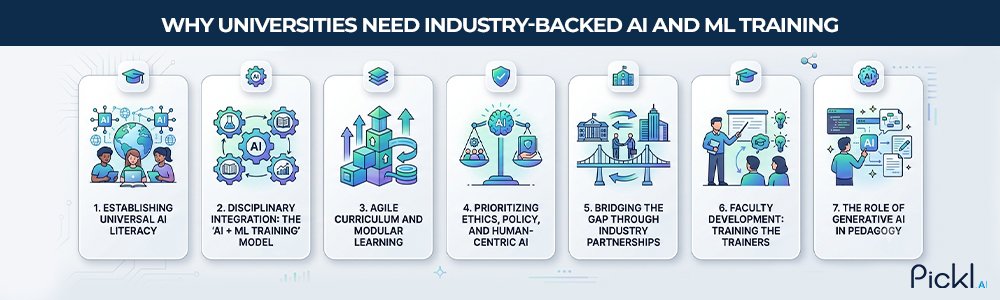
1. Establishing Universal AI Literacy
The first step in curriculum integration is the recognition that AI literacy is the new “digital literacy.” Just as the ability to use a word processor or search the internet became a baseline requirement for all professionals in the late 20th century, understanding the capabilities and limitations of AI is now essential for every student, regardless of their major.
Universities should implement a mandatory “Foundations of AI” course for all incoming students. This course would not necessarily focus on the heavy mathematics of neural networks or Python coding.
Instead, it would cover the conceptual architecture of AI: what a model is, how data training works, the difference between generative and analytical AI, and how to interact with these systems effectively through prompt engineering.
By democratizing this knowledge, universities ensure that a philosophy major and a mechanical engineer start with the same baseline understanding of the tools that will inevitably shape their professional lives.
2. Disciplinary Integration: The “AI + ML Training” Model
The most profound impact of AI occurs at the intersection of technology and specific subject matter expertise. Therefore, the goal should not be to turn every student into a computer scientist, but to create “AI-augmented” professionals in every field. This is the “AI + ML” model.
In the Humanities, AI can integrated through digital humanities projects where students use Natural Language Processing (NLP) to analyze thousands of historical texts or identify patterns in linguistics.
Medicine, the curriculum must evolve to include the use of ML in diagnostics, genomic sequencing, and personalized treatment plans, teaching future doctors how to interpret AI-generated recommendations. In Business and Economics, students should learn how to use predictive analytics to model market trends or automate supply chain logistics.
By embedding AI training within the context of a specific discipline, universities provide students with a practical roadmap for how these tools applied in the real world. This prevents AI from being seen as an abstract, external force and instead positions it as a powerful instrument within the student’s chosen craft.
3. Agile Curriculum and Modular Learning
The traditional university model—where a curriculum is reviewed every five to ten years—is incompatible with the current rate of AI development. To keep pace, universities must adopt an agile approach to curriculum design.
This can be achieved through “modular learning.” Rather than waiting to overhaul an entire degree program, departments can introduce short-form certificate courses or “micro-credentials” that focus on specific, emerging AI technologies.
For instance, a university might offer a six-week module on “Large Language Models in Legal Research” for law students. This modularity allows the institution to pivot quickly as new technologies emerge, ensuring that students are not graduating with obsolete skills.
4. Prioritizing Ethics, Policy, and Human-Centric AI
As AI becomes more pervasive, the demand for ethical oversight and policy development grows exponentially. Universities have a unique responsibility to lead the conversation on the social implications of AI.
AI training must not be purely technical. It must be deeply rooted in ethics, sociology, and law. Students need to be trained to identify algorithmic bias, understand the “black box” problem of AI decision-making, and navigate the complexities of data privacy and intellectual property.
Integrating these topics into the curriculum prepares students to be not just users of AI, but responsible stewards of the technology. A curriculum that produces brilliant coders who do not understand the social consequences of their work is a failure of the modern university.
5. Bridging the Gap through Industry Partnerships
The most advanced AI research is currently happening within private sector labs like OpenAI, Google DeepMind, and NVIDIA. For universities to provide high-quality training, they must foster deep, bidirectional partnerships with industry leaders.
These partnerships can take several forms. First, industry professionals can serve as adjunct faculty or “professors of practice,” bringing real-world case studies into the classroom. Second, universities can secure access to proprietary datasets and high-performance computing (HPC) resources, which are often too expensive for academic institutions to maintain on their own.
Third, capstone projects should be designed in collaboration with companies, allowing students to solve actual problems using ML. This “co-op” style of learning ensures that the skills being taught are those that the market actually demands.
6. Faculty Development: Training the Trainers
A significant barrier to AI integration is the “skills gap” among faculty. Many professors, while experts in their fields, may feel ill-equipped to teach AI-related concepts. Universities must invest heavily in faculty development.
Internal “AI Academies” can be established to help professors from all departments learn how to integrate AI into their research and teaching. This is not about forcing every professor to become a coder; it is about helping them see how AI can enhance their specific field of study.
When faculty members are comfortable with the technology, they can naturally weave it into their lectures and assignments, creating a culture of innovation that trickles down to the students.
7. The Role of Generative AI in Pedagogy
Finally, universities must rethink pedagogy itself. AI is not just a subject to be taught; it is a tool for teaching. The integration of AI into the curriculum should include the use of AI-driven personalized learning platforms that can adapt to a student’s individual pace and style.
Furthermore, the “assessment” model must change. In a world where AI can write essays and solve complex equations, the traditional take-home exam is becoming obsolete.
Universities should pivot toward oral examinations, in-class demonstrations, and project-based assessments that require critical thinking and human creativity—qualities that AI cannot yet replicate. By integrating AI into the learning process, universities teach students how to work with AI, rather than competing against it.
Conclusion
The integration of AI and ML into the university curriculum is an existential necessity. The goal is to produce graduates who are not intimidated by AI, but who see it as a “bicycle for the mind”—a tool that amplifies their human potential.
By establishing universal AI literacy, fostering interdisciplinary “AI + ML” programs, prioritizing ethics, and maintaining agile, industry-linked curricula, universities can ensure they remain the engines of progress. The future belongs to those who can bridge the gap between human intuition and machine intelligence. Higher education’s role is to build that bridge.
Frequently Asked Questions
Why is industry collaboration so crucial for modern AI and ML training programs?
Industry collaboration is vital because it ensures that AI and ML training remains current with real-world technological advancements and market demands. Companies provide access to proprietary tools, current challenges, and mentorship, allowing students to gain practical experience with relevant industry problems, making them highly desirable candidates upon graduation.
What specific benefits do students gain from an industry-academia AI and ML training model?
Students gain hands-on experience with real datasets and cutting-edge tools, develop problem-solving skills for industry-specific challenges, and build valuable professional networks. This practical exposure significantly boosts their employability, often leading to internships and job offers directly from partner companies, providing a significant edge in their AI and ML training.
How can universities attract and maintain strong partnerships with leading AI and ML companies?
Universities can attract partnerships by demonstrating academic excellence, showcasing innovative research, and offering flexible collaboration models. Maintaining these relationships requires clear communication, shared intellectual property agreements, and tangible benefits for industry partners, such as access to talent pools and research outcomes that advance their own AI and ML training initiatives and product development.
Author
-

Written by:
Neha Singh