
Summary: Leading in the AI-driven world is challenging, especially, when you have AI taking over different work profiles, this holds true even for academicians. However, with the right knowledge and expertise, academicians can learn to leverage the power of AI and use it to make learning more effective.
Introduction
| Dimension | AI pilot | Academic transformation |
| Scope | One tool, one course | Curriculum, assessment, operations |
| Ownership | Individual faculty | Executive sponsor and academic council |
| Success metric | Tool adoption | Retention, employability, faculty time saved |
| Duration | One term | 12-18 month roadmap and beyond |
Academic transformation with AI is the structured redesign of curriculum, teaching methods, assessment, and institutional operations using artificial intelligence and learner data. It moves
institutions from isolated tool pilots to measurable, outcome-driven change across learning, faculty capability, graduate employability, and industry alignment.Pickl.AI perspective: Pilots stall because no one owns the outcome. Transformation begins when a named leader owns a metric, not a tool.
Source: UNESCO: Artificial intelligence in education sets a human-centred baseline for institutional policy.
Why should universities invest in academic transformation now?
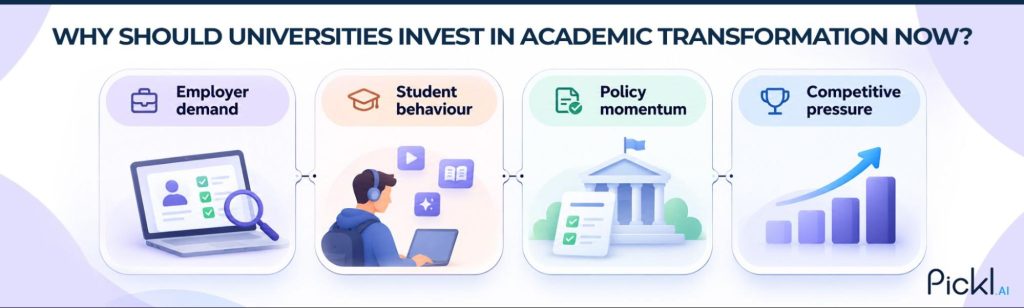
Employers now expect graduates to work with AI from day one, and students already use generative AI without institutional guidance. Institutions that delay lose ground in graduate employability, faculty credibility, and enrolment competitiveness to peers that integrate AI into curriculum and assessment.
- Employer demand: Hiring teams screen for AI fluency alongside domain skills.
- Student behaviour: Learners use generative AI daily. Institutions without clear rules lose control of academic integrity.
- Policy momentum: India’s National Education Policy 2020 calls for technology integration, multidisciplinary learning, and skill-based education.
- Competitive pressure: Prospective students compare institutions on outcomes and industry relevance.
Pickl.AI perspective: Delay costs more than adoption. Every unmanaged semester widens the gap between what students use and what faculty assess.
How do you build an AI roadmap for academic transformation?
| Phase | Timeline | Key output |
| 1. Assess | Months 1-3 | Readiness audit of data, faculty skills, and infrastructure |
| 2. Pilot | Months 4-8 | Two or three departmental use cases with baselines |
| 3. Scale | Months 9-14 | Proven use cases rolled out institution-wide |
| 4. Embed | Months 15-18 | Governance, training, and an annual review cycle |
Build the roadmap in four phases over 12 to 18 months: assess readiness, pilot in two or three high-enrolment departments, scale proven use cases, and embed governance. Assign one
executive sponsor, set measurable outcome metrics before selecting tools, and review progress every semester. Executive sponsor: A dean or director owns outcomes and removes blockers.
- Baseline first: Capture current retention, feedback turnaround, and placement data before any pilot starts.
- Cross-functional council: Include academics, IT, student services, and industry partners.
Which AI use cases deliver the fastest results in higher education?
Personalised learning support, automated formative feedback, early-alert analytics for at-risk students, and administrative automation deliver results within one to two semesters. They require limited curriculum change, use existing data, and produce measurable gains in retention, faculty time saved, and learner engagement.Pickl.AI perspective: Start with feedback automation. It returns time to faculty instead of adding to their workload, which builds support for harder changes.
| Use case | Primary metric | Time to impact | Effort |
| Personalised learning support | Learner engagement | 1 semester | Medium |
| Automated formative feedback | Feedback turnaround time | 1 semester | Low |
| Early-alert analytics | Retention rate | 1-2 semesters | Medium |
| Administrative automation | Staff hours saved | 1 semester | Low |
Source: OECD: Education and skills publishes cross-country evidence on digital education.
How do you upskill faculty for AI-enabled teaching?
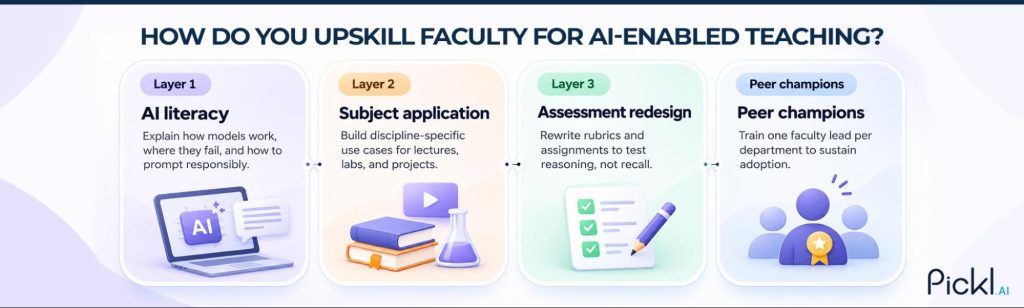
Upskill faculty through role-based, practice-led training built on three layers: AI literacy, subject-specific use cases, and assessment redesign. Short, hands-on cohort workshops led by trained peer champions from their own department help faculty apply AI to their own courses within days, not months.
- Layer 1, AI literacy: Explain how models work, where they fail, and how to prompt responsibly.
- Layer 2, Subject application: Build discipline-specific use cases for lectures, labs, and projects.
- Layer 3, Assessment redesign: Rewrite rubrics and assignments to test reasoning, not recall.
- Peer champions: Train one faculty lead per department to sustain adoption.
Pickl.AI rule: Every faculty session ends with one deliverable, such as a redesigned assignment, rubric, or lesson plan, that the faculty member uses the following week.
Source: EDUCAUSE publishes research on teaching, learning, and technology in higher education.
How do you govern AI in academics without slowing innovation?
Govern AI with a tiered policy: approve low-risk uses by default, review medium-risk uses by department, and restrict high-risk uses such as fully automated grading decisions. Publish clear rules on disclosure, data privacy, and academic integrity so faculty and students know what is permitted.
| Risk tier | Example uses | Approval route |
| Low | Drafting aids, study support, summarisation | Approved by default, with disclosure |
| Medium | AI tutors, feedback tools using student data | Department review and privacy check |
| High | Automated grading, admissions screening | Restricted; human decision required |
- Disclosure: Students declare AI use in every submission.
- Data privacy: No student data enters a tool without an institutional agreement.
Source: NIST AI Risk Management Framework offers a practical structure for classifying and managing AI risk.
How do you measure the ROI of academic transformation?
Measure the ROI of academic transformation across four indicators: learner outcomes, faculty productivity, operational cost, and employability. Set a baseline before launch, track each indicator every semester, and tie AI investments to named targets such as retention rate, time-to-feedback, and placement outcomes.
| Indicator | Example metric | Data source |
| Learner outcomes | Retention rate, pass rate | LMS and student records |
| Faculty productivity | Hours saved per course, feedback turnaround | Faculty time logs |
| Operational cost | Cost per student query resolved | Administrative systems |
| Employability | Placement rate, employer feedback | Placement cell |
Pickl.AI perspective: Report faculty time saved as hours reinvested in mentoring. Boards fund transformation when savings convert into student outcomes.
Source: India’s NIRF ranking framework evaluates institutions on teaching, graduation outcomes, and outreach, which makes it a useful anchor for outcome metrics.
Frequently Asked Questions
How long does academic transformation with AI take?
A full academic transformation takes 12 to 18 months for a first cycle. Pilots show results within one to two semesters, institution-wide scaling follows in the second year, and continuous improvement never ends. Institutions that set baselines early and assign one executive sponsor reach scale faster.
Will AI replace faculty and teachers?
No. AI automates routine, repetitive tasks such as first-draft feedback, scheduling, and content curation, while faculty keep ownership of mentoring, professional judgement, and academic standards. Institutions that redeploy saved time into student mentoring improve the learning experience instead of reducing teaching roles.
How much does it cost to start AI-led academic transformation?
Cost scales with scope, so start small: budget first for faculty training and data readiness, then software licences. Fund two or three departmental pilots from existing digital budgets and expand only after baseline metrics show gains in retention, feedback time, or staff hours saved.
What skills do leaders need to drive academic transformation with AI?
Academic leaders need four skills: AI literacy, data-informed decision-making, change management, and ethical governance. They do not need to code; they need to set outcome metrics, align academics with industry, and keep faculty, IT, and student services working toward one roadmap.
What support does Pickl.AI offer to institutions’ academic transformation?
Pickl.AI, the upskilling platform from TransOrg Analytics, partners with colleges, universities, and corporate learning teams to deliver AI and data science programs, faculty enablement, and industry-aligned curricula. Institutions get practitioner-led training, mentor support, project-based learning, and job-ready skills mapped to current hiring demand.
- Faculty enablement: Cohort workshops that convert AI literacy into classroom practice.
- Industry-aligned curricula: Programs mapped to roles in data science, analytics, and AI.
- Project-based learning: Capstones built on real business problems.
- Next step: Start with a readiness assessment at Pickl.AI.
Author
-

Written by:
Neha Singh