
Summary: Faculty development programmes are essential for modernizing university education. By integrating AI, Data Science, and industry collaborations like Pickl.AI, institutions bridge the gap between academia and the corporate world. This blog explores key trends, benefits, and components of effective training modules designed to empower the next generation of global educators.
Introduction
In the rapidly evolving landscape of global education, the role of a university professor has transcended traditional lecturing. As we navigate through 2026, the integration of Artificial Intelligence, Data Science, and hybrid learning models has redefined the classroom experience.
To keep pace with these tectonic shifts, faculty development programmes have emerged as the cornerstone of institutional excellence. No longer just a periodic requirement, these programmes are now strategic imperatives that ensure educators remain relevant in a world driven by automation and complex data.
The future of higher education depends not just on the infrastructure or the curriculum, but on the agility of the faculty. Modern faculty development programmes are shifting from “one-size-fits-all” workshops to personalized, industry-aligned, and technology-heavy training modules. This blog explores the emerging trends in faculty upskilling and why investing in the growth of educators is the most significant investment a university can make today.
Why Faculty Development Programmes Matter for Universities
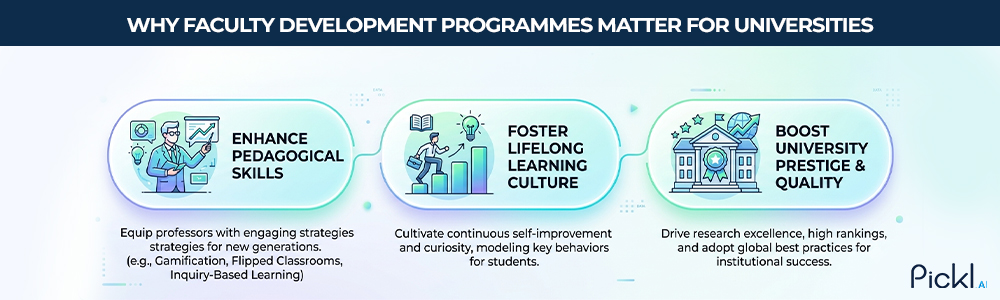
Universities are the incubators of future leaders, but they can only fulfill this role if their mentors are equipped with contemporary knowledge. Faculty development programmes matter because they bridge the gap between academic theory and the fast-paced reality of the professional world.
Firstly, these programmes enhance pedagogical skills. Teaching a Gen Z or Gen Alpha student requires different engagement strategies than those used a decade ago. FDPs introduce teachers to gamification, flipped classrooms, and inquiry-based learning.
Secondly, they foster a culture of lifelong learning. When professors participate in faculty development programmes, they model the very behavior they expect from their students—curiosity and adaptability.
Furthermore, in an era of global university rankings, the quality of faculty directly impacts institutional prestige. Faculty development programmes encourage research, publication, and the adoption of global best practices, ensuring that the university remains a competitive hub for academic excellence.
Role of Industry–Academia Collaboration in Faculty Development Programmes
One of the most significant trends in 2026 is the blurring of lines between the corporate world and the classroom. Traditionally, academia and industry operated in silos. However, modern industry-academia collaboration through faculty development programmes.are increasingly being designed in collaboration with industry leaders to ensure that what is taught in the classroom is applicable in the boardroom.
Industry–academia collaboration brings real-world case studies and cutting-edge tools into the academic sphere. A prime example of this synergy is Pickl.AI, a pioneer in Data Science education. Pickl.AI has been instrumental in promoting faculty development programmes across various colleges by offering specialized training in Data Analytics and AI.
By collaborating with institutions, it empowers faculty members to move beyond theoretical models. Their programmes provide educators with hands-on experience on industry-standard tools, enabling them to guide students through real-world data challenges.
This type of collaboration ensures that the faculty is not just teaching from a textbook but is sharing insights derived from current industry trends. Such initiatives transform teachers into “industry-ready mentors,” significantly boosting the employability of their students.
Key Components of an Effective Faculty Development Programme
For faculty development programmes to be successful, they must be comprehensive and outcome-oriented. The key components include:
- Technological Proficiency: Training on AI tools, Learning Management Systems (LMS), and virtual reality labs is essential.
- Research and Innovation: Encouraging faculty to pursue original research, apply for patents, and write for high-impact journals.
- Soft Skills and Emotional Intelligence: Modern educators must be mentors and counselors. FDPs should include modules on student psychology, conflict resolution, and leadership.
- Curriculum Design: Teaching faculty how to design a dynamic curriculum that integrates interdisciplinary subjects.
- Assessment and Evaluation: Moving away from rote-learning exams toward continuous, competency-based assessments.
- Inclusivity and Diversity: Sensitizing faculty to create inclusive environments for students from diverse backgrounds and abilities.
Benefits of Faculty Development Programmes for Institutions
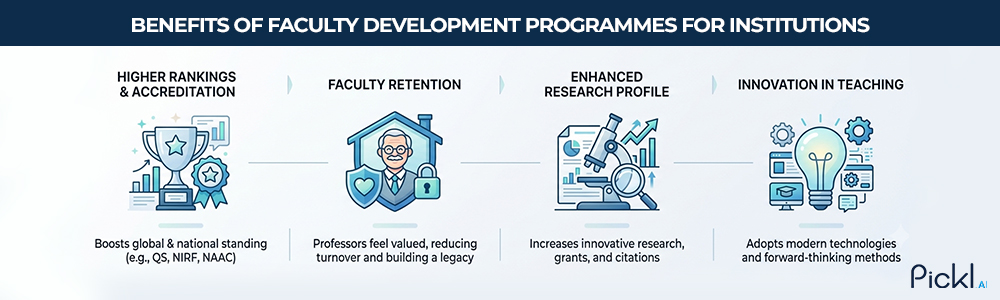
Institutions that prioritize faculty development programmes reap immense long-term benefits.
- Improved Student Outcomes: High-quality teaching leads to better student performance, higher graduation rates, and superior placement statistics.
Accreditation and Rankings
Bodies like the NAAC and NIRF (in India) or global rankings like QS and Times Higher Education place high value on faculty quality and professional development.
Faculty Retention
Professors feel valued when an institution invests in their growth. This reduces turnover and helps the university build a legacy of experienced educators.
Enhanced Research Profile
FDPs often spark new research ideas, leading to an increase in grants, citations, and institutional intellectual property.
Innovation in Teaching
It encourage the use of modern technology, making the institution a forward-thinking brand in the education market.
Faculty Development Programmes in Data Science, AI, and ML
As we move deeper into the decade, Data Science, Artificial Intelligence (AI), and Machine Learning (ML) are no longer niche subjects—they are foundational. Consequently, there is a massive surge in faculty development programmes specifically tailored to these domains.
Even faculty from non-technical backgrounds, such as Humanities or Commerce, are now seeking training in Data Science to understand how data impacts their respective fields. For engineering and science faculty, staying updated with the latest ML algorithms and AI ethics is mandatory.
These specialized faculty development programmes focus on:
- Data Visualization: Helping faculty represent complex information simply.
- Predictive Analytics: Using data to predict student performance and institutional trends.
- AI Ethics: Teaching the moral implications of automated decision-making.
- Hands-on Coding: Bridging the gap for faculty who may have the theoretical logic but need the practical coding skills to guide modern students.
By integrating these technologies, It ensure that the university stays at the cutting edge of the digital revolution.
Frequently Asked Questions
What is the primary objective of faculty development programmes?
The primary objective is to enhance the professional skills of educators. This includes improving teaching methodologies, fostering research capabilities, and updating their knowledge on the latest industry trends and technological advancements. Ultimately, these programmes aim to improve the quality of education and student learning outcomes.
How do industry-led faculty development programmes benefit students?
When faculty members participate in industry-led faculty development programmes, like those offered by Pickl.AI, they gain practical insights into current market demands. They can then pass this knowledge to students, ensuring the curriculum is relevant, practical, and aligned with what employers are looking for in 2026.
Are faculty development programmes mandatory for university accreditation?
Yes, most global and national accreditation bodies consider a critical criterion for ranking. Regular participation in FDPs demonstrates an institution’s commitment to quality assurance, continuous improvement, and the professional growth of its staff, which directly influences the university’s overall score and reputation.
Author
-

Written by:
Neha Singh