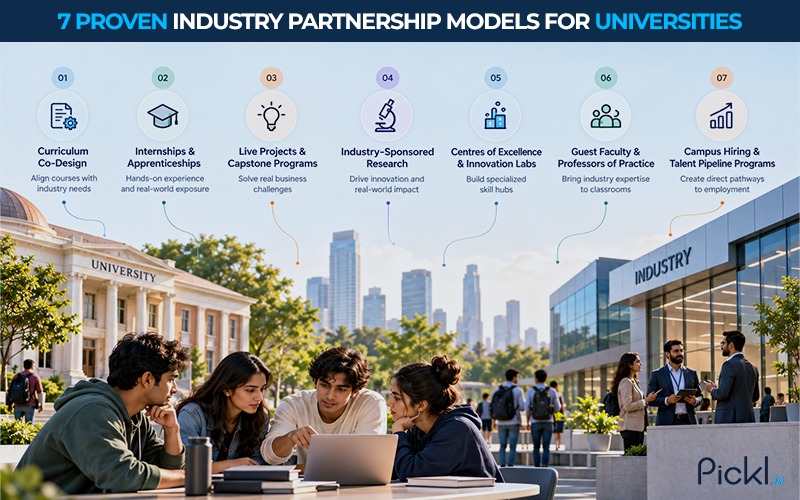

Summary: Industry-partnership models have become a cornerstone for the success of any university. In the rapidly evolving times, where AI and data skills are taking over the conventional academic knowledge clearly highlights the growing need for the colleges to opt for industry-partnership. This blog covers all the key details of the different types of industry-academia partnership model.
Introduction
Industry partnership models for universities are structured programs wherein universities and company work together. The objective is to make universities and colleges align their curriculum with the demand in the industry. Both universities and companies work towards shared goals. The core objective is to make the students job-ready, running joint research, and creating a steady talent pipeline.
Why Do Universities Need Industry Partnerships?
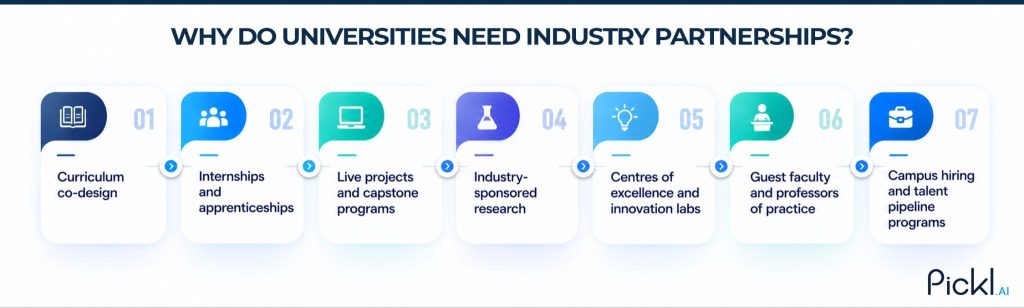
Universities need industry partnership to train their students on industry skills. Nowadays, employers are looking for candidates who have mastered data skills, AI skills that can be implemented in the real world. Over the years, there has been a constant rise in the demand for AI skills. Most of the companies are now emphasizing on the usage of AI, and candidates who are qualified in this domain will always have an edge over the others.
One of the key concerns for employers has been the lack of practical skills. At the same time, universities struggle to keep syllabi up to date in fast-changing fields like data, AI, finance and digital business.
Industry partnerships close this gap. For universities, they improve placements, relevance and reputation. For companies, they reduce hiring and training costs and open the door to fresh ideas and early access to talent.
Model 1: Curriculum Co-Design
What it is: The company helps the university design, review or update courses so that what students learn matches what the industry needs.
How it works:
- Industry experts join the Board of Studies or an advisory council
- Companies suggest skills, tools and case studies to add
- Some modules or electives are built jointly and taught with industry input
Benefit to the university: A more relevant syllabus and stronger credibility with students, parents and accreditation bodies.
Benefit to the company: Graduates who already know its tools, language and ways of working, which means shorter onboarding.
Best for: Universities that want quick, low-cost impact without large infrastructure.
Model 2: Internships and Apprenticeships
What it is: Students spend a fixed period working inside a company, learning on the job while still studying.
How it works:
- The university and company agree on duration, learning outcomes and evaluation
- Students get a mentor at the company and a faculty guide at the university
- Performance is reviewed jointly, and credits may be linked to the internship
Benefit to the university: Students gain real exposure, and internship conversion into job offers improves placement outcomes.
Benefit to the company: A low-risk way to test talent before making a full-time offer.
Best for: Programs in management, engineering, data, healthcare and other applied fields.
Model 3: Live Projects and Capstone Programs
What it is: Students solve a real business problem shared by a company, as part of their coursework or final-year project.
How it works:
- The company shares a problem statement, such as improving customer retention or cleaning a dataset
- Student teams work on it for a term under faculty and industry guidance
- Teams present their solutions to company leaders at the end
Benefit to the university: Learning becomes practical, and students build portfolios that stand out.
Benefit to the company: Fresh thinking on real problems, and a chance to spot top performers.
Best for: Universities that want hands-on learning without long-term company commitments.
Model 4: Industry-Sponsored Research
What it is: A company funds or co-funds research at the university to solve a technical or business challenge.
How it works:
- Both sides agree on the research question, timeline, budget and ownership of results
- Faculty and research scholars lead the work
- Findings may lead to publications, patents or new products
Benefit to the university: Research funding, better lab capacity and real-world impact for faculty work.
Benefit to the company: Access to expert researchers and facilities without building its own R&D team.
Best for: Research-focused universities and companies in technology, pharma, manufacturing and energy.
Tip: Agree on intellectual property (IP) rights in writing at the start. This is the most common cause of disputes.
Model 5: Centres of Excellence and Innovation Labs
What it is: A long-term, dedicated center on campus, often set up with a company, focused on one skill area such as AI, cybersecurity or analytics.
How it works:
- The company may provide tools, software, equipment, mentors or funding
- The university provides space, faculty and students
- The center runs training, certifications, projects and events
Benefit to the university: A visible, premium offering that attracts students and strengthens its brand.
Benefit to the company: A strong presence on campus, early access to skilled talent and a platform to promote its technology.
Best for: Established partnerships where both sides are ready for a multi-year commitment.
Model 6: Guest Faculty and Professors of Practice
What it is: Working professionals teach, mentor or run workshops at the university.
How it works:
- Experts deliver guest lectures, masterclasses, bootcamps or full courses
- Some universities appoint senior professionals as Professors of Practice for a longer term
- Sessions focus on practical skills, case studies and career guidance
Benefit to the university: Students learn directly from people doing the job today.
Benefit to the company: Employer branding, and a chance to build relationships with students and faculty.
Best for: Universities that want to start small and build trust before moving to deeper partnerships.
Model 7: Campus Hiring and Talent Pipeline Programs
What it is: A structured program where a company works with the university over several months to prepare students for hiring, instead of only visiting for a one-day placement drive.
How it works:
- The company shares the skills and roles it needs
- The university runs pre-placement training, assessments and communication or aptitude workshops
- Selected students join through new-joiner or fresher batches, often with a short induction on campus
Benefit to the university: Better placement results and a closer relationship with recruiters.
Benefit to the company: A more prepared, motivated hiring pool, with lower drop-off and faster productivity after joining.
Best for: Companies that hire in volume and universities that want to improve placement quality, not just numbers.
Quick Comparison of the 7 Models
| Model | Commitment Level | Main Outcome | Good Starting Point? |
| Curriculum co-design | Medium | Industry-relevant syllabus | Yes |
| Internships and apprenticeships | Medium | Work experience and job conversion | Yes |
| Live projects and capstones | Low to medium | Practical problem-solving | Yes |
| Industry-sponsored research | High | Innovation, patents, funding | No |
| Centres of excellence | High | Long-term skill and brand building | No |
| Guest faculty and practice professors | Low | Exposure and mentoring | Yes |
| Campus hiring and talent pipelines | Medium | Better placements and hiring | Yes |
How to Choose the Right Partnership Model
Image Description: An infographic outlining key considerations for universities choosing the right industry partnership model. It highlights three factors: primary goals such as placements and brand visibility, available time and budget, and measurable success indicators including internship conversions, placement quality, and completed projects.
Alt Text: Infographic highlighting goals, budgets, and measurable outcomes for selecting university industry partnerships.
The right partnership model is crucial for universities to outshine. However, not every industry partnership model doesn’t suit every university. Hence, there are certain questions that needs to be considered when going ahead for a partnership model:
What is our main goal?
The main goal while choosing any industry-partnership model is to focus on enhancing placement, ensuring that it offers brand visibility and is also relevant as per the demand of the industry.
How much time and budget can we commit?
Considering the time and budget is also paramount. For example, for some colleges, a short-term program is a viable option, while others may look for a long-term association that provides constant support.
How will we measure success?
Pick two or three clear numbers, such as internship conversions, placement quality or projects completed. If the industry partnership offers all these, then it becomes one of the best choices for colleges and universities.
How to Start a University-Industry Partnership: 5 Simple Steps
Starting a university-industry partnership can require careful research. Understanding the offerings that the partnering industry has to offer plays a crucial role. Here are 5 simple steps for a smoother and successful association with the industry.
Define the Goal
Start by defining clear objectives is the first step to finalize the industry partnership. Universities may aim to improve student skills and industry exposure, while businesses may seek skilled talent, research support or fresh ideas. Clear goals help both partners focus on shared outcomes.
Start Small
Begin with a guest lecture, a live industry project, an internship or a faculty workshop. These initiatives give both sides a clear understanding of how working together for a longer term can be a profitable move.
Sign a Simple Agreement
Document the key terms of the partnership, including roles, timelines, data sharing, intellectual property (IP) and confidentiality. A clear agreement helps set expectations and avoid confusion later.
Assign One Point of Contact on Each Side
Nominate one representative from the university and one from the industry partner. They can coordinate activities, share updates, resolve issues, and ensure that tasks stay on track.
Review Progress Every Term
Assess the partnership at the end of each academic term. Review outcomes, gather feedback, identify gaps and agree on improvements. Use these insights to decide whether to continue, refine, or expand the collaboration.
Frequently Asked Questions
What is the most common type of industry-university partnership?
Internships and guest lectures are the most common industry-partnership model. This requires less investment and time; hence it becomes a viable option.
How do industry partnerships benefit universities?
The industry partnership makes the course relevant to the industry demand. It helps in improving the placement outcome, and also increases the university’s reputation among students, parents and employers.
How do companies benefit from partnering with universities?
Companies get access to fresh talent, lower training and hiring costs, new ideas from research and a stronger employer brand on campus.
How long does it take to build a strong university-industry partnership?
A simple program, such as a guest lecture series, can start within weeks. Deeper models like research collaborations or centres of excellence usually take several months to plan and sign.
What should an industry-academia partnership agreement include?
It should cover the goals, roles of each party, timeline, budget, data and confidentiality terms, intellectual property ownership, and how success will be measured and reviewed.
Conclusion
The best industry partnership models for universities are the ones that create real value for both sides. Based on the requirements, universities can choose the right industry-partnership model.
Ready to build a partnership that delivers results? Reach out to explore which model fits your institution or organization best.
Author
-

Written by:
Neha Singh