
Summary: As AI continues to reshape industries, it has highlighted the critical importance of evolving educational curricula from conventional knowledge delivery models to dynamic, skills-driven learning ecosystems. AI-integrated curriculum introduces the necessary job-ready skills that are in-demand by the industry. In this blog, we unfold some of the key pointers that universities must imbibe while redesigning their curriculum to make it industry-aligned.
Introduction
The rise of AI has fundamentally reshaped educational demands. Moreover, there is a considerable lack of required AI and data skills in the market. Although the university curriculum is modified every year, it is not at par with the demand of the industry. This has resulted in the drop in the university admission rates.
The employers are now demanding AI and Data Science professionals, but many institutes are still hanging around the old school of academic learning. Industry-aligned curriculum is the need of the hour. Most of the universities lack the integration of real-world case studies and projects that eventually reflects on the university admission rates.
The need of the hour is to redesign the programs around the industry demand. Starting programs in AI, Data Science, and Business Analytics are more meaningful and also help in building the foundation skills that make the students future-ready.
Why Industry-Aligned Programs Improve University Admissions
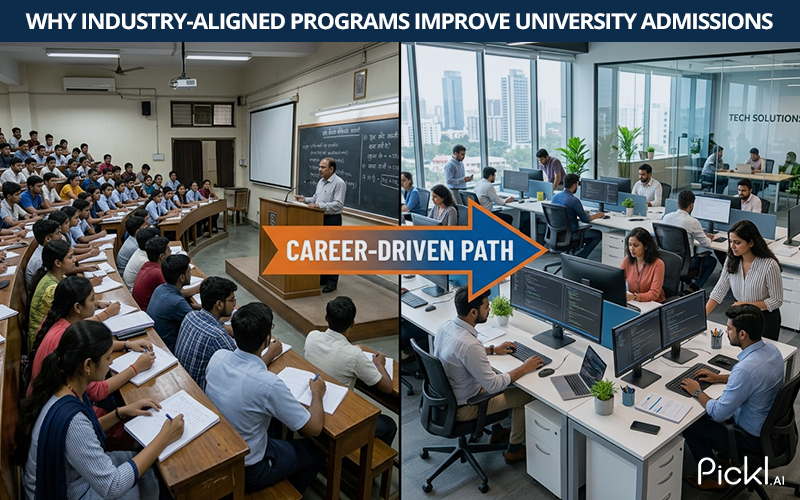
Industry-aligned programs help in scaling the university admission rates by bridging the gap between theoretical education and workplace demands through practical, hands-on training by resolving the key concerns of the students. These courses directly fulfil the career-driven expectations of modern students, thereby driving positive career growth and institutional excellence.
Post-pandemic students and parents are not choosing universities based on legacy rankings alone. As per the recent NASSCOM and LinkedIn Learning surveys 72% of prospective students are now focussing on outcome driven programs rather than university rankings. They are researching which colleges produce graduates that companies actually hire—in high-demand fields like AI, Data Science, and Business Analytics.
This isn’t just a fad, rather the student demand for AI courses has increased in the recent years. There has been a 17% year-on-year increase in demand. In fact, the AI and machine learning specialists represent the fastest-growing job category in India. It is projected that there will be a demand for 2.3 million professionals by 2027 in the AI domain. Despite this, the universities are producing far fewer qualified graduates.
University admission in specialized AI and Data Science is witnessing an average 25-30% increase in programs.
While many universities are contemplating, several institutes like IITs and other premium institutes have already implemented the EdTech-university partnerships. The focus of institutes is to create career-oriented courses that bring together theoretical expertise and real-world skills that eventually boosts career growth. All these aspects significantly improve the admission rates. Traditional universities that cling to the conventional curricula risk losing their best students.
What ‘Industry-Aligned’ Actually Means in 2026

In today’s context, industry aligned courses are not just about adding some guest lectures or internships, it has turned into a full-time association with learning platforms that offer real world exposure. The alignment should not be theoretical, rather, it should include adding the necessary tools, real world case studies, methodologies and primarily changing mindset that is driven by technology.
Today students are more focussed on hands-on mastery of Python, SQL, Power BI, and Large Language Model frameworks. These are the exact tools they will use on day one. Institutes focussing on this have witnessed a massive rise in university admission and placement.
Key Aspects of Establishing Industry-Aligned Curriculum in 2026
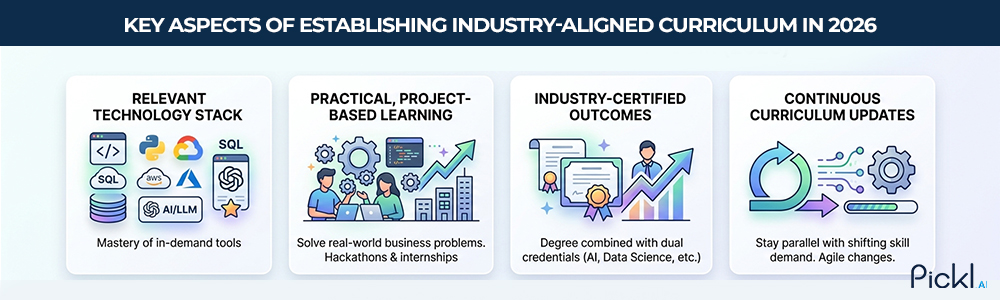
Relevant Technology Stack: Students are now looking for mastery in tools that is widely used in the industry. These include Python, SQL, cloud platforms (AWS, Azure), Power BI, Tableau, and Generative AI frameworks (ChatGPT APIs, LLMs).
Practical, Project-Based Learning: Adding real-world projects, hackathons against live business problems, and structured internship pipelines replace traditional assignments. Students solve problems that companies face—this becomes their portfolio entry.
Industry-Certified Outcomes: Dual credentials matter. A degree alone signals academic completion. A degree of completion along with the industry-recognized certification in AI, Data Science, or Business Analytics paves the way for a positive career trajectory.
Continuous Curriculum Updates: The dynamism of the skill demand requires the institute to make continuous curriculum updates that is at par with the demand of the industry.
In addition to the above, even the government has acknowledged this change of events and has introduced an amendment in the National Education Policy. The multi-disciplinary, skill-based, industry-partnership mandate is not just a suggestion but institutional requirements.
How to Increase University Admissions Through Program Redesign?
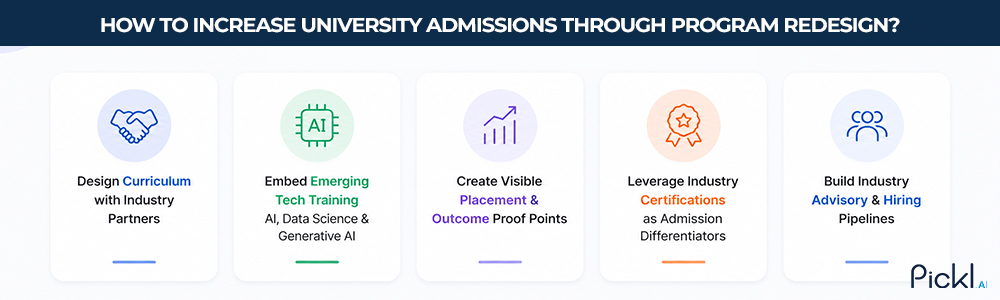
Universities can significantly boost admission rates and rankings by aligning their curriculum with industry demands. This shift ensures students have the necessary skill sets after the completion of the course.
Designing the Curriculum along with Industry Partners
Most universities have industry advisory boards that meet once a year and rubber-stamp existing curricula. Real transformation requires flipping this model. Working along with the industry partners who help in actively designing the course modules is the need of the hour.
Establishing a structured curriculum review cycle can help in identifying emerging skill gaps. Aligning skill taxonomy with NSDC (National Skill Development Council) and NASSCOM frameworks is important. It also ensures that the students earning credentials are recognized across sectors.
Embed Emerging Tech Training—AI, Data Science & Generative AI
Student search behaviour proves it: institutions offering specialized trending courses for colleges in AI, Machine Learning, and Data Science see 3-4x higher inquiry volumes compared to peers offering traditional curricula.
Designing a completely AI-aligned curricula may not be a feasible option sometimes. Hence, associating with industries or platform offering industry-aligned training and workshops can be a great move to integrate AI skills while the students continue to progress through their course.
Create Visible Placement & Outcome Proof Points
Build an outcomes narrative and display it prominently. This means:
- Transparent placement portals showing company names, roles offered, and salary bands (where possible)
- Alumni LinkedIn mapping to demonstrate where graduates landed and their career progression
- Employer testimonials specifically crediting your program for hiring-ready graduates
- Visible metrics dashboards in admission materials and website: “95% placement within 3 months,” “Average package ₹12.5 LPA for AI/DS graduates”
Universities that quantify outcomes outcompete those with vague claims. A parent reviewing two institutions will choose the one that shows, not tells.
Leverage Industry Certifications as Admission Differentiators
When your program offers Google Cloud certifications, Microsoft Azure credentials, or IBM Data Science certifications alongside the degree, the admissions value proposition becomes tangible. Students and parents can directly compare: “Does Uni A’s degree help me get hired? Does Uni B’s degree + certification help me get hired faster and at higher pay?”
The data is clear: graduates with dual credentials (degree + industry certification) receive offers 40% faster on average and command 15-25% salary premiums compared to degree-only peers.
This becomes your admission narrative: “Graduate with your degree AND an industry-recognized credential—ensuring you step into your first role fully prepared.”
Build Industry Advisory & Hiring Pipelines
Transform MoUs (Memoranda of Understanding) into actual hiring pipelines. An MoU is a press release. A hiring pipeline is a virtuous cycle: strong placements → stronger institutional brand → higher admission applications → better candidate quality → even stronger placements.
Create structured pathways where industry partners actively recruit from your program. Facilitate internships that convert to full-time offers. Track which companies are hiring most from your graduates and deepen those partnerships.
The Role of Strategic EdTech Partnerships in Curriculum Transformation
The Build-vs.-Partner Dilemma
Universities face a critical choice: build cutting-edge AI and Data Science curriculum in-house or partner with specialized providers.
Most universities cannot build at the pace the market demands. Here’s why:
- Curriculum development requires 18-24 months
- By the time content launches, tools and frameworks have evolved
- Hiring faculty with both academic credentials AND current industry skills is prohibitively expensive
- Maintaining currency requires continuous monitoring of industry shifts
Strategic EdTech partnerships reduce this friction
A high-quality curriculum partner brings:
- Content expertise updated every 6 months reflecting industry shifts
- Tool licenses and platform access (Python environments, cloud credits, BI tools)
- Faculty training and co-delivery support so your institution retains curricular ownership
- Industry connections providing internship and placement opportunities
- Accreditation alignment ensuring NEP compliance and regulatory safety
The admission marketing advantage: Co-branded programs signal that your university is serious about industry readiness. “In partnership with [recognized EdTech provider]” carries weight.
The Window of Differentiation Is Closing
The AI and data science courses for universities are now opening new career avenues by helping the students learn AI and data skills. Many companies now emphasize on hiring students from institutes offering AI-driven courses. An institute that offers industry partnership is well recognized by companies rather than the ones that still follow the age old teaching methodology.
Conclusion
The universities that are gaining admission ground aren’t running better marketing campaigns. They are offering better programs.
Increasing university admissions starts with admitting a hard truth: students are ROI-driven, employers demand specific skills, and traditional curricula don’t deliver. With the advanced AI and data science courses for universities can enhance their credibility while driving a higher admission rate.
Frequently Asked Question
How do we ensure faculty buy-in for curriculum changes?
Industry-aligned programs work best with co-delivery models where faculty retain ownership while receiving support from curriculum partners. Invest in faculty training on new tools and methodologies. Showcase early placement success—faculty take pride in graduating students who are immediately hireable.
What’s the minimum investment of time required to launch an industry-aligned program?
Universities and colleges looking to integrate industry-aligned programs might need 12-15 course modules, however, there are Ed-tech platforms that can customize the entire program to seamlessly align with the current full-time programs.
How do we communicate industry-aligned programs in admission marketing?
Universities and colleges can promote the industry-aligned through social media platforms like LinkedIn, Instagram, and others. This will help in gaining traction from the students and parents who are looking for university admission. Besides, posting about the success of the program, student testimonials, alumni success will help in building credibility and increasing the university admission rate.
How often should we update curriculum once it’s launched?
Reviewing the industry-aligned programs quarterly helps in upgrading the course and introducing the necessary changes. This isn’t optional; rather it is essential for maintaining credibility with employers and establishing the relevancy of the program.
Author
-

Written by:
Neha Singh