
Summary: Campus placements are crucial, and to pace up with the changes, it is important to integrate AI and other advanced technologies. This blog explores innovative ways to transform and enhance campus placement strategies, making them more efficient, data-driven, and aligned with the changing demands of the job market.
Introduction
Campus placements have become the key parameter of success for any institute. It influences brand reputation and student admissions. The growing competition and demand for skilled professionals has made it mandatory to modify the curriculum. The focus is to bring in programs that trains the students on latest technologies and its application that eventually boosts the campus placement rates. Industry-academia partnership has become the key to upgrade the curriculum.
How do institutions achieve this growth? Here is the roadmap that will help the institution to boost their placement outcomes.
Current Campus Hiring Trends in India
At present, there is a shift toward skill-based recruitment. Nowadays, companies are focussed on hiring individuals who not only have academic expertise, but are also able to lead. Achieving this simply through regular courses is not possible. Hence, the focus has now shifted to university industry partnership.
Here are some of the key trends showing a shift in the market:
- As per the India Skill Reports 2024, students’ employability report has improved to 51.25%.
- Companies are no more looking for students with conventional expertise, they are now focussing on niche expertise.
- Recruiters are engaging with students much earlier in their academic journey during the second and third years.
- There has been a growing demand for students who have expertise in Artificial Intelligence and Data Science.
- It is expected that AI will create 4 million jobs in the next five years.
- Niche roles like prompt engineering are bagging more packages as companies to standard entry-level positions.
- Paid internships are being used as a primary tool to identify and secure talent before the final placement season.
- Employers are now hiring individuals who not only have technical skills but also have practical experience, hence internships are not just an option, but a necessary credential.
| 64% | 93% | 150K | 40% |
| Engineering graduate employability in India (2024), up from 57% in 2023 — Wheebox | Indian youth who prefer an internship before searching for a job (2025) | Fresher hires by IT sector in 2024, down from 600K in 2022 | Planned increase in fresher hiring by Global Capability Centres (GCCs), offering a significant new avenue for campus placements beyond traditional IT firms. |
What Are the Most Common Placement Challenges for Colleges?
The widening skill gap is one of the key concerns. While most of the universities continue to pursue conventional education, the shift of recruitment agencies is towards hiring individuals who bring practical skills on the table
Widening Skill Gap
According to industry reports, nearly 85% of engineering graduates in India are not immediately employable for core technical roles. This creates a massive gap between the demand of the industry and talent pool available.
Lack of Soft Skill
Recruiters often complain that students struggle with communication and teamwork. Soft Skill is not just about how well one speaks, but it also revolves around problem solving skills, leadership qualities and problem-solving skills.
Quality over Quantity
Managing a large number of students while maintaining quality is another one of the common placement challenges. Institutions must address these issues by modernizing their approach to training and corporate outreach.
Widening Skill Gap
While most universities continue with conventional education, recruiters are shifting toward candidates who bring practical skills. According to a TeamLease report, only 10% of the 1.5 million engineers graduating annually are expected to secure employment — the primary reason being the skills gap.
| 83%Of 2024 engineering graduates remained unemployed or without internships, per the Unstop Talent Report 2025 — despite 71.5% being rated “employable” on standardised skill tests (India Skills Report 2025). This gap reveals a structural disconnect between assessment and real-world hiring. |
Lack of soft skills
Soft skills go beyond communication — they include problem-solving, leadership, adaptability, and teamwork. Reports indicate that 52% of graduates fail interviews due to poor spoken English or presentation skills, not technical incompetence.
| 42.6%Overall graduate employability in India in 2024, down from 44.3% in 2023, driven primarily by a decline in non-technical (soft) skill proficiency — Mercer-Mettl India Graduate Skill Index 2025. Only 44.3% of graduates demonstrated adequate creativity skills, the lowest among all soft skill categories measured. |
Quality over quantity
Managing a large number of students while maintaining training quality remains a structural challenge for placement cells. Institutions must modernise both their training approach and corporate outreach to address this.
How Can Colleges and Universities Develop a Comprehensive Campus Recruitment Strategy?
A successful campus recruitment strategy must be proactive rather than reactive. Making the right move at the right time ensures the first mover advantage. Incorporating the new skills from the start of the semester helps in building the right mindset that eventually shapes the career graph of the students.
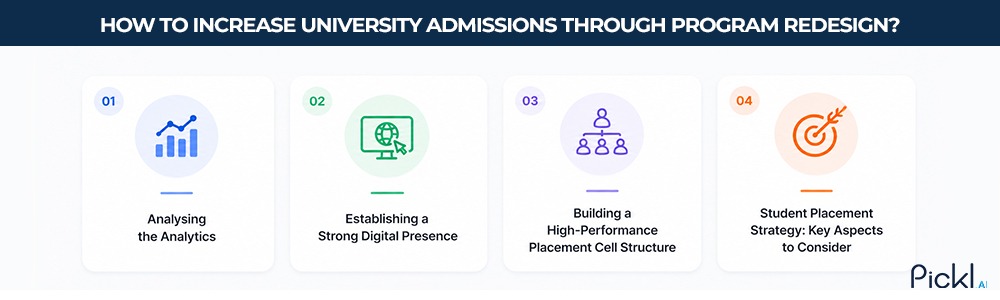
Analysing the Analytics
We are living in a data-driven world, the focus of placement cell in colleges should also be on the new wave of change. How the companies are recruiting, the shift in the recruitment process and new sectors that are expanding. A good strategy includes diversifying the recruiter list. Do not rely only on big tech companies, ensuring better placement rates.
Establishing a Strong Digital Presence
Branding is also a vital part of recruitment strategy. Your institution must have a professional digital presence. Share success stories of alumni on social media. Publish a high-quality placement brochure that highlights your infrastructure and labs. When recruiters see a professional approach, they are more likely to trust the quality of your students.
Building a High-Performance Placement Cell Structure
A well-structured placement cell is the cornerstone of any successful campus recruitment strategy. Training and Placement Officer (TPO), Corporate Relation Manager and Training Coordinator are key pillars of any institution’s successful placement rate. While a Training and Placement Officer (TPO) oversees end-to-end placement activity and industry liaison, the Corporate Relations Manager builds long-term recruiter partnerships, and the Training Coordinator manages student preparation across aptitude, communication, and technical skills.
| Training & Placement Officer | Corporate Relations Manager | Training Coordinator |
| Oversees end-to-end placement operations, manages recruiter relationships, and reports outcomes to institutional leadership. | Builds and sustains long-term recruiter partnerships, drives sector diversification, and coordinates campus visit logistics. | Plans and executes aptitude, communication, and technical training programs; tracks individual student progress and readiness. |
| Placement Calendar | Student Database | Recruiter Database |
| Maps milestones semester-wise — training sprints, mock drives, recruiter outreach windows, and final placement season deadlines. | Tracks profiles, aptitude scores, internship history, skill certifications, and placement readiness status in real time. | Logs company preferences, past visit records, role types offered, salary bands, and feedback from previous hiring cycles. |
Student Placement Strategy: Key Aspects to Consider
Having a well-defined placement strategy ensures that every learner receives personalized training, career counselling, and technical skill development to meet the high standards of top-tier corporate employers.
Analysing Student Potential
Every student has different strengths. A one-size-fits-all approach does not work anymore. A solid student placement strategy begins with an assessment of each student. Use aptitude tests to identify areas of improvement early on. Provide remedial training for those who struggle with math or logic. This builds a strong foundation for the actual recruitment drives.
Focus on personality development
Colleges and universities need to focus on overall development of the students and making them industry-ready. This involves making them learn about new technologies and at the same time enhancing their ability to present their skills in front of a larger audience.
Many platforms offer internship programs that focus on soft skill training along with technical mastery. As per the placement reports of XLRI, 42.5% of students received Pre-Placement Offers clearly highlighting that companies are looking for students with professional capabilities.
Building Confidence
Institutes and universities that encourage students to tackle real-world projects, present ideas in public forums, and build professional portfolios significantly boost student confidence. This hands-on approach ensures graduates are not only self-assured but fully prepared to navigate the challenges of the professional world.
Structured Interview Preparation
Interview preparation is crucial when it comes to improving the placement status of any institute. Regularly organizing sessions and workshops on mock interview, presentation skills, group discussion and running domain specific aptitude tests can help in improving the skills sets of the students. Around 52% of graduates fail interviews due to communication gaps rather than technical gaps. Verbal communication drills and presentation workshops should be mandatory components of the preparation cycle.
Building Industry-ready Resumes
A resume is the first filter in any hiring process. While the institutes continue to focus on enhancing the key skills (technical and non-technical), it is quintessential to help the student build ATS-compliant resume. Guidance on ATS (Applicant Tracking System) compatibility is increasingly relevant as companies at scale now use software to shortlist candidates before any human review occurs.
Making internships a Core Part
Internships are no longer optional credentials — they are primary hiring pipelines. Over 93% of Indian youth preferred an internship before job-searching in 2025. Institutions should focus on integrating internships as a part of their curriculum. IIT Bombay received 300 PPOs in 2024, of which 258 were accepted , exemplifying the growing significance of an effective internship program.
How Does a University Industry Partnership Boost Recruitment?

A university industry partnership creates a direct pipeline for talent by allowing companies to influence the curriculum, set up specialized labs, and mentor students through guest lectures.
Strong ties with the industry are essential for any modern college. This industry-academia partnership is more than just a formal agreement. It is a collaborative ecosystem. Companies can set up “Centers of Excellence” on campus.
These partnerships also benefit the faculty. Teachers can participate in industry immersion programs. They learn about the latest trends and bring that knowledge back to the classroom. It leads to “curriculum co-creation.”
Conclusion
Securing a high-quality college placement requires a focus on coding proficiency, core engineering fundamentals, and the ability to work in multidisciplinary teams across different technical sectors.
Improving campus placements is a continuous process. It requires constant upgradation of the curriculum, introducing new technologies and making students job-ready. The first step to make this move. Addressing placement challenges through a robust placement strategy will ensure better outcomes.
Whether it is a general university or an engineering college placement cell, the goal is to create value for the students. A professional and data-driven approach will lead to long-term success for the institution.
Frequently Asked Questions
How can universities raise their non-IT branch placement rates?
Upskilling is the key to ensure a higher placement rate, and this is not just limited to training students on latest technology, but helping them implement the same is also crucial. Promoting industry tie-ups, participating in different competitions are the key to ensure that the curriculum is at par with the demand in the industry.
What part does the network of alumni play in campus placements?
Alumni serve as an essential element to the business world. For present students, they can serve as mentors and referrals. Alumni who are successful also improve the institution’s reputation. Students get firsthand information about the current demand in the industry.
How can institutions overcome the placement challenges?
One of the key concerns for any institution is to ensure a steady placement rate. In competitive times, where upskilling has become synonymous with growth, it is important for institutes to adopt new curricula or upgrade the current one by adding industry-oriented skill training. Industry-academia partnership is the key to success. With this institutes can boost their campus placement strategy and establish themselves.
Author
-

Written by:
Neha Singh