
From Classroom to Cubicle: How Placement Support Bridges the Data Science Career Gap
Technical refinement, mock interviews, portfolios, networking—bridging data science education to jobs.
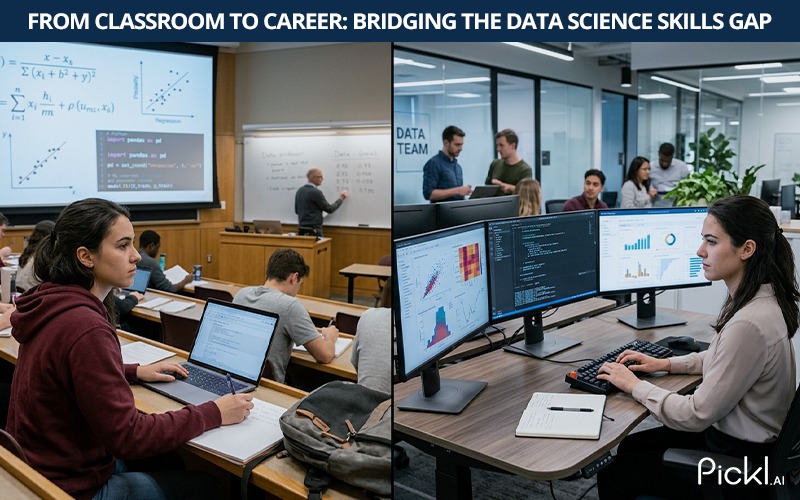
Summary: Placement support transforms data science students from learners to earners by refining skills in Python, SQL, and ML; building portfolios; conducting mock interviews; and forging industry connections. It overcomes experience paradoxes, translates theory to business value, and boosts employability through academia-corporate collaborations for high-impact careers.
Introduction
The leap from academic learning to professional employment is often the most daunting phase of a student’s journey. In the rapidly evolving field of data science, where theoretical knowledge of algorithms must meet the messy reality of big data and business objectives, this transition is particularly complex. While a university degree or a certification provides the foundational tools, it is the career-centric ecosystem specifically placement support for data science students that converts that potential into a paycheck.
In this blog, we explore how robust placement support systems act as the ultimate bridge between learning and employment, ensuring that the next generation of data professionals is not just educated, but employable.
What Is Placement Support for Data Science Students?
Placement support is far more than just a “job board” or a list of vacancies. It is a comprehensive, end-to-end service provided by educational institutions and bootcamps to prepare students for the rigors of the job market.
For a data science student, this support includes:
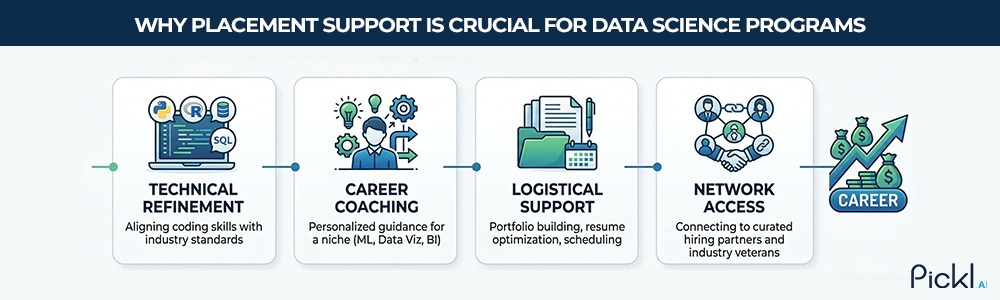
- Technical Refinement: Aligning coding skills (Python, R, SQL) with industry standards.
- Career Coaching: Personalized guidance on choosing the right niche, such as Machine Learning Engineering, Data Visualization, or Business Intelligence.
- Logistical Support: Portfolio building, resume optimization, and interview scheduling.
- Network Access: Connecting students with a curated list of hiring partners and industry veterans.
Essentially, it is a strategic framework designed to ensure that the time and money invested in education result in a high-value career.
Why Placement Support Is Crucial for Data Science Programs
The data science landscape is hyper-competitive. With thousands of applicants vying for roles at top-tier companies, having “knowledge” is no longer enough. Here is why dedicated placement support for data science students is vital:
Navigating the “Experience Paradox”
Most entry-level jobs require “1-2 years of experience.” Placement support helps students overcome this by highlighting capstone projects, internships, and open-source contributions as valid professional experience.
Translating Theory into Business Value
In a classroom, data is usually clean and objectives are clear. In the real world, data is “dirty” and business problems are vague. Placement support includes mentorship that teaches students how to articulate the ROI (Return on Investment) of their models to stakeholders.
Overcoming Technical Anxiety
Technical interviews for data science can be grueling, involving live coding, probability brainteasers, and architectural design questions. Dedicated support systems provide the “stress testing” needed to handle these interviews with confidence.
Role of Industry–Academia Collaboration in Placement Support
The most effective placement support models are those built on strong partnerships between educational institutions and the corporate world. This collaboration ensures that the curriculum stays relevant.
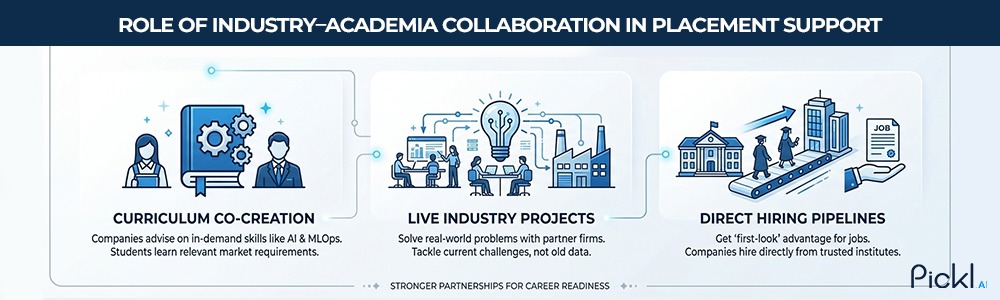
Curriculum Co-Creation
When tech companies advise on what skills are in demand (e.g., Generative AI or MLOps), students learn exactly what the market is buying.
Live Industry Projects
Instead of working on stale datasets from 2015, students work on real-time problems provided by partner companies.
Direct Pipelines
Many corporations skip the traditional job-posting route and hire directly from trusted partner institutes, giving students “first-look” advantages.
Key Components of Placement Support for Data Science Students
To successfully transition a student into the workforce, a placement program must cover four key pillars:
Portfolio and Resume Building
A data scientist’s resume is their GitHub and Kaggle profile. Support teams help students curate a “Project Portfolio” that proves they can handle data end-to-end—from ingestion and cleaning to modeling and deployment.
Mock Interviews and Feedback Loops
Placement cells conduct “Simulated Technical Rounds.” These aren’t just about getting the right answer; they are about the process. Recruiters look for how a student thinks, and mock interviews provide the constructive criticism necessary to refine that thought process.
Soft Skills and Communication
Data science is 50% math and 50% storytelling. Placement support trains students to explain complex neural networks to a Marketing Manager in a way that makes sense. This “bridge-building” skill is often the deciding factor in hiring.
Networking and Mentorship
“It’s not what you know, but who you know.” Placement support provides access to alumni networks and LinkedIn strategies, helping students tap into the “hidden job market” where 70% of jobs are filled without being publicly advertised.
Benefits of Placement Support for Universities and Institutes
While the student is the primary beneficiary, the institution also gains significant advantages:
Enhanced Brand Reputation
High placement rates become the ultimate marketing tool. An institute that consistently places students in “Big Tech” or “Fortune 500” companies gains instant credibility.
Higher Enrollment ROI
When students see a clear path to employment, they are more likely to invest in expensive, high-level data science programs.
Stronger Alumni Advocacy
Successfully placed students become successful alumni who return to hire from their alma mater, creating a self-sustaining ecosystem of growth.
Best Practices for Scalable Placement Support Models
As the number of data science aspirants grows, institutions must scale their support without losing the personal touch. Best practices include:
AI-Driven Job Matching
Using machine learning to match a student’s specific skill set (e.g., Natural Language Processing) with companies looking for that specific niche.
Continuous Career Services
Offering support not just for the first job, but for the first 12 months of employment to ensure successful integration.
Tiered Mentorship
Utilizing senior students and alumni to mentor juniors, creating a scalable “learning-by-teaching” culture.
Global Industry Standard Alignment
Ensuring that the placement support isn’t just local, but prepares students for remote roles in global markets like Silicon Valley, London, or Bangalore.
Conclusion
The transition from a learner to an earner is the “Last Mile” of education. In the realm of data science, this mile is filled with technical hurdles and intense competition. Comprehensive placement support for data science students acts as a navigator, providing the maps, tools, and connections needed to reach the destination. By focusing on both technical mastery and professional presence, these programs ensure that students don’t just graduate—they thrive.
Frequently Asked Questions
Does placement support guarantee a job?
While no reputable program can “guarantee” a job (as the final performance in an interview depends on the student), placement support significantly increases the probability of employment by providing the right opportunities and preparation.
How long does placement support usually last?
Most high-quality data science programs provide support starting from the middle of the curriculum up until 6–12 months after graduation.
Is placement support only for freshers?
No. Placement support is equally crucial for career switchers. It helps professionals from other backgrounds (like Marketing or Mechanical Engineering) rebrand their previous experience to fit a data science context.
What is the most important part of placement support for data science?
Portfolio building is often considered the most critical. In data science, “showing” your work through documented code and visualizations is always more impactful than “telling” someone you have a certificate.
Do companies value candidates from programs with placement support?
Yes. Recruiters prefer candidates from these programs because they know the candidates have been “vetted,” trained in professional etiquette, and possess industry-relevant skills.