
Summary: The rapid evolution of AI and its growing adoption across industries have created a new wave of job roles, this demand for a change in the curriculum design. Academic excellence is not the only benchmark of expertise anymore; companies are now looking for individuals who can apply their theoretical knowledge to practical applications. Developing an industry-aligned curriculum is crucial. This blog explores the key details around the same.
Introduction
The growing gap between the graduates and the skills that organization need is widening. This clearly highlights the loopholes in the curriculum design and models that the colleges and universities are following. Nearly 40% of leaders say that the skills gap at their company has worsened in the last year. The figures are alarming, hence, there is a dire need for a purposeful curriculum design.
Leveraging the power of AI and data science is imperative to ensure that the curriculum remains in sync with the evolving industry standards. Nowadays, companies are looking for hiring students who are not just academically sound, but also capable of immediately picking up their job. It is expected that India will need 1.25 million AI professionals by 2027, hence there is a mounting pressure on institutes to shift their focus on professional technical and skill-based education.
Yet many institutions still operate curricula that were designed for a world that no longer exists. The solution is not a curriculum refresh every five years, rather it is a strategic, continuous course development process anchored in real industry intelligence.
| 87% of executives report a skills gap in their workforce53% of graduates feel underprepared for their first role3–5 yrs average lag between industry need and curriculum update cycles |
Why Traditional Curriculum Design Is Failing Industry

The traditional approach to curriculum development for higher education was largely internally driven. However, it is imperative to introduce industry-aligned curriculum that brings together faculty expertise, accreditation checklists, and legacy program structures.
The growing integration of AI, and its use cases has made it mandatory for students to be equipped with all the necessary skills that helps them stand ahead of the league. Institutes need to restructure their curriculum development for higher education by introducing AI-powered tools usage, data skills, ability to collaborate and work with cross-functional team. This is only possible through industry-academic partnership.
Key Components of an Effective Industry-Aligned Curriculum Design
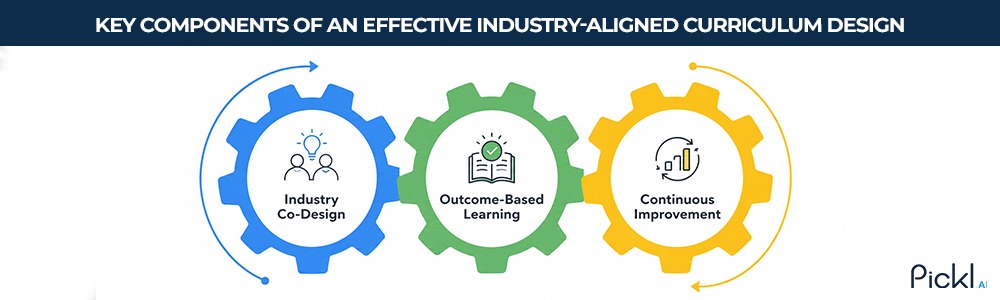
Effective curriculum design best practices are underpinned by the following foundational pillars. Each is necessary, while none can thrive alone:
Stakeholder Co-Design with Industry Partners
An effective Industry-aligned program requires active co-designing with employers. Institutes should first focus on understanding the demand in the market, identifying the skills that are in great demand and then critically analysing their current curriculum. Based on this study, they should amend the curriculum making it in alignment with the demand in the industry.
Outcome-Based Learning Architecture
Every module, assessment, and teaching method must trace back to a defined, measurable outcome. Setting the tangible targets is a must to assess the success rate of a particular program. This holds true even when we are collaborating with industry partners. Defining the goals of the program and aligning it with measurable goals is the first step to have an outcome-driven learning framework.
Continuous Improvement Infrastructure
Developing and alleging the curriculum with the industry standards is a regular practice. It needs governance, and regular review that ensure seamless integration with the ongoing curriculum making it more relevant.
Designing for Emerging Fields: Data Science and AI Curricula

Data science and artificial intelligence, these two are not just a buzz, rather they have had a ripple effect across the industry spectrum. The ubiquity of these technologies has also raised the demand for skilled professionals in the same domain. Their application is not just limited to a sector, but the widespread use cases is triggering a demand for a revised learning pedagogy that trains the students in the desired skill sets.
A comprehensive data science curriculum today cannot simply teach Python and statistical modelling. It must also cover data ethics and governance, cloud-based data infrastructure, MLOps pipelines, and business communication for non-technical stakeholders. Without these applied competencies, graduates are technically literate but professionally underprepared.
Similarly, an effective AI course curriculum must go beyond foundational machine learning concepts. It must address prompt engineering, model evaluation and bias, responsible AI deployment, and cross-functional integration of AI tools. As organisations increasingly embed AI across operations, the ability to work intelligently with AI systems not just build them, is a core employability competency.
Key competencies for a future-ready AI course curriculum
- Prompt engineering
- Model evaluation & bias detection
- Responsible AI deployment
- AI tool integration in workflows
- Data governance & compliance
- MLOps & pipeline management
- Stakeholder communication
A Scalable Course Development Process
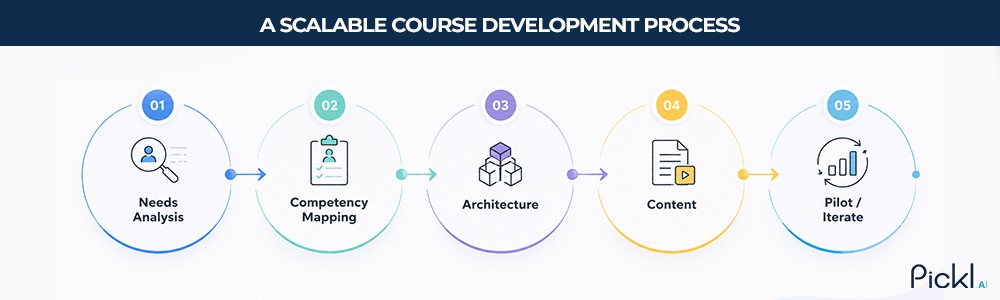
One of the most common failure points in curriculum development for higher education is the absence of a structured, scalable course development process. Ad hoc design produces inconsistent quality and slow iteration cycles. High-performing institutions follow a repeatable methodology:
Needs Analysis
Understanding the market gap is a must before we start developing and designing the curriculum. Analysing the skill gap in the market, competitors analysis and how they are integrating the new age technology to make the curriculum up-to-date is the first step to scale up the pedagogy making it more relevant.
Competency Mapping
Translate employer needs into a structured competency framework. Map each competency to one or more learning outcomes. This is the backbone of your curriculum design.
Curriculum Architecture
Sequence modules to build mastery progressively foundational concepts first, applied practice second, integrative projects third. Use curriculum mapping tools to visualise dependencies and coverage gaps.
Content Development & QA
Commission content aligned to the competency framework. Validate with subject matter experts, industry reviewers, and where possible with employer panels who can assess real-world applicability.
Pilot, Measure, Iterate
Launch with a cohort designed for feedback capture. Track engagement metrics, assessment performance, and critically graduate employment outcomes. Use these signals to drive continuous improvement.
Curriculum Design Best Practices for Higher Education

Whether you are building a new postgraduate programme or refreshing an existing undergraduate offering, the following curriculum design best practices are applicable across contexts:
Practical Learning at Every Stage
Theoretical knowledge must be scaffolded with applied practice. Project-based learning, case studies drawn from real industry scenarios, live briefs with employer partners, and simulation environments all bridge the theory-to-application gap. For professional technical and skill-based education especially, the proportion of applied learning should increase as learners advance through the programme.
Integrate Soft Skills
Technical mastery alone does not produce high-performing professionals. Communication, problem-solving, cross-functional collaboration, and adaptability are decisive factors in both hiring and promotion decisions. These should not be relegated to isolated modules, they must be threaded throughout the learning architecture.
Use Accreditation as a Strategic Signal
Accreditation frameworks from professional bodies often encode current industry standards. Pursuing accreditation from a respected sector body is not just a quality assurance mechanism. It is a curriculum alignment mechanism. Accreditors typically maintain close relationships with employer communities, and their standards reflect evolving industry expectations.
Using Technology to Enable Scale and Speed
Curriculum management platforms, learning experience design tools, and LMS integrations allow institutions to manage complex programme portfolios without losing coherence. The right technology stack reduces the time between identifying a curriculum gap and deploying an updated module from months to weeks.
Track Graduate Outcomes as a Performance Metric
The most rigorous measure of a well-designed industry-aligned curriculum is not student satisfaction scores. It is graduate employment outcomes. Institutions should track placement rates, time-to-employment, employer satisfaction ratings, and salary benchmarks as primary indicators of curriculum effectiveness.
A Practical Roadmap to Design an Industry-aligned Curriculum
Every institute who wants to stand ahead of the competition should refresh their curriculum and make it in synchronization with the industry-demand. Upgrading to data science curriculum, AI-based programs, internships and workshops is a must. Institutions should evolve their approach to curriculum design by auditing how the current programmes are designed.
Frequently Asked Questions
What is curriculum design and it is important?
The concept of curriculum design refers to the process of designing the teaching and learning experience to fulfill particular learning objectives. In universities, for example, the curriculum design process affects graduates’ employability and accreditation status.
How do different curriculum designs and models apply to professional technical and skill-based education?
There are different curriculum designs and models like competency-based, outcome-based, or project-based frameworks serve distinct purposes. Competency-based models are especially effective, as they map directly to employer-defined skill benchmarks, enabling measurable job-readiness rather than just academic attainment.
What should an effective data science curriculum or AI course curriculum include today?
An effective data science curriculum should cover topics like applied statistics, Python, cloud data infrastructure, MLOps, and data ethics. While an AI course curriculum should additionally include prompt engineering, responsible AI deployment, and cross-functional AI integration.
What are some of the important curriculum design best practices institutions should follow during the course development process?
Leading curriculum design best practices include embedding industry advisory input, integrating labour market data, and building continuous review cycles into the course development process. Practical, project-based learning components should be the focus while also including rigorous theoretical foundations throughout.
How can institutions ensure their curriculum development for higher education stay industry-aligned over time?
With having industry advisory boards, yearly evaluations of employers’ opinions, monitoring of graduates’ job placements, and curriculum management software for curriculum development and evaluation process can assist in maintaining the same level of progress as the development of the industry.
Author
-

Written by:
Neha Singh