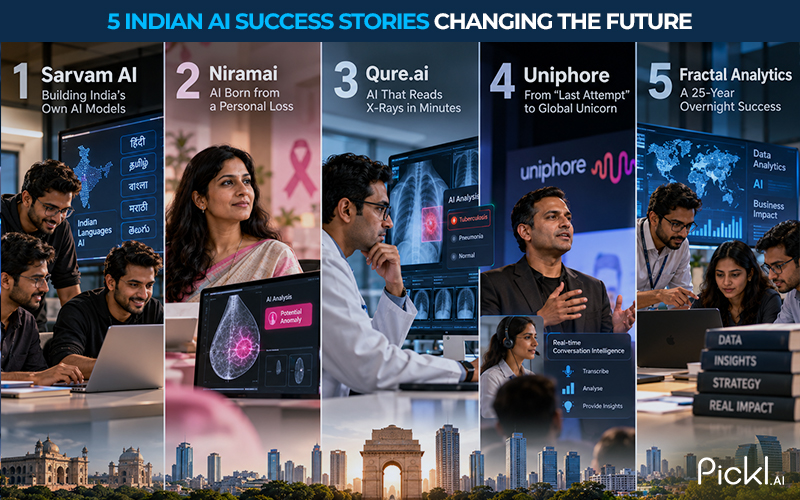

Summary: AI is the next big thing, and Indian companies are working their way to harness the power of AI. Companies like Sarvam AI, Fractal Analytics and more have created a strong foothold in the market showcasing India’s prowess in integrating AI for various business processes. The blog unfolds the 5 AI success stories worth inspiration.
Introduction
AI success stories from India have been making headlines. Yes, we are on our way to make India shine on the global pedestal as the AI innovator. There have been several companies that have steadily made a strong impact in the market. From a Bengaluru lab building India’s own language models to a Chennai start-up that began as a “last attempt”, Indian founders are proving that world-class AI can be built here, for Indian problems. These five AI success stories from India show what ambition, patience and purpose can achieve, and why your dream is more possible than you think.
1. Sarvam AI: Building India’s Own AI Models
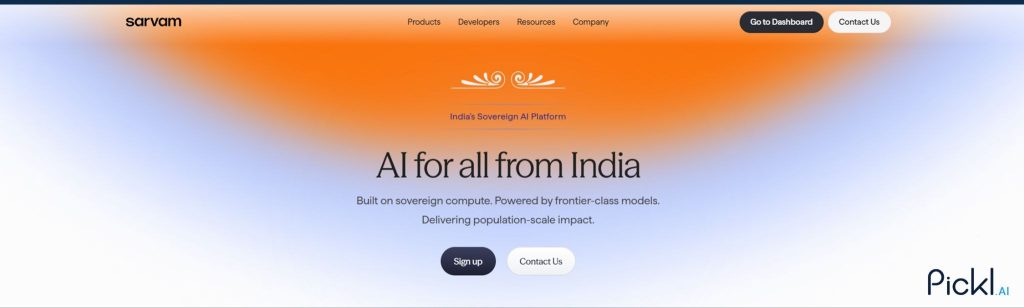
Pratyush Kumar and Vivek Raghavan founded Sarvam AI in Bengaluru in August 2023. Kumar had earlier co-founded AI4Bharat and One Fourth Labs, while Raghavan spent over a decade at UIDAI, the body behind Aadhaar. Within five months of launch, Sarvam raised $41 million.
The real breakthrough came next. The government selected Sarvam to build India’s first indigenous large language model under the IndiaAI Mission, and in February 2026 it unveiled 30-billion and 105-billion parameter models trained on 22 Indian languages. In June 2026, Sarvam became a unicorn, raising $234 million at a $1.5 billion valuation.
The lesson: Own a problem others overlook. While the world chased English chatbots, Sarvam bet on Indian languages and voice.
2. Niramai: AI Born from a Personal Loss
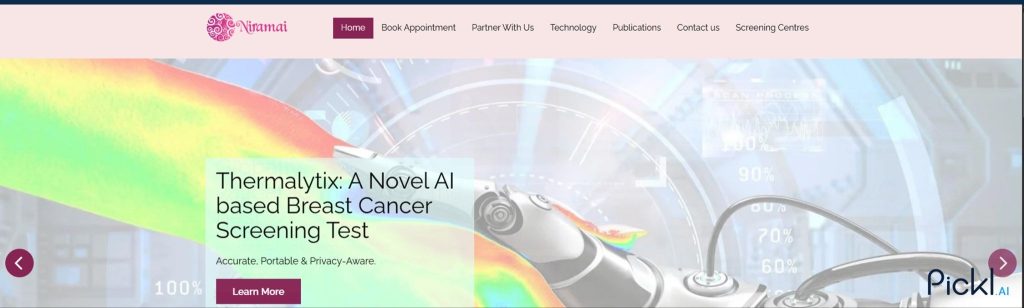
Geetha Manjunath’s cousin died at 42 after a late breast cancer diagnosis. Instead of moving on, she quit her job and, in 2016, launched Niramai Health Analytix in Bengaluru.
Its patented Thermalytix technology combines thermal imaging with AI to flag early-stage breast cancer. The test is radiation-free, non-invasive and portable, which matters because mammography is less effective for women under 45 and is expensive and hard to access. Niramai says its screening has reached about 2.5 lakh women across 22 countries, and earlier coverage reported rural camp prices as low as ₹100 per test.
The lesson: Your “why” is your strongest asset. A personal mission can carry you through years of hard, unglamorous work.
3. Qure.ai: AI That Reads X-Rays in Minutes
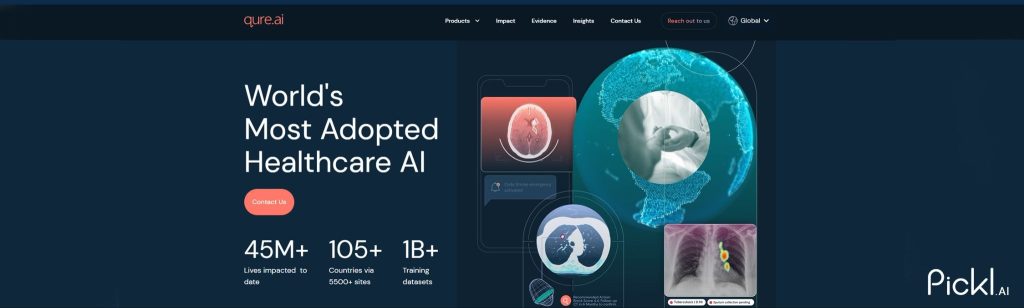
Founded in 2016 by Prashant Warier and Dr Pooja Rao, and incubated by Fractal Analytics, Qure.ai set out to solve a stubborn problem: India has too few radiologists for its patients. Its qXR tool uses deep learning to read chest X-rays, helping cut tuberculosis diagnosis from weeks to minutes.
Today Qure.ai’s AI is deployed in more than 105 countries and over 4,800 sites. In January 2026 it won a multimillion-dollar Gates Foundation grant to develop AI-enabled ultrasound for TB and pneumonia. An Indian health technology assessment also found qXR to be cost-saving for TB screening, which is exactly what public health programmes need.
The lesson: Pair technical depth with domain expertise. Warier brought operations research and Dr Rao brought neuroscience and machine learning, a combination no single founder had.
4. Uniphore: From “Last Attempt” to Global Unicorn
Umesh Sachdev and Ravi Saraogi met in college at JIIT Noida. When they moved to Chennai, they told themselves it was only for six months, and that Uniphore would be their last attempt at entrepreneurship. They joined the IIT Madras incubation programme and spent a year in the lab building speech technology for Indian languages.
In 2013 they rebranded as Uniphore and pivoted to enterprise conversational AI. By February 2022, a $400 million round valued the company at $2.5 billion, and in October 2025 it closed a $260 million Series F. Uniphore now serves over 2,500 enterprise customers.
The lesson: You don’t need a perfect first idea. You need the willingness to learn, pivot and keep going.
5. Fractal Analytics: A 25-Year Overnight Success
Fractal was founded in 2000 by a group of IIM Ahmedabad graduates, including Srikanth Velamakanni and Pranay Agrawal, long before AI became a boardroom buzzword. Its clients include Citigroup, Nestle and Philips.
The road was not smooth. Fractal first planned an IPO in 2021 but deferred it amid weak markets, and it posted a net loss of ₹54.7 crore in FY24. It then turned around to a net profit of ₹220.6 crore in FY25, and its roughly ₹2,834 crore IPO opened in February 2026. Fractal also incubated Qure.ai, proof that successful founders lift others.
The lesson: Patience compounds. Delays and losses are chapters, not the end of the story.
What These Indian AI Founders Have in Common
- They solved real Indian problems. Language diversity, TB, breast cancer screening and contact-centre complexity are local challenges with global demand.
- They played the long game. Fractal took 25 years and Uniphore took 14 years to reach their milestones.
- They built on India’s ecosystem. IIT Madras, IIM Ahmedabad and government programmes like IndiaAI gave them launchpads.
- They stayed flexible. Uniphore pivoted, and Niramai turned grief into a product.
How to Start Your Own AI Journey
You don’t need to launch a start-up tomorrow. Learn the fundamentals of data and AI, pick one real problem in your city, college or industry, build a small project, and share it. Join communities, find mentors and treat every setback as data.
Frequently Asked Questions
Which Indian AI start-up became a unicorn in 2026?
Sarvam AI, a Bengaluru-based full-stack AI company, became a unicorn in June 2026 after a Series B round valuing it at $1.5 billion.
Who founded Niramai and what does it do?
Dr Geetha Manjunath founded Niramai in 2016. It uses AI-powered thermal imaging (Thermalytix) for non-invasive, radiation-free breast cancer screening.
What is Qure.ai known for?
Qure.ai uses AI to read X-rays and CT scans quickly. Its qXR tool is widely used for TB screening and is deployed in over 100 countries.
Do you need to be a coder to succeed in AI?
Not necessarily. Fractal’s founders came from business school, Qure.ai’s CEO from operations research, and Niramai’s founder from data research. Domain knowledge and problem-solving matter as much as coding.
Are there other AI success stories in India worth following?
Yes. India’s AI ecosystem is growing fast, with new unicorns and deep-tech start-ups emerging in healthcare, language technology, agriculture and finance.
Conclusion: Your Dream Belongs in This List Too
All the AI companies mentioned here started by analysing the problem and the gap that existed. They started working on it with conviction, came up with the solution. Any individual who wants to make a mark or planning to start a venture in the AI domain, should always focus on solving the problem , start small and then start building solutions around it.
Author
-

Written by:
Neha Singh