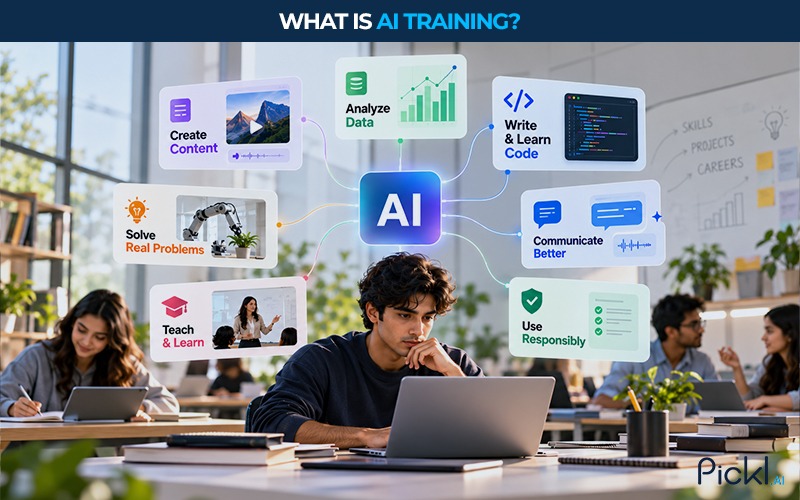

Summary: AI training has become a cornerstone for the success of students, professionals and educators. The integration of AI has brought a shift in the job scenario. Companies are now looking to hire candidates who are well-versed in using different AI tools and integrating them with the current business process. Besides, educators also need to level up their skills to make learning more impactful.
Introduction
Artificial intelligence is no longer a future technology. It has already taken over several work like follow-up emails, chatbots, analyzing data, coding, and more. Today, the world runs on AI-integrated technology. Yet, when it comes to using AI in daily life, our major focus is image generation, writing emails, and creating some ad copies. There is a wider gap between what AI has to offer and how we are using it currently. Hence, the need for AI training becomes integral.
Here we will be exploring all the key details about AI training, its use cases, and how we can also use AI training for faculty to help them level up their skills.
What Is AI Training?
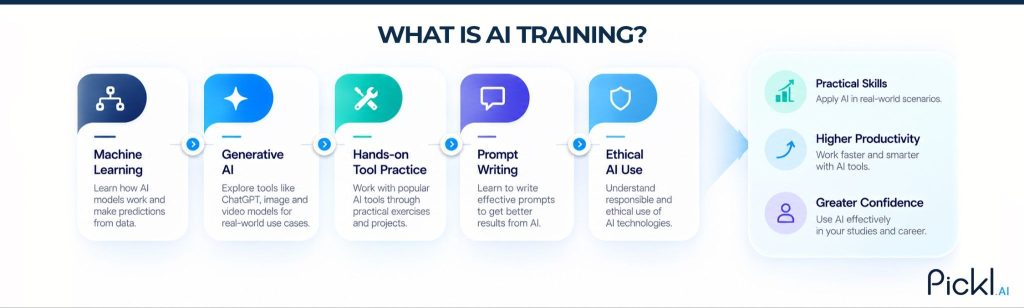
AI training is the structured process of learning how artificial intelligence works and how to use it effectively to enhance productivity. It covers core concepts such as machine learning and generative AI, hands-on practice with AI tools, prompt writing, and ethical use. The goal is practical skill and confidence, not just awareness.
The Two Meanings of AI Training
The phrase is used in two different ways, and it helps to know the difference.
Training an AI model
Engineers feed large datasets into an algorithm so it learns patterns and makes predictions. This is a technical process carried out by data scientists.
Training people to use AI
Learners, employees, and educators are taught how to work with AI tools. This is what most professionals, teachers, and students are searching for, and it is the focus of this blog.
Why Does AI Training Matter?
AI tools are now part of everyday work, but access to a tool is not the same as skill. Without proper AI Training, people either avoid AI out of fear or use it carelessly and trust wrong answers.
Here is why AI Training matters:
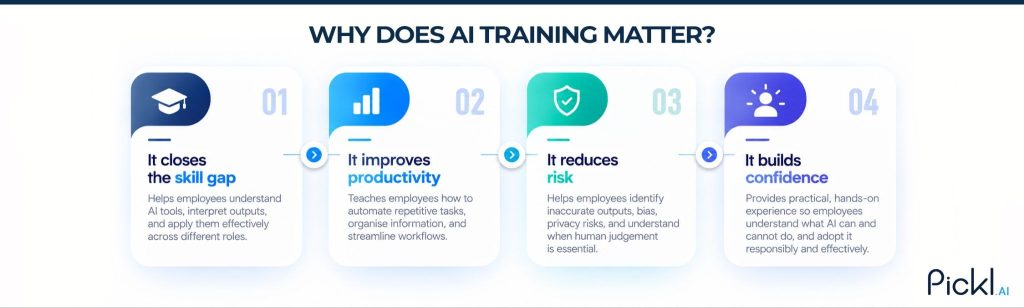
It closes the skill gap
As AI becomes part of everyday business operations, employers increasingly expect AI literacy across both technical and non-technical roles. Training helps employees understand AI tools, interpret their outputs, and apply them effectively to tasks such as research, communication, data analysis, and decision-making.
It improves productivity
AI training teaches employees how to use AI tools to automate repetitive tasks, organise information, generate initial drafts, and streamline routine workflows. Instead of spending hours on manual work, employees can focus more on strategic thinking, problem-solving, and creativity.
It reduces risk
Using AI without adequate knowledge can lead to inaccurate outputs, biased recommendations, data privacy breaches, and unintended consequences. Training helps employees recognise these risks, verify AI-generated information, protect sensitive data, and understand when human judgement is essential.
It builds confidence
Structured training provides practical, hands-on experience that helps replace uncertainty with confidence. As employees understand what AI can and cannot do, they become better equipped to identify useful applications, experiment responsibly, and adopt AI more effectively across teams.
What Does a Good AI Training Program Include?
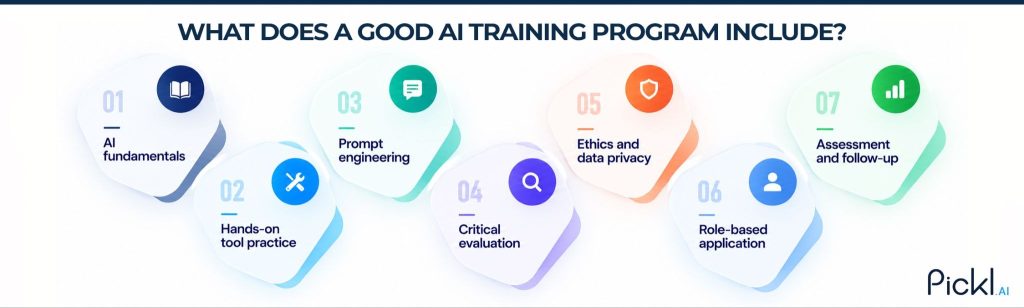
Not every course delivers real results. A strong AI Training program usually covers these elements:
- AI fundamentals: What AI, machine learning and generative AI are, in plain language.
- Hands-on tool practice: Using popular AI assistants for writing, research, analysis and presentations.
- Prompt engineering: Writing clear, specific instructions to get accurate and useful outputs.
- Critical evaluation: Fact-checking AI responses and recognising hallucinations and bias.
- Ethics and data privacy: Knowing what information should never be shared with an AI tool.
- Role-based application: Real use cases tailored to the learner’s profession.
- Assessment and follow-up: Practical tasks, feedback and refresher support.
What Is AI Training for Faculty?
AI Training for faculty is a specialised form of AI Training designed for professors, lecturers and academic staff. It helps educators understand AI tools, redesign teaching and assessment, and guide students toward ethical and effective AI use.
Students are already using AI, whether institutions are ready or not. If faculty members lack training, classrooms end up with confusion, inconsistent rules and missed opportunities. AI Training for faculty replaces that uncertainty with a clear, confident approach.
A good faculty program typically covers:
- Understanding what generative AI can and cannot do
- Using AI to prepare lesson plans, case studies, quizzes and rubrics
- Designing assignments that encourage original thinking in an AI era
- Setting clear classroom policies on acceptable AI use
- Spotting over-reliance on AI and handling academic integrity concerns
- Using AI for research support, feedback and administrative tasks
Benefits of AI Training for Faculty
When institutions invest in AI Training for faculty, the benefits reach teachers, students and the institution itself.
Time savings
AI can speed up content creation, grading support, and routine communication. Educators can prepare lesson plans, draft feedback, and create learning materials faster. This leaves more time for student interaction and academic planning.
Better teaching quality
Educators can use AI to personalise examples, design engaging activities, and explain complex ideas in simpler ways. They can adapt learning materials to different student needs and make lessons more interactive.
Stronger student outcome
Students gain practical AI skills that employers increasingly value. They learn to use AI tools for research, problem-solving, data analysis, and creative tasks. These skills help them prepare for real-world workplace challenges.
Consistent policies
Shared AI guidelines help departments use these tools responsibly. They clarify expectations around academic integrity, data privacy, and acceptable use. This reduces confusion and helps educators make consistent decisions across courses.
Future-ready institutions
Colleges and universities that integrate AI into teaching and learning can better prepare students for changing industry needs. This strengthens their academic relevance, supports innovation, and builds credibility among students, employers, and industry partners.
Frequently Asked Questions About AI Training
What is AI Training in simple words?
AI Training means learning how to understand and use artificial intelligence tools safely and effectively. It can also refer to teaching an AI model using data, but for most people it means building practical AI skills.
Do I need technical skills to start AI Training?
No. Most beginner programs require no coding. If you can use a browser and write clear instructions, you can begin AI Training today.
What is AI Training for faculty?
AI Training for faculty is a program that teaches educators how to use AI in teaching, assessment, research and administration while maintaining academic integrity.
How long does AI Training take?
It depends on the goal. A foundational workshop can take a few hours or a day, while deeper programs run for several weeks with practice assignments.
Conclusion
AI is changing how we learn, teach and work, and the people who benefit most will be those who understand it. AI Training gives learners and professionals the skills to use AI with confidence, accuracy and responsibility. For educational institutions, AI Training for faculty is the most powerful starting point, because empowered educators create AI-ready students.
The right time to begin is now. Start with the basics, practise on real tasks, and keep learning as the technology grows.
Author
-

Written by:
Neha Singh