
Summary: Industry-led workshops are an integral part of learning. Colleges and universities are aggressively investing in introducing expert-led workshops that bring industry experience and expertise to the college. This enhances the learning experience and at the same time, equips the students with job-ready skills.
Introduction
The skill-based learning is not merely a concept; it has become a reality of the most of the institution. The impact is now visible at the school level. Student workshops around AI, analytics, soft skill and leadership have now become a part of the curriculum. As per India Skills Report, 2024, only 46% of the Indian graduates are considered employable by the industry, the rest of them lack the employability skills. With the industry-experts driven workshops, schools, colleges and universities can merge the expertise with the regular curriculum upgrading it to match the industry standards.
The way ahead will be defined by how well the educational institutes are able to blend together traditional lectures and semester exams with intensive hands-on student workshops led not by faculty, but by practitioners from the industry. The objective of these workshops is to help the student acquire the right skills and knowledge and preparing them for the future.
This is not a passing trend. It is a deliberate, strategic investment that academic leaders across India and globally are doubling down on. The question is: why now, and why with such urgency?
The Skills Crisis in Higher Education
Here is the uncomfortable truth, most of the institutes focus on how well they are executing the academic curriculum, but most of the institutes find it difficult to place their students after the completion of the course. Here are some noteworthy stats that are an eye-opener:
- According to reports from the National Association of Colleges and Employers (NACE) many engineering and commerce graduates are considered “not industry-ready” at the time of hiring.
- As per the India Skills Report 2024, only 51.25% of final-year students and postgraduates tested were considered employable.
- On a similar front, the Periodic Labour Force Survey 2023 showed that urban youth unemployment (ages 15–29) at 17.5%, with graduates forming the biggest share of the unemployed.
- The TeamLease report titled From Degree Factories to Employability Hubs shows that nearly 75% of higher education institutions (HEIs) in India remain misaligned with industry needs.
- 36% of the higher education institutions have incorporated soft skills like communication, teamwork, and critical thinking in their programs.
This stark reality shows the grave reality that clearly indicates the need for structural reform at the grassroot level. Institutes have to move ahead from the theoretical perspective and start to focus on nurturing additional skills that makes the student job-ready. This is precisely where industry expert workshops enter the picture.
What are Expert-Led Student Workshops?

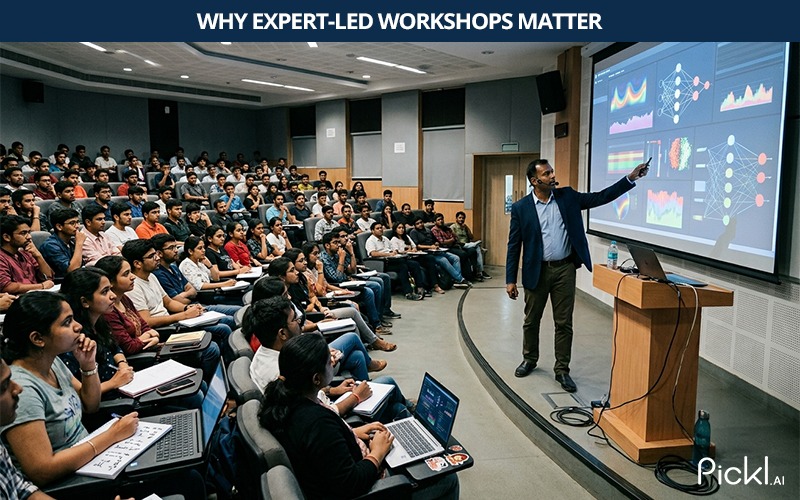
Expert-led student workshops are well-structured learning programs that can range from a day or two to several weeks depending on the kind of program. These workshops are often led by industry experts. These are not like a regular classroom session rather, they are meticulously designed programs that help in meeting the industry demand.
- Outcome-oriented: focused on building a concrete skill or completing a real project
- Practitioner-led: delivered by people actively working in the field
- Hands-on: involving tools, case studies, and live demonstrations
- Current: reflecting what is actually happening in the industry today
Additionally, workshops for college students have now emerged as a common norm. These workshops cover a range of disciplines like communication and leadership to highly technical domains. But in the recent trend shows the growing inclination of students towards AI and ML workshops, AI workshops, and data science workshops. These workshops train the students on practical skills that prepares them for the real-world scenario.
Why Academic Leaders Are Prioritising These Programs
Academic leaders recognize the potential of such programs. These AI and ML workshops have a significant impact on improving the portfolio of the students. Besides, the exposure to the industry-relevant use cases helps them acquire skills that can be implemented immediately. Furthermore, this practical foundation reduces the onboarding time and training resources organizations must invest in new hires.
1. Accreditation and Ranking Pressures Are Rising
Accreditation bodies are now focussing on industry linkages, skill-based training, and employability outcomes. Even the companies coming for placement are keen on associating with colleges that have industry-association and industry-driven courses. This highlights how well the institutes are focussing on preparing their students for the future.
2. Employers Are Demanding Demonstrable Skills
The hiring trends are changing, hiring managers are not only relying on degree-centric recruitment, rather, they are looking for individuals who can apply the skills. Students who have hands-on knowledge of different tools and modern technology like AI, Gen AI, machine learning and analytics have an edge over the others. Hence, there has been a steady rise in the demand for such professional courses.
Student workshops for job-ready graduates directly address this shift. A student who holds expertise in all these skills and walks into an interview with the professional certification holds a better prospect of making it through the interview.
Academic leaders understand this dynamic. By embedding expert-led workshops into the academic calendar, they are equipping students with proof-of-skill that complements their degrees.
3. Bridging the Skill Gap Is Now an Institutional Responsibility
Skill gap is a major concern, and workshops bridging student skill gaps are a proven way to build up industry-relevant skills.
The skill gaps most commonly cited by employers include:
- Lack of practical skills in using AI, and machine learning
- Understanding of data-driven decision-making
- Lack of problem-solving skills and leadership qualities
- Ineffective communication in a professional setup
Expert-led workshops address each of these areas. They bring together hard skills (technical knowledge) and soft skills (communication, personality development and presentation skills) to create a holistic program that helps in overcoming all the above-mentioned challenges.
The Rise of AI and ML Workshops in Campus Programs

No area has seen a more explosive demand than artificial intelligence and machine learning. The global AI market is projected to reach $3497.26 billion in 2033. The success of the students will depend on their ability to acquire the high-level skills that place them at the forefront of the digital economy. For students entering the workforce over the next five years, familiarity with AI concepts is quickly becoming a baseline expectation — not a differentiator.
This is driving a surge in demand for AI and ML workshops and dedicated AI workshops on campuses. These sessions, led by practitioners who build AI systems professionally, give students:
- A hands-on introduction to machine learning concepts and tools
- Exposure to real datasets and model-building exercises
- Understanding of where and how AI is applied in business and research
- A foundation for pursuing deeper specialisation or certifications
Academic leaders who are investing in these workshops are future-proofing their institutions. By integrating technologies with the core curriculum, we can today be future-proofing their institutions. They recognise that students who graduate with AI and data skills will outperform peers who don’t — and that institutional reputation is built on outcomes.
The ROI of Expert-Led Workshops: What the Data Shows

Academic leaders have a pragmatic approach. Adding industry-aligned workshops and training in the core modules will have rewarding outcomes. There are significant evidence showcasing that expert-led workshops in advanced technologies are effective in enhancing the employability of students and reputation of the institutes.
Improved Placement Rates
Institutions that integrate structured skill workshops into their programs consistently report higher campus placement rates and better-quality offers. Students with workshop credentials are more likely to clear technical interview rounds.
Higher Student Satisfaction
Students who participate in industry expert workshops report higher satisfaction with their academic experience. They feel more prepared, more confident, and more connected to real-world applications of their studies.
Stronger Alumni Networks
When industry experts conduct workshops on campus, they often become long-term partners, mentors, recruiters, and guest speakers. This creates sustained value well beyond a single workshop.
Faculty Upskilling
Exposure to industry practitioners also benefits faculty, who gain visibility into current practices, tools, and trends, helping them update their own teaching with contemporary relevance.
Conclusion
The investment in expert-led student workshops is not a simple addition to the institute’s portfolio, rather it showcases the visionary approach towards student development. Expert-led workshops in advanced technologies like AI, data science, data analytics and machine learning are no longer optional—they are a necessity. Through strategic alliances with specialized training providers, educational institutions can empower their curriculum and secure a trajectory of futuristic growth.
Frequently Asked Questions
Why are expert-led workshops essential for students today?
Expert-led workshops focus on bridging the gap between theory and practice. They provide the right expertise in industry-relevant skills like AI, data science, analytics and machine learning that make students employable.
How do AI and ML workshops specifically benefit institutional rankings?
By integrating specialized AI and ML workshops, institutions demonstrate a commitment to futuristic growth and technical excellence. This eventually improves placement statistics and boosts institutional ranking.
How are expert-led workshops different from regular classroom sessions?
The expert-led training and workshops are outcome-driven. They focus more on providing the expertise in skills that can be immediately implemented. With hands-on projects and real-world use cases, these workshops make students employable. On the contrary, the conventional medium of learning focuses more on theory and is not as effective as the workshops and training.
What Makes a Student Workshop Truly Effective?
Effective student workshops must bridge the gap between theory and practice. By focusing on real-world use cases, these programs ensure that students don’t just acquire technical skills, but also master the ability to apply them in professional environments.
What should academic leaders look for in a workshop training partner?
Effective partners should bring genuine industry credentials and design programs that complement the existing curriculum. Leaders should prioritize providers that offer hands-on application over simple presentations, provide recognized certifications, and offer post-workshop resources. This ensures the investment leads to measurable student success and long-term institutional growth.
Author
-

Written by:
Neha Singh