
Summary: This blog examines the importance of an industry-supported data science curriculum. It highlights how university-industry collaboration bridges the skills gap, offers benefits like real-world projects, and outlines implementation models to ensure students are “day-one ready” for the competitive workforce.
Introduction
The world of technology moves fast, but the world of data moves even faster. A few years ago, knowing basic statistics and Excel was enough to land a job as an analyst. Today, companies are looking for experts in machine learning, deep learning, and generative AI. This rapid shift has created a challenge for higher education: How do universities keep up?
The answer lies in a new approach to education: the industry-supported data science curriculum.
Traditional academic programs provide a strong theoretical foundation, but they often struggle to teach the practical, messy, real-world skills that employers demand. By collaborating with tech giants and specialized firms, universities can transform their degree programs into launchpads for successful careers.
In this blog, we will explore what an industry-supported data science curriculum looks like, why it is essential, and how universities can implement it to benefit students and employers alike.
What Is an Industry-Supported Data Science Curriculum?
An industry-supported data science curriculum is an academic program designed, reviewed, or delivered in partnership with active business organizations. Unlike a traditional syllabus, which might remain unchanged for years, this type of curriculum is dynamic. It evolves alongside the market.
In this model, industry experts contribute by:
- Identifying the most relevant tools (like Python, R, TensorFlow, or Tableau).
- Providing real-world datasets for student practice.
- Suggesting specific learning outcomes that match current job descriptions.
For example, a traditional course might teach the mathematical formula behind a neural network. An industry-aligned data science curriculum will still teach the math, but it will also require students to build a fraud detection model using actual credit card transaction data provided by a banking partner.
Why Universities Need Industry Alignment in Data Science Education
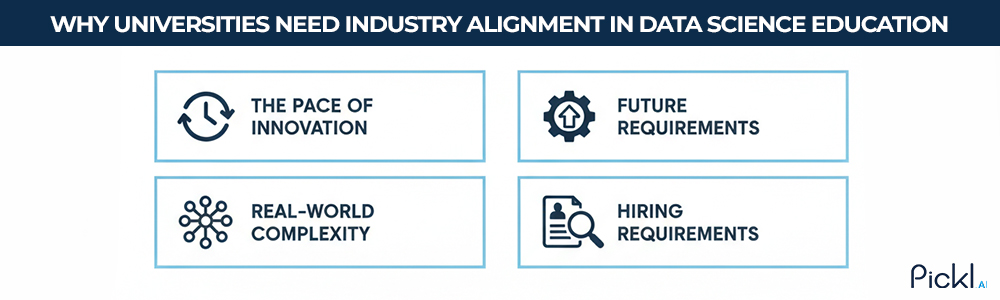
The gap between what is taught in the classroom and what is needed in the boardroom is often called the “employability gap.” This is particularly wide in data science.
The Pace of Innovation
Technologies like Large Language Models (LLMs) and MLOps (Machine Learning Operations) didn’t exist in textbooks five years ago. An industry-supported data science curriculum ensures that students are learning today’s tools, not yesterday’s history.
Real-World Complexity
Academic data is often clean and structured. Real-world data is messy, incomplete, and unstructured. Without industry alignment, students graduate thinking data science is just about running algorithms. They are unprepared for the reality of data cleaning and engineering, which makes up 80% of the job.
Hiring Requirements
Recruiters no longer look just for degrees; they look for portfolios. They want to see that a graduate has solved a business problem. A curriculum built with industry input prioritizes these project-based outcomes.
Core Elements of an Industry-Aligned Data Science Curriculum
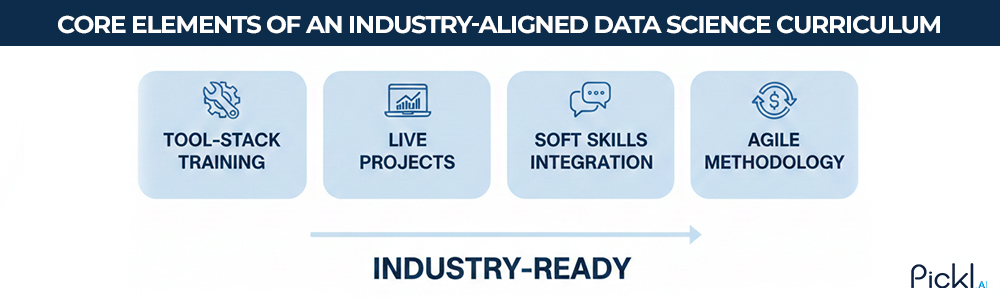
To create a truly effective program, universities cannot simply add a guest lecture and call it “industry-aligned.” A robust industry-aligned data science curriculum typically includes the following core elements:
Tool-Stack Training
Instruction on industry-standard platforms such as AWS, Microsoft Azure, and Google Cloud, rather than just academic software.
Live Projects
Capstone projects where students solve actual problems for partner companies. For instance, analyzing customer churn for a retail chain.
Soft Skills Integration
Data scientists must communicate their findings. Industry partners often emphasize the importance of data storytelling and business acumen.
Agile Methodology
Teaching students to work in “sprints” and use version control systems like Git, mirroring a real software development environment.
Role of University–Industry Collaboration in Data Science
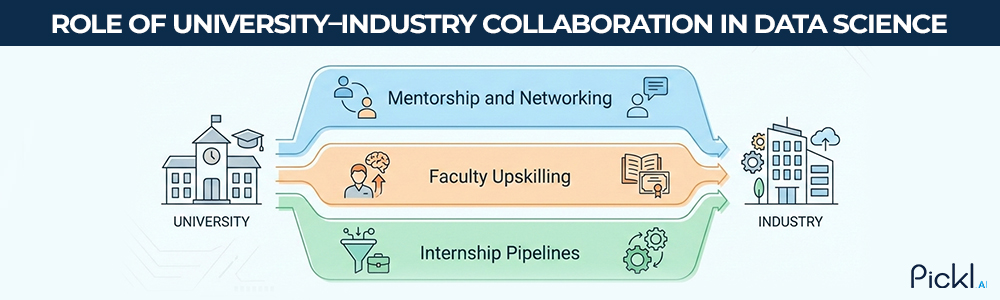
Successful university-industry collaboration in data science goes beyond syllabus design. It creates an ecosystem where academia and business feed into each other.
Mentorship and Networking
Industry partners often provide mentors who guide students through their final projects. This gives students a foot in the door and helps them understand professional expectations.
Faculty Upskilling
It isn’t just students who learn. Collaboration allows professors to spend time in industry settings, updating their own knowledge so they can teach the latest trends.
Internship Pipelines
When a company helps design a course, it is essentially training its future employees. This leads to structured internship programs where the transition from student to employee is seamless.
Benefits of an Industry-Supported Data Science Curriculum
Adopting this model creates a “win-win-win” situation for students, universities, and corporate partners.
For Students
- Higher Employability: Graduates are “day-one ready,” reducing the fear of the job search.
- Practical Confidence: Having worked on real datasets, they are less intimidated by complex business problems.
- Better Salaries: Specialized skills in areas like Cloud Computing or AI often command higher starting packages.
For Universities
- Brand Reputation: A university known for high placement rates attracts top talent.
- Research Opportunities: University-industry collaboration in data science often leads to funded research labs and grants.
For Industry Partners
- Reduced Training Costs: Companies spend less time training new hires because the university has already taught them the specific skills needed.
- Fresh Perspectives: Students often bring innovative ideas to old business problems during their capstone projects.
Common Curriculum Models Universities Can Adopt
There is no one-size-fits-all approach. Universities can implement an industry-supported data science curriculum in various ways:
- The Advisory Board Model: A committee of industry leaders meets quarterly to review the syllabus and suggest changes.
- The Co-Branded Degree: A university offers a “Master’s in Data Science powered by [Tech Company].” The company designs specific modules and certifies the students.
- The Bootcamp Integration: Universities partner with ed-tech firms or bootcamps to run intensive, short-term coding semesters within a traditional 4-year degree.
Challenges in Implementing Industry-Supported Curriculum
While the benefits are clear, the path isn’t always smooth.
Academic Bureaucracy
Universities are designed to be stable, which makes them slow to change. Approving a new syllabus can take months or years, by which time the technology may have changed.
Intellectual Property (IP)
Companies are often hesitant to share proprietary data with universities due to privacy concerns and IP risks.
Balancing Theory and Practice
There is a risk of becoming too vocational. A good university degree must still teach the fundamental theories (the “why”) and not just the tools (the “how”).
Best Practices for Building a Sustainable Industry-Supported Curriculum
To overcome these challenges, institutions should follow these best practices:
- Modular Design: Instead of rewriting the whole degree, create flexible elective modules that can be updated every semester without heavy bureaucratic approval.
- Alumni Feedback Loops: Survey graduates six months into their jobs to ask, “What did you wish you had learned?” Use this data to refine the industry-supported data science curriculum.
- Data Anonymization: To solve IP issues, industry partners can provide anonymized or synthetic datasets that mimic real scenarios without exposing sensitive secrets.
Future Trends in Data Science Curriculum Design
As we look ahead, the industry-aligned data science curriculum will continue to evolve.
- AI Ethics and Governance: Industry is under pressure to use AI responsible. Curriculums will increasingly focus on bias, fairness, and legal compliance.
- Domain Specialization: We will see more specialized tracks, such as “Data Science for Healthcare” or “FinTech Analytics,” rather than generic data science degrees.
- No-Code/Low-Code Analytics: As tools become more user-friendly, the curriculum might shift focus from complex coding to high-level strategic thinking and model interpretation.
Conclusion
The gap between academic theory and professional practice is the biggest hurdle for new data scientists. An industry-supported data science curriculum bridges this gap effectively. By integrating real-world tools, live projects, and expert mentorship, universities can ensure their students are not just educated, but employable.
For higher education institutions, university-industry collaboration in data science is no longer a luxury—it is a necessity. As the demand for data skills grows, the universities that succeed will be the ones that invite the industry into the classroom.
Frequently Asked Questions
What is an industry-supported data science curriculum?
An industry-supported data science curriculum is an academic program designed in partnership with technology companies and business leaders. It integrates current industry tools, real-world datasets, and practical projects to ensure students learn skills that are immediately applicable in the job market.
How does an industry-aligned data science curriculum benefit students?
It benefits students by teaching them the exact skills employers are looking for. This leads to higher employability, better confidence in handling real business problems, and often higher starting salaries compared to graduates from purely theoretical programs.
Why is university–industry collaboration important in data science education?
Data science technology changes very quickly. University-industry collaboration in data science ensures that professors and students stay updated on the latest trends (like AI and Cloud Computing) that might not yet be in standard textbooks.
What role do industry partners play in curriculum design?
Industry partners help by reviewing the syllabus, providing access to proprietary software or datasets, offering mentorship, delivering guest lectures, and defining the learning outcomes that match current job roles.
How can universities implement an industry-supported curriculum effectively?
Universities can implement this by forming industry advisory boards, creating flexible elective modules that can be updated quickly, and incorporating capstone projects where students solve live problems for partner companies.
Author
-

Written by:
Neha Singh