
Summary: This blog explains why faculty development programs are crucial for integrating AI into higher education. It discusses core skills like prompt engineering and ethics, explores training models like Pickl.AI, and highlights the benefits of upskilling educators to create AI-ready campuses that produce employable graduates.
Introduction
Artificial Intelligence (AI) is no longer a futuristic concept; it is the present reality of higher education. From ChatGPT writing essays to intelligent tutoring systems personalizing learning, AI is reshaping the classroom at breakneck speed.
However, a university’s ability to adapt to this change doesn’t depend solely on buying the latest software or upgrading computer labs. It depends on its most critical asset: the faculty.
If professors don’t understand how to use AI, they cannot teach students to use it effectively. This is why faculty development programs for AI are not just an “optional perk”—they are an absolute necessity for building AI-ready campuses.
In this blog, we will explore why faculty training for AI education is critical, the core skills educators need, and how institutions can implement successful faculty upskilling for AI teaching models.
Why Faculty Development Is Critical for AI Education
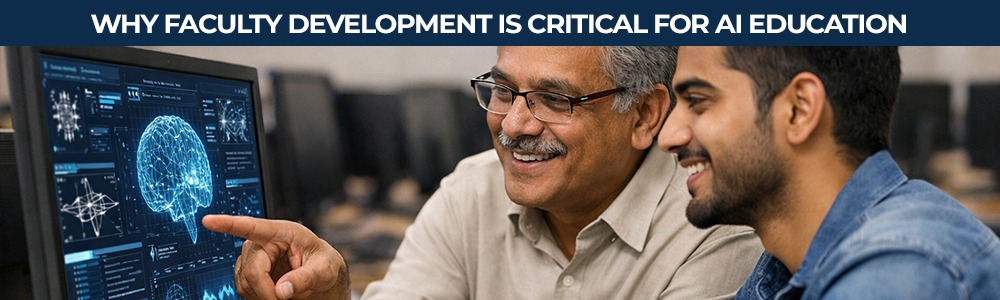
The traditional model of the professor as the “source of all knowledge” is shifting. In an AI-driven world, students can access information instantly. The role of the faculty is evolving into that of a mentor, a facilitator, and a critical thinker.
Faculty development programs matter because:
- Bridging the Generational Gap: Students are often “digital natives” who adapt quickly to new tools. Without proper training, a “digital divide” grows between students and faculty, making teaching less effective.
- Combating Misinformation: AI tools can hallucinate (make up facts). Faculty need to know how these tools work to teach students how to verify information.
- Enhancing Research: AI isn’t just for teaching; it can accelerate research data analysis. Faculty trained in AI can publish faster and secure more grants.
Core Skills Faculty Need to Teach AI Effectively
Upskilling faculty isn’t just about teaching them to code. Effective AI skills development for faculty involves a mix of technical and ethical competencies.
AI Literacy and Prompt Engineering
Faculty don’t need to be data scientists, but they must understand the basics of Generative AI. This includes “Prompt Engineering”—the art of asking AI the right questions to get useful outputs.
Ethical AI Use
This is arguably the most important skill. Professors must be trained to spot algorithmic bias and understand data privacy issues so they can guide students on using AI responsibly.
AI-Assisted Assessment
Grading is time-consuming. Faculty need to learn how to use AI tools to automate administrative grading tasks while keeping the qualitative feedback human-centric.
How Faculty Development Programs Build AI-Ready Campuses
An “AI-Ready Campus” is an ecosystem where technology and pedagogy work in harmony. Faculty development programs are the engine that powers this ecosystem.
When a university invests in faculty training for AI education, it creates a ripple effect:
- Curriculum Upgrades: Trained faculty naturally start integrating AI tools into their syllabus, ensuring students learn relevant industry skills.
- Standardized Policies: Instead of banning AI out of fear, trained faculty help draft university-wide policies that encourage “responsible use.”
- Innovation Culture: A faculty comfortable with AI is more likely to experiment with new teaching methods, such as “Flipped Classrooms” powered by AI tutors.
Models of Faculty Training for AI Education
There is no “one-size-fits-all” approach. Successful universities use a combination of models to ensure faculty upskilling for AI teaching is effective.
The “Train-the-Trainer” Model
Institutions identify “AI Champions”—tech-savvy faculty members who receive advanced training. These champions then return to their departments to train their peers. This peer-to-peer learning is often less intimidating than external lectures.
Continuous Learning Workshops
One-off seminars don’t work. The best programs offer continuous workshops.
Real-World Example: Pickl.AI’s Approach: A prime example of a structured approach is the Faculty Development Program by Pickl.AI. Unlike generic webinars, Pickl.AI collaborates with colleges to offer deep-dive training. Their program covers three essential pillars:
- Pedagogical Training: How to use AI to improve teaching delivery.
- Research Skills: Integrating Machine Learning into academic research.
- Technical Proficiency: Hands-on training with trending tools like Python, Data Analytics, and GenAI.
By using a structured curriculum similar to Pickl.AI’s, universities ensure their faculty aren’t just “aware” of AI, but are proficient users of it.
The “Sandbox” Model
Some universities create digital “sandboxes”—safe environments where faculty can play with AI tools, make mistakes, and learn without the pressure of a live classroom.
Benefits of AI-Focused Faculty Development
Investing in faculty development programs for AI delivers a high Return on Investment (ROI) for institutions.
Higher Student Employability
When faculty teach with modern tools, students graduate with the skills employers actually want.
Increased Research Output
AI tools can drastically reduce the time needed for literature reviews and data crunching, allowing faculty to publish more papers.
Global Reputation
Universities known for tech-savvy faculty attract top-tier global talent and partnerships.
Challenges in Faculty Upskilling for AI Teaching
Despite the benefits, the road to an AI-ready campus is not without hurdles.
Resistance to Change
Many senior faculty members may view AI as a threat to their job security or the integrity of education.
Time Constraints
Professors are already overburdened with administrative work. Finding time for rigorous training is difficult.
Rapid Obsolescence
AI tools change every month. A tool learned in January might be outdated by December, making continuous training a logistical challenge.
Best Practices for Implementing Faculty Development Programs for AI
While there are certain challenges that hinders the seamless transition and adoption of faculty development programs in AI, to overcome these challenges, universities must be strategic.
Incentivize Learning
Tie AI training completion to tenure points, promotions, or professional development grants.
Focus on “Human-in-the-Loop”
Reassure faculty that AI is a co-pilot, not a replacement. Emphasize that their human mentorship is more valuable than ever.
Partner with Industry Experts
Universities often lag behind industry trends. Partnering with ed-tech firms (like the Pickl.AI example mentioned earlier) ensures the training content is current and industry-relevant.
The Future of Faculty Development in AI-Driven Campuses
The future of faculty development is hyper-personalized. Just as AI personalizes learning for students, it will soon personalize training for teachers.
Imagine an “AI Coach” for every professor—a digital assistant that analyzes their lecture recordings and suggests: “You spoke too fast here,” or “Here is a better AI tool to explain this complex concept.”
Furthermore, we will see a shift towards Interdisciplinary AI Training. It won’t just be Computer Science professors learning AI; Literature professors will learn to use Large Language Models (LLMs) to analyze texts, and Art professors will use Generative AI for design.
Conclusion
Building an AI-ready campus is not about replacing teachers with robots. It is about empowering teachers to be superheroes with robotic sidekicks.
Faculty development programs for AI are the bridge between the traditional past and the intelligent future. By investing in faculty upskilling for AI teaching, universities ensure that their education remains relevant, their research remains cutting-edge, and their students remain employable.
The choice for higher education institutions is clear: Adapt to AI through continuous training, or risk becoming obsolete.
Frequently Asked Questions
What are faculty development programs for AI?
Faculty development programs for AI are structured training initiatives designed to equip educators with the skills to understand, use, and teach Artificial Intelligence tools. They focus on integrating AI into curriculum, research, and administrative tasks.
Why is faculty training important for AI education?
Faculty training is crucial because students are already adopting AI. If faculty cannot guide them on ethical and effective use, a skills gap emerges. Furthermore, AI tools can significantly enhance teaching efficiency and research outcomes.
What skills should faculty develop to teach AI effectively?
Faculty need a mix of technical and soft skills, including AI literacy (understanding how models work), Prompt Engineering, Data Ethics (privacy and bias), and the ability to redesign assessments for an AI-enabled world.
How do faculty development programs help build AI-ready campuses?
They create a culture of innovation. Trained faculty update curriculums to match industry standards, implement fair AI policies, and use technology to create more engaging, personalized learning experiences for students.
What challenges do universities face in faculty upskilling for AI teaching?
Common challenges include resistance to change from staff, lack of time for training, budget constraints, and the difficulty of keeping training materials up-to-date with the rapidly changing AI landscape.
Author
-

Written by:
Neha Singh