

Summary: Explore why placement assistance matters in today’s competitive job market. This blog details how placement programs bridge the skills gap, enhance interview readiness, and provide exclusive access to hiring partners. Learn how expert mentorship transforms students into employability-ready professionals, ensuring a high return on investment for your career.
Introduction
In today’s competitive job market, a degree or a certificate is often not enough. You might have the technical skills, but without the right guidance on how to present them, landing your dream job can feel like an uphill battle. This is where placement assistance comes in.
Whether you are a fresh graduate or a professional looking to switch careers, enrolling in a course with a dedicated placement assistance program can be the deciding factor between months of job hunting and landing an offer letter quickly.
In this blog, we will explore why placement support is crucial and how it transforms your career journey.
Placement Assistance Bridges the Gap Between Learning and Employment
There is a growing disconnect between what students learn in classrooms and what employers actually need. This phenomenon, often called the “skills gap,” is a major reason why many qualified candidates struggle to find work.
According to the 2025 Graduate Employability Report by Cengage Group, nearly 48% of recent graduates felt unprepared to apply for entry-level jobs in their field. Furthermore, the report highlights that 33% of graduates remained unemployed shortly after graduation due to a misalignment of skills.
Placement assistance acts as a bridge across this gap. It doesn’t just hand you a job; it polishes the raw skills you’ve learned and aligns them with industry expectations. While your course teaches you what to do, a placement program teaches you how to get hired for it.
Add the image of size 1080*1080. It should have How Placement Assistance Programs Are Helping in Improving Employability written on it.
How Placement Assistance Programs Are Helping in Improving Employability
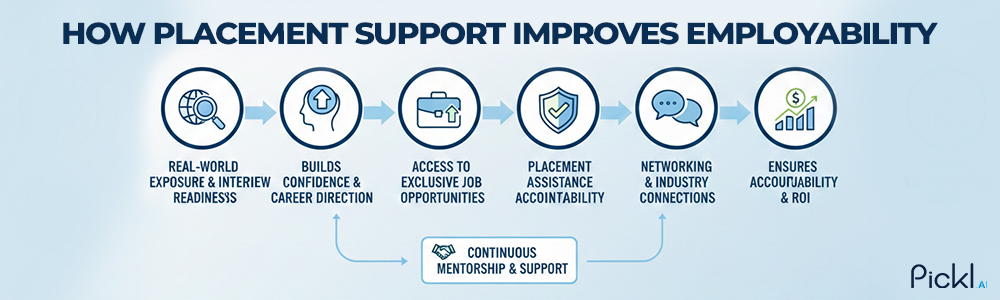
Employability is not just about knowing how to code or manage accounts; it is about how you function in a professional environment. A robust placement assistance program focuses on holistic development.
Employers today are looking for a mix of “hard skills” (technical knowledge) and “soft skills” (communication, teamwork). A significant 70% of corporate leaders report a critical skills gap in their organizations, specifically citing a lack of soft skills in new hires. Placement teams work tirelessly to fix this by offering:
- Resume Building: Crafting ATS-friendly resumes that get past automated filters.
- Soft Skills Training: Workshops on communication, email etiquette, and workplace adaptability.
- Personal Branding: Helping students optimize their LinkedIn profiles to attract recruiters.
Real-World Exposure and Interview Readiness
One of the biggest hurdles for job seekers is the fear of the unknown. “What will the interviewer ask?” “How do I solve a coding problem on a whiteboard?”
Placement assistance removes this anxiety through rigorous preparation. Standard courses might end with a final exam, but a course with placement support continues until you are job-ready.
- Mock Interviews: You undergo simulated interviews with industry experts who provide feedback on your body language, technical answers, and tone.
- Aptitude Training: Many technical roles require passing an initial aptitude test. Placement programs often include dedicated modules for this.
- Capstone Projects: Placement teams often encourage “live projects” that mimic real office challenges, giving you talking points that impress interviewers more than textbook theory.
Builds Confidence and Career Direction
Job hunting is mentally exhausting. Rejection emails can chip away at your self-esteem. A dedicated placement program provides a support system that keeps you motivated.
Mentors in these programs act as career counselors. They help you identify your strengths. For example, if you are learning Digital Marketing but are better at analytics than content writing, they will steer you toward SEO or Data Analytics roles. This clarity builds confidence, ensuring you apply for roles where you are most likely to succeed.
Access to Exclusive Job Opportunities
Did you know that a large percentage of job openings are never published on job portals like Indeed or LinkedIn? This is known as the “hidden job market.”
Institutes with a strong placement assistance team have tied up with hundreds of hiring partners. These companies often prefer hiring directly from training institutes to save time and ensure they get trained candidates.
- Direct Line to HR: Your resume is often sent directly to the hiring manager, bypassing the pile of thousands of online applicants.
- Exclusive Drives: Many institutes organize “placement drives” where multiple companies visit to hire their students exclusively.
Placement Assistance Ensures Accountability
When you learn on your own (self-paced learning), it is easy to slack off. However, when you are part of a placement assistance program, the institute takes partial responsibility for your success.
They track your progress, ensure you complete your assignments, and monitor your interview performance. If you fail an interview, the placement team analyzes why—was it a technical error or a communication issue?—and helps you fix it before the next opportunity. This accountability ensures you are constantly improving.
Networking and Industry Connections
In the professional world, who you know is often as important as what you know. Data suggests that professional connections and referrals account for nearly 25% of successful job placements, often weighing more than the degree itself.
Placement assistance opens the door to a powerful network:
- Alumni Networks: You get connected with past students who are already working in top companies.
- Guest Lectures: Frequent interactions with industry leaders who conduct workshops.
- Corporate Tie-ups: Direct access to recruitment teams from top MNCs and startups.
Ensures Accountability and ROI
Education is an investment of both time and money. The ultimate Return on Investment (ROI) is a high-paying job.
Courses with placement assistance might cost slightly more than basic courses, but the financial payoff is significantly higher. Research on employment services shows that job seekers who receive individualized staff assistance (like placement support) can earn up to 20% more on average than those who navigate the market alone.
The placement team ensures that your investment yields returns by negotiating better salaries and helping you understand industry standards so you don’t settle for less than you deserve.
Continuous Mentorship and Support
Support shouldn’t end the day you finish your final class. The best placement programs offer continuous mentorship.
Even after your course is over, placement officers remain in touch. They share job openings, help you customize cover letters for specific roles, and offer moral support during dry spells in the job market. This long-term association transforms the institute from a mere service provider into a lifelong career partner.
Conclusion
In a world saturated with degrees and certifications, placement assistance is the differentiator that fast-tracks your career. It bridges the gap between being a student and becoming a professional. From building a stellar resume to prepping you for high-pressure interviews and providing access to exclusive job openings, the value of a structured placement program is undeniable.
If you are looking to upskill, don’t just look for a course syllabus; look for a partner that is committed to your career success.
Frequently Asked Questions
What services are typically included in a placement assistance program?
A standard placement assistance program includes resume and LinkedIn profile building, soft skills and communication training, mock interviews, aptitude test preparation, and scheduling interviews with hiring partners.
How long does the placement support last after the course ends?
This varies by institute, but most reputable programs offer support for 3 to 6 months after course completion. Some “pay after placement” models offer support until you land a job.
Is placement assistance helpful for students from non-IT backgrounds?
Absolutely. In fact, it is even more critical for non-IT students entering tech fields. The placement team helps highlight your transferable skills and prepares you to answer questions about your career transition confidently.
Why is placement assistance important in IT training?
The IT industry evolves rapidly. A placement program ensures you are aware of the latest hiring trends (like AI tools or specific coding frameworks) and gives you access to technical mock interviews that mirror the rigorous selection process of tech giants.
Author
-

Written by:
Neha Singh


