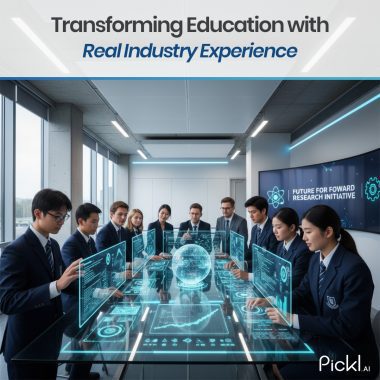

Summary: This article explores the evolution of Industry-Academia Partnerships and their role in bridging the skills gap. It discusses why companies invest in universities, highlights successful models like Pickl.AI’s collaboration, and examines how these alliances improve student employability while driving scientific research and innovation in India’s education sector.
Introduction
For decades, the worlds of industry and academia operated in parallel universes. Universities focused on theoretical knowledge and research for research’s sake, while corporations focused on quarterly profits and immediate problem-solving. But as technology accelerates and the skills gap widens, these two worlds are colliding in the best way possible.
Today, Industry-Academia Partnerships are no longer just a “nice-to-have” philanthropic gesture; they are a strategic necessity driving innovation, economic growth, and most importantly, student success.
The Evolution of Industry Partnerships with Universities
The relationship between companies and colleges has undergone a massive transformation. In the mid-20th century, industry partnerships with universities were largely transactional. A company might donate equipment to a lab or sponsor a generic scholarship in exchange for a tax write-off. Interaction was minimal, and the curriculum remained largely untouched by market realities.
However, the 21st century brought a paradigm shift. The rise of the knowledge economy meant that businesses could no longer afford to retrain every graduate from scratch. They needed day-one readiness. This demand forced a move from “sponsorship” to “collaboration.”
We are now seeing deep integration where industry experts co-design curricula, companies set up labs on campuses, and universities function as R&D extensions for corporate giants. This evolution has turned campuses into innovation hubs where students don’t just learn about the future—they build it.
How Students Win: The Direct Impact on Student Success
When an industry-academia partnership is executed well, the biggest winner is the student. The benefits go far beyond a degree certificate:
Bridge to Employability
Students gain exposure to real-world tools and workflows, moving beyond outdated textbook theories. This dramatically reduces the “training period” companies typically need for new hires.
Access to Mentorship
Partnerships often bring industry leaders into the classroom as guest lecturers or mentors, providing students with career guidance that academic faculty alone cannot offer.
Live Projects and Internships
Instead of hypothetical case studies, students work on live industry problems. This experience is invaluable for building a portfolio that stands out to recruiters.
Networking Opportunities
Direct interaction with corporate partners opens doors to unadvertised job openings and professional networks early in a student’s career.
Why Companies Are Investing in Academic Alliances

Why are global giants and agile startups alike pouring millions into industry partnerships? The answer lies in the “Talent War.”
Building a Talent Pipeline
By partnering with universities, companies get “first dibs” on top talent. They can mold students during their formative years, ensuring a steady stream of graduates who possess the exact niche skills the company needs.
Cost-Effective R&D
Establishing a dedicated R&D facility is expensive. Partnering with a university allows companies to leverage state-of-the-art academic infrastructure and the intellectual power of faculty and PhD scholars at a fraction of the cost.
Fostering Innovation
Academics often approach problems with a fresh, theoretical perspective that can break corporate groupthink. This synergy often leads to breakthrough innovations in product and process.
Corporate Social Responsibility (CSR)
Beyond profit, contributing to education aligns with global CSR goals, enhancing a brand’s reputation as a socially responsible leader.
Types of Successful Collaborations
Collaborations today come in various shapes and sizes, ranging from research parks to curriculum integration. A prime example of a model that directly impacts employability is Pickl.AI’s partnership with colleges.
Pickl.AI: A Case Study in Skill-Building
Pickl.AI has redefined industry partnerships with universities by moving beyond the traditional workshop model. Their collaboration focuses on a deep-dive integration into the college ecosystem.
Industry-Oriented Curriculum
Pickl.AI works with faculties to update outdated syllabi with cutting-edge Data Science and AI modules used in the actual workforce.
Capstone Projects
Students don’t just learn code; they solve real business datasets, simulating the pressure and complexity of a corporate analyst role.
Job Guarantee
Perhaps the most significant commitment is their focus on outcomes. By aligning training strictly with market needs, they bridge the gap so effectively that they can offer job guarantee programs—a testament to the confidence they have in their industry-aligned pedagogy.
This model proves that when industry actively participates in the “skilling” process, the employability gap doesn’t just shrink; it disappears.
Key Sectors Leading the Way
While every sector benefits from academic alliances, a few are spearheading this trend in 2024-2025:
Biotechnology & Pharma
With the race for personalized medicine and gene therapy, companies are heavily relying on university labs for early-stage discovery.
Artificial Intelligence & Data Science
The rapid evolution of AI means textbooks are obsolete before they are printed. Tech giants partner with institutes to ensure students are learning the current state of the art, not the history of it.
Renewable Energy
Achieving “Net Zero” requires massive innovation. Energy companies are funding university research into green hydrogen, battery storage, and sustainable materials.
Semiconductors
With national missions like the India Semiconductor Mission, there is a surge in partnerships to train engineers in chip design and fabrication, a highly specialized field.
Evolution of Industry-Academia Partnerships for Scientific Research and Innovation in India
India is currently witnessing a golden age of industry-academia partnership, driven by policy and necessity. Historically, Indian research was largely government-funded and confined to labs like CSIR or DRDO. However, the landscape is shifting.
Policy Catalysts:
National Education Policy (NEP) 2020
The NEP explicitly mandates the creation of Research and Development (R&D) cells in colleges and encourages internships, making industry interaction a core part of the curriculum.
Anusandhan National Research Foundation (ANRF)
With a corpus of ₹50,000 crore (largely sourced from industry contributions), ANRF aims to fund research that has direct industrial applications, forcing a handshake between professors and CEOs.
Innovation Hubs
Initiatives like the IIT Madras Research Park serve as beacons, where startups and corporate R&D centers sit inside the university campus, allowing for seamless knowledge transfer.
This evolution signifies a move from “brain drain” to “brain gain,” where Indian universities are becoming hotbeds for global innovation, supported by active industry participation.
Conclusion
The future of education is collaborative. Industry-Academia Partnerships are the bridge that connects the potential of youth with the power of the economy. For students, these alliances mean the difference between having a degree and having a career.
For companies, they represent survival and growth in a talent-starved world. As models like Pickl.AI demonstrate, when the classroom meets the boardroom, the result is a workforce that is not just ready for the future, but capable of shaping it.
Frequently Asked Questions
Which industries are most active in university partnerships?
The technology sector (specifically AI and Data Science), Biotechnology/Pharmaceuticals, and Engineering (Semiconductors and Renewable Energy) are currently the most active. These fields evolve rapidly, requiring a constant influx of fresh, specialized talent that only universities can provide.
How do industry-academia partnerships benefit students specifically?
These partnerships provide students with practical, hands-on experience through internships and live projects, access to industry mentors, and up-to-date curricula. This significantly boosts their employability, professional network, and readiness for the corporate world.
How can we enhance industry-academia collaboration?
Enhancement requires a shift from transactional to strategic relationships. Universities should offer flexible curricula that can adapt to industry feedback. Governments can incentivize these partnerships through funding (like the ANRF in India) and tax benefits. Companies, in turn, need to view universities not just as recruitment centers but as long-term R&D partners.
Author
-

Written by:
Neha Singh