
Summary: This blog explores how universities integrate industry certification to boost employability. It highlights the “Triple Win” for students, universities, and employers, using examples like Pickl.AI. Learn how bridging academic theory with professional skills creates valuable degrees and workforce-ready graduates in a changing job market.
Introduction
The job market is changing fast. A few decades ago, a university degree was the golden ticket to a good job. Today, it is still important, but often it is not enough. Employers are looking for more than just theory. They want proof of practical skills. This shift has placed a spotlight on the industry certification.
Universities face a challenge. They must ensure their graduates are ready for work on day one. To do this, many higher education institutions are integrating industry certification programs directly into their degrees. This strategy bridges the gap between academic learning and real-world application. It transforms a standard degree into a powerful career tool.
What Are Industry Certifications and Why They Matter
An industry certification is a credential that verifies a person’s knowledge or skills in a specific area. Unlike a broad university course, these certifications are often created by leading companies or professional associations. Think of Google, Microsoft, or specialized trade bodies.
They matter because they are standard. An employer in India knows that a specific cloud computing certification means the same thing as it does in the USA. It provides immediate validation. When a student lists a recognized industry certification on their resume, they are telling recruiters, “I have the specific skills you need right now.” This reduces the risk for hiring managers.
The Role of University-Industry Partnerships in Curriculum Design
To offer these certifications, schools need help. This is where university-industry partnerships come into play. Universities are experts in pedagogy and foundational knowledge. Companies are experts in current market trends. When they work together, the result is a dynamic curriculum.
A great example of this is the collaboration between ed-tech platforms and higher education. Take Pickl.AI, for instance. Pickl.AI collaborates with colleges and universities to promote curriculum upgrades on trending technologies like Data Science. By partnering with an industry-focused organization, universities can inject real-world projects and updated tools into their classrooms. This ensures the syllabus does not become outdated. It allows students to work on live problems while earning their degree.
These collaborations ensure that the university industry relationship is active, not passive. It moves beyond guest lectures to co-created content that leads to tangible credentials.
How Embedded Industry Certifications Enhance Degree Value
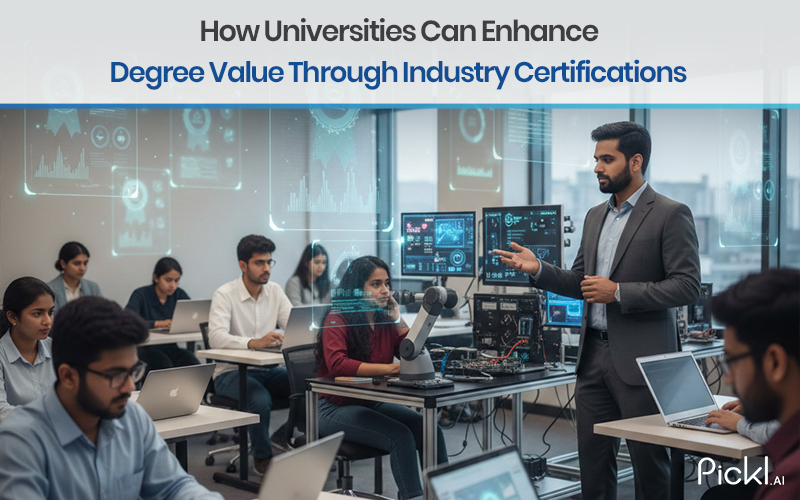
When a university embeds an industry certification into a degree, it adds a layer of practical value. Students do not just graduate with a Bachelor’s or Master’s. They graduate with a degree plus a recognized professional credential.
This dual-qualification approach saves time and money. Students do not have to seek out these certifications after graduation. They earn them as part of their coursework. For example, a marketing course might include a digital marketing certification from a major platform. An accounting degree might integrate modules that count towards CPA or ACCA qualification. This makes the degree itself more valuable. It gives the university a unique selling point in a crowded education market.
Why the Traditional Degree Is No Longer Enough
The pace of technology is the main driver here. In fields like IT, engineering, and finance, tools change every year. A textbook written five years ago might be obsolete today. A traditional degree takes three to four years to complete. By the time a student graduates, the skills they learned in year one might be old news.
This is why the traditional model struggles alone. Employers are skeptical. They often find that graduates have great theoretical knowledge but lack technical proficiency. They cannot wait six months to train a new hire. They need someone who can hit the ground running. An industry certification proves that the candidate is up-to-date with current standards. It fills the “skills gap” that many employers complain about.
Professional Skill Certifications: A Bridge Between Academia and Employment
Professional skill certifications act as a bridge. On one side, you have the deep, critical thinking skills provided by a university. On the other side, you have the specific technical demands of a job. Certifications connect the two.
For instance, a computer science student understands algorithms (Academic). But do they know how to deploy code on a specific cloud platform (Industry)? Professional skill certifications answer “yes.” They focus on competency. They require students to pass exams that test their ability to perform tasks. This practical focus is often missing in purely academic environments. By adding these to the mix, universities ensure their students are not just educated, but employable.
The Triple Win: Benefits for Students, Universities, and Employers
Integrating industry certification creates a “Triple Win” scenario. Everyone involved benefits from this model.
For Students
They get a competitive edge. They leave school with a portfolio of credentials. This leads to higher starting salaries and faster hiring. It also builds confidence. They know they have met global standards.
For Universities
It boosts enrollment. Students are smart shoppers. They look for programs that offer the best return on investment. A university that offers built-in industry certification tracks is more attractive. It also improves graduate employability stats, which boosts rankings.
For Employers
Recruitment becomes easier. When they see a specific certification, they know the candidate has the baseline skills. It reduces the cost of onboarding and training. They get access to a pool of talent that is “work-ready.”
The Future: Certification-Driven Higher Education
The landscape of university industry relations is shifting toward a hybrid model. We are moving toward “certification-driven” higher education. In the future, we may see degrees that are essentially stacks of certifications tied together with capstone projects.
This supports the idea of lifelong learning. Professionals will return to universities not just for full degrees, but for specific, high-level certifications to update their skills. The university becomes a hub for continuous professional development. This keeps the alumni network strong and ensures the university stays relevant throughout a person’s career.
Strategic Models for Implementing Industry Certifications
How can universities actually do this? There are several models to implement industry certification pathways.
The Elective Model
Universities offer certification courses as electives. Students choose them based on their career interest.
The Bootcamp Model
Short, intensive workshops run during semester breaks. These focus entirely on passing a specific certification exam.
The Integrated Core
The hardest but most effective model. Here, the industry syllabus is woven into core subjects. For example, a Data Science module is designed using the curriculum from partners like Pickl.AI. The final exam for the course might also serve as the qualification exam for the certification.
These models allow universities to remain flexible. They can swap out certifications as technology changes without overhauling the entire degree program.
Conclusion
The era of the standalone degree is ending. To remain relevant, universities must embrace the industry certification. By partnering with forward-thinking organizations and integrating professional skill certifications, higher education can reclaim its promise of career readiness.
Collaborations, such as those seen with Pickl.AI, show the way forward. They demonstrate how academia can pivot to meet market needs. For university leaders, the path is clear. Enhance your degrees with industry credentials. It is the best way to serve your students and secure the future of your institution.
Frequently Asked Question
What is the difference between a degree and an industry certification?
A degree provides a broad education. It focuses on theory, critical thinking, and foundational knowledge over several years. An industry certification is a specific credential. It validates a distinct skill set or mastery of a specific tool, often based on current market standards.
How could this industry certification benefit you and your personal career goals?
Earning an industry certification shows employers you have practical, up-to-date skills. It can help you stand out in a pile of resumes. It often leads to better job roles, higher pay, and faster career advancement because it proves you are ready to work immediately.
How do industry certifications enhance a university degree?
They add practical value to academic theory. By earning a certification alongside a degree, students prove they can apply what they have learned. It bridges the gap between the classroom and the workplace, making the degree more valuable to potential employers.
Author
-

Written by:
Neha Singh