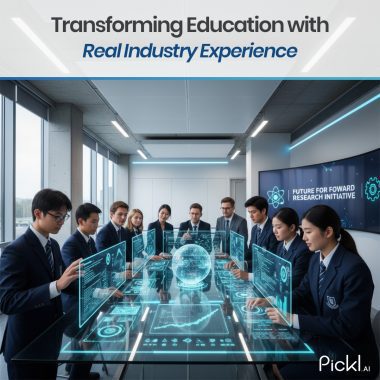

Summary: The modern academic system is now inclining towards industry partnership that promotes practical learning and putting theory into practice. These partnerships accelerate technological breakthroughs, provide students with real-world experience, and solve complex industrial challenges. By pooling resources and expertise, they foster economic growth and create societal value, turning academic insights into impactful, market-ready solutions.
Introduction
In today’s rapidly evolving global economy, innovation does not happen in a vacuum. It requires a synergy between deep theoretical knowledge and practical, real-world application. This is where academic industry collaboration comes into play.
For decades, universities and corporations operated in separate silos. Universities focused on fundamental research and education, while companies focused on product development and profit. However, as technology advances at breakneck speed—particularly in fields like Artificial Intelligence (AI) and Data Science—the lines are blurring.
Today, academic industry collaboration is no longer a luxury; it is a necessity. It is the engine driving workforce readiness, cutting-edge research, and economic growth. This blog explores how these partnerships create tangible impact, the best practices to sustain them, and real-world examples of how they are shaping the future of education.
Understanding Academic Industry Collaboration
Academic industry collaboration refers to the strategic interaction between higher education institutions and business entities. These partnerships can take many forms, ranging from simple internship programs and guest lectures to complex joint research and development (R&D) projects and co-designed curricula.
The goal is mutual benefit. Universities gain access to industry resources, funding, and real-world data, while industries gain access to top-tier talent, cutting-edge research facilities, and fresh perspectives on solving complex business problems. When these two sectors align, they create a bridge that connects the classroom to the boardroom.
Why Academic Industry Collaboration Matters Today
The landscape of work is changing. According to the World Economic Forum, nearly half of all employees will need reskilling by 2025. Traditional academic curriculums often struggle to keep pace with these shifts.
Academic industry collaboration matters because it accelerates the transfer of knowledge. It ensures that the skills being taught in lecture halls are the same skills required in the job market. Without this collaboration, we face a widening “skills gap,” where graduates struggle to find employment despite having degrees, and employers struggle to find qualified candidates despite having open positions.
Key Areas Where Industry–Academia Collaboration Creates Impact
The impact of these partnerships is far-reaching. It transforms how institutions function, how research is conducted, and how students learn.
Academic Leaders Need a Better Understanding of Benefits
For a partnership to succeed, buy-in must start at the top. Academic leaders need a better understanding of how partnerships with business benefit their institutions and society.
Often, universities view industry ties solely as a source of funding. However, the impact goes deeper. Collaborations enhance the reputation of the university, making it more attractive to prospective students.
When a college is known for placing students in top tech firms or leading groundbreaking industrial research, its brand value skyrockets. Furthermore, these partnerships help universities fulfill their social mission by driving local economic development and fostering innovation ecosystems.
Exchange of Information Creates New Knowledge
One of the most profound impacts occurs in research. When companies and universities collaborate on projects, their exchange of information creates new knowledge for both organizations.
In a siloed environment, academic research might remain theoretical, published in journals, but never applied. Conversely, corporate R&D can become tunnel-visioned, focusing only on immediate product updates. Collaboration breaks these barriers.
Academics get to test their theories on real-world datasets provided by companies. In return, companies gain access to rigorous scientific methodology and “blue sky” thinking that can lead to disruptive innovations rather than just incremental improvements.
Enhancing Curriculum and Employability: The Pickl.AI Example
Perhaps the most direct impact of academic industry collaboration is on student employability. A prime example of this is the work being done by Pickl.AI.
Recognizing the massive demand for skilled Data Science professionals, Pickl.AI has strategically partnered with several colleges to bridge the gap between theory and practice. These collaborations focus on enhancing the existing curriculum with industry-relevant modules.
Through these partnerships, Pickl.AI ensures that students are not just learning textbook statistics but are applying machine learning models to real datasets. They provide mentorship, capstone projects, and industry insights that faculty alone might not be able to offer.
The result? A workforce that is “day-one ready.” Students graduating from these collaborative programs possess the practical skills employers crave, significantly boosting their employability and career trajectories.
Best Practices for High-Impact Academic-Industry Collaboration
To replicate success stories like Pickl.AI’s, institutions and companies must follow a structured approach. Here are the academic industry collaboration best practices:
Define Clear Objectives
Both parties must agree on what success looks like. Is it about hiring students? Is it about patenting a new technology? Ambiguity leads to failure.
Align Time Horizons
Academics often work on multi-year timelines, while businesses work in quarters. Best practices involve setting milestones that satisfy the corporate need for speed while respecting the academic need for rigor.
Establish Intellectual Property (IP) Frameworks Early
Disputes over who owns the research output can kill a partnership. Clear contracts regarding IP rights are essential from day one.
Foster Personal Relationships
Successful collaboration is people-centric. Encouraging regular interaction between faculty and industry professionals builds trust and understanding.
Create Mutual Value
The partnership must be a two-way street. If one side feels they are giving more than they are getting, the collaboration will fizzle out.
Challenges and How to Overcome Them
Despite the clear Industry-academia collaboration benefits, obstacles remain.
Cultural Differences
Universities value open knowledge and publication; companies value secrecy and competitive advantage.
Solution: Create “safe zones” for pre-competitive research where findings can be shared, while protecting proprietary data for later stages.
Bureaucracy
Universities can be slow to approve contracts, frustrating agile businesses.
Solution: Streamlined administrative processes and dedicated liaison officers can speed up decision-making.
Curriculum Rigidity
Changing a university syllabus can take years.
Solution: Introduce “micro-credentials” or elective modules run by industry partners (like the Pickl.AI model) which are easier to implement than changing core degree requirements.
The Future of Academic Industry Collaboration

The future of academic industry collaboration is integrated and immersive. We are moving away from the transactional model (where a company simply donates money) to a transformational model.
In the future, we will see more “Innovation Hubs” where companies literally set up offices on university campuses. We will see the rise of “professors of practice”—industry veterans who teach part-time. Digital platforms will allow for global collaboration, connecting a university in India with a tech firm in Silicon Valley seamlessly.
Furthermore, as lifelong learning becomes the norm, universities and industries will co-create continuous learning pathways, ensuring that the workforce can upskill rapidly in response to new technologies.
Conclusion
The synergy between education and enterprise is the key to unlocking potential. Academic industry collaboration is more than just a buzzword; it is a strategic imperative for a robust economy.
By fostering open exchange, respecting the strengths of both sectors, and focusing on student outcomes—as demonstrated by initiatives like those of Pickl.AI—we can create a world where education leads directly to impact. For universities, the message is clear: the ivory tower is a thing of the past. The future belongs to the connected campus.
Frequently Asked Questions
What is the impact of industry partnerships on research?
Industry partnerships accelerate the application of research. They provide academics with real-world data and funding, ensuring that scientific discoveries are translated into tangible products and solutions that benefit society.
Why is industry collaboration important for universities?
Collaboration is vital because it keeps the curriculum relevant. It provides universities with financial resources, boosts their reputation, and drastically improves the employability of their graduates, which in turn attracts more students.
How do academic-industry collaborations benefit students?
Students gain hands-on experience through internships and live projects. They get exposure to the latest tools and technologies used in the corporate world, and they build a professional network before they even graduate.
Which industries collaborate most with universities?
Currently, the technology, pharmaceutical, biotechnology, and engineering sectors are the most active collaborators. This is driven by the rapid pace of innovation and the high demand for specialized research in these fields.
How can universities build strong industry partnerships?
Universities can build strong partnerships by adopting academic industry collaboration best practices. This includes aligning their research capabilities with industry needs, simplifying administrative processes, and creating dedicated engagement centers to manage relationships with corporate partners.
Author
-

Written by:
Neha Singh