
Summary: University–industry collaboration closes the skills gap by aligning academic curricula with real-world tech demands. By integrating industry instructors and practical projects, students gain job-ready expertise. Programs like Pickl.AI facilitate this by upgrading faculty skills, ensuring that higher education evolves at the same rapid pace as the AI industry.
Introduction
The world of work is changing faster than ever. New technologies like Artificial Intelligence (AI) and data science are reshaping industries. However, there is a major problem. Employers often cannot find workers with the right skills. At the same time, many graduates struggle to find jobs. This problem is known as the “skills gap.”
How do we fix this mismatch? The answer lies in academic industry collaboration.
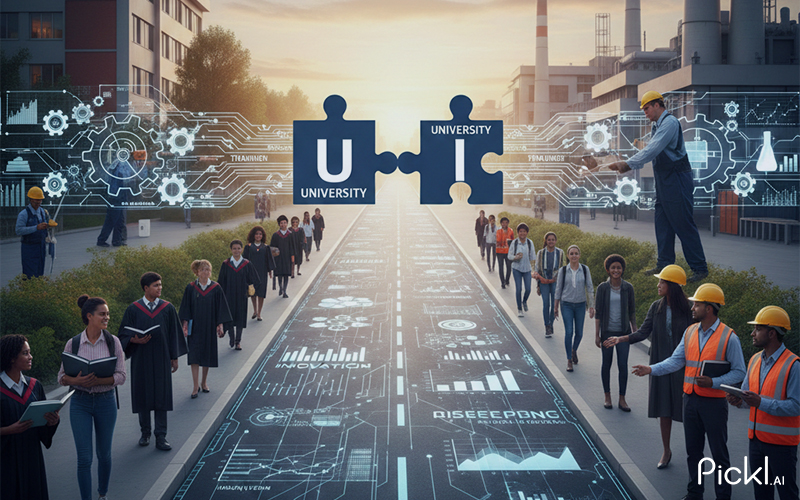
When universities and businesses work together, they create a bridge. This bridge connects classroom theory with real-world practice. It ensures that students learn what employers actually need. In this blog, we will explore how academic industry collaboration is closing the skills gap and preparing the workforce of the future.
Understanding the Skills Gap
Before we look at the solution, we must understand the problem. The skills gap is the difference between the skills employers need and the skills job seekers have.
For a long time, universities focused heavily on theory. They taught students about things, but not always how to do them. Meanwhile, industries evolved rapidly. A textbook written five years ago might be outdated today. This leaves graduates unprepared for modern roles.
The skills gap affects everyone. Companies lose money because positions stay open. Students face frustration because their degrees do not lead to jobs. To solve this, education and business must stop working in silos. They must embrace academic industry collaboration.
| Technology Domain | Estimated Skill Gap / Shortage | Key Statistic |
| AI / GenAI | 51% Gap | 1 qualified candidate for every 10 open roles. |
| Cloud Computing | 55-60% Gap | Need for 2 million professionals by 2025. |
| Cybersecurity | 30% Deficit | 1.5 million professionals needed immediately. |
| Overall Employability | ~42.6% | Only ~42% of Indian graduates are considered “employable” for modern tech roles. |
The Role of University–Industry Collaboration in Closing the Skills Gap
University-industry collaboration acts as a feedback loop. Companies tell universities what skills are missing in the market. Universities then adapt their teaching to meet those needs.
This partnership transforms education. It moves learning from a static process to a dynamic one. It ensures that a degree is not just a piece of paper. Instead, it becomes a certificate of employability. By aligning goals, both sectors can create a talent pool that is ready for day one on the job.
Key Ways University–Industry Collaboration Helps Bridge the Skills Gap
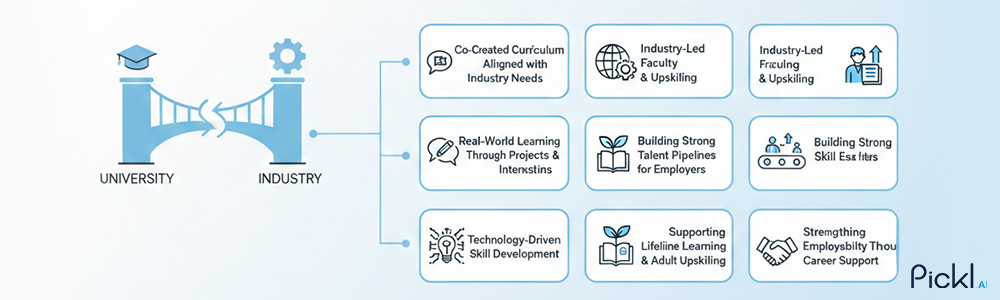
There are several methods universities and companies use to work together. Here are the most effective ways this partnership closes the gap.
Co-Created Curriculum Aligned with Industry Needs
One of the most impactful forms of academic industry collaboration is curriculum design. In the past, professors designed courses alone. Now, industry leaders sit at the table. They suggest new topics and remove outdated ones.
For example, a tech company might help a university update its computer science program to include the latest coding languages. This ensures that what students learn is relevant today, not yesterday.
Real-World Learning Through Projects & Internships
Theory is important, but practice is vital. Collaborations open doors for “experiential learning.” This means learning by doing.
Universities partner with firms to offer internships, apprenticeships, and live projects. Students get to work on real business problems. They use the same tools professionals use. This experience is invaluable. It helps students understand workplace culture and expectations before they graduate.
Industry-Led Faculty Training & Upskilling
It is not just students who need to learn. Professors must stay updated too. If a teacher has not worked in the industry for 20 years, they might teach outdated methods.
Strong partnerships involve faculty immersion programs. Professors might spend a summer working at a partner company. Alternatively, industry experts might come to the university as guest lecturers. This exchange of knowledge keeps the teaching faculty sharp and relevant.
Building Strong Talent Pipelines for Employers
Recruiting is expensive and time-consuming. Academic industry collaboration streamlines this process.
When a company partners with a university, they get early access to top talent. They can spot high-performing students during internships. This creates a direct pipeline. For the student, it means a job offer before graduation. For the company, it means hiring someone they already trust.
Technology-Driven Skill Development
Modern jobs require modern tools. However, university labs can be expensive to upgrade. Industry partners often step in to help.
Companies may donate software licenses or hardware to universities. For instance, an engineering firm might provide a university with the latest 3D printing technology. This ensures students train on the exact equipment they will use in their careers.
Supporting Lifelong Learning & Adult Upskilling
The skills gap does not just affect young students. Current employees need to learn new skills too.
Universities and industries are working together to offer short courses and certificates. These are often called “micro-credentials.” An accountant might take a short university course on data analytics, sponsored by their employer. This keeps the existing workforce competitive.
Strengthening Employability Through Career Support
Getting a job requires more than technical skills. It requires “soft skills” like communication, teamwork, and problem-solving.
Industry partners often run workshops on campus. They conduct mock interviews and resume reviews. They teach students how to navigate the corporate world. This mentorship boosts confidence and employability.
Benefits for Universities, Students, and Employers
When collaboration works well, everyone wins. Here is a look at the Industry-academia collaboration benefits:
- For Students: They gain relevant skills and higher employability. They graduate with a network of professional contacts.
- For Universities: They improve their reputation. A university with high job placement rates attracts more students. They also gain access to industry funding and resources.
- For Employers: They get a workforce that is “job-ready.” They spend less time and money on training new hires. They also get fresh ideas from students and researchers.
Challenges in Closing the Skills Gap and How to Overcome Them
While the benefits are clear, collaboration is not always easy. Universities and businesses operate differently. Universities move slowly and value academic freedom. Businesses move fast and value profit.
Common Challenges:
- Time Horizons: Research takes time, but business needs are immediate.
- Intellectual Property (IP): Who owns the results of a joint project?
- Culture Clash: different terminologies and priorities.
Overcoming these challenges
To succeed, partners should follow academic industry collaboration best practices. This includes setting clear goals from the start. Both sides must agree on timelines and IP rights. Regular communication is key. Building trust takes time, but it is the foundation of success.
The Future of University–Industry Collaboration
The future of work is hybrid and digital. Therefore, the future of education must be the same.
We will likely see more “embedded” degrees. This is where a student spends half their time at university and half at a company. Online learning will also play a bigger role. Industry experts will teach global classrooms via Zoom or VR.
As AI changes jobs, the need for reskilling will grow. Academic industry collaboration will become a lifelong partnership, not just a one-time degree.
Conclusion
The skills gap is a major challenge, but it is solvable. It requires a shift in mindset. Education and industry can no longer live in separate worlds. They must merge.
Academic industry collaboration is the most effective tool we have to close the skills gap. By co-creating curriculums, offering real-world experience, and sharing resources, we can build a stronger workforce. This partnership ensures that students are not just educated, but empowered to succeed in the modern economy.
Frequently Asked Questions
How does university–industry collaboration help close the skills gap?
It helps by aligning what is taught in schools with what is needed in jobs. Through academic industry collaboration, universities update their courses based on employer feedback. This ensures graduates have the specific technical and soft skills that companies are looking for.
What types of university–industry collaborations work best?
The most effective collaborations are long-term partnerships. These include joint research projects, student internships, and co-designed curriculums. Following academic industry collaboration best practices, such as clear communication and shared goals, ensures these partnerships succeed.
What industries face the biggest skills gaps?
Currently, the technology sector faces the largest gap, specifically in AI, cybersecurity, and data science. However, manufacturing, healthcare, and green energy sectors also face significant shortages of skilled workers.
How do industry partnerships improve employability?
Partnerships give students hands-on experience. When students work on real industry projects, they build a portfolio. Networking with professionals during their studies also makes it easier to find a job after graduation. One of the main Industry-academia collaboration benefits is a smoother transition from student to employee.
Author
-

Written by:
Neha Singh