
AI Project Ideas for College Students
Summary: AI projects are integral for anyone who wants to make a career in the AI domain. These…
Summary: AI projects are integral for anyone who wants to make a career in the AI domain. These are important for anyone who wants to boost their portfolio and enhance their resume. This blog illustrates some of the key aspects that one must take into consideration when choosing an AI project for their portfolio.
Introduction
AI projects are a valuable addition that is non-negotiable. Anyone who is willing to make a career in the AI domain, or someone who is pursuing a course in this segment, should focus on working on AI projects that highlights their learnings and skills.
AI projects validate what learners can actually build and solve. Hence, it becomes as integral as building an ATS-based resume. For higher education institutions and training providers, introducing project-based learning becomes integral for strengthening the employability of the students.
Today, the market is highly competitive and companies are aggressively switching to AI, they are looking for individuals who can work along with these changing trends. The AI projects showcase how well they can use AI to create innovative solutions. It gives recruiters tangible evidence of their problem-solving, technical, analytical and application-oriented skills.
The focus, therefore, should not simply be on adding AI projects to a curriculum, but on designing projects that mirror the kinds of challenges learners are likely to encounter in the workplace. This is where industry-academia collaboration can play a critical role: bringing real datasets, business use cases, industry mentorship and practical evaluation into the learning experience.
The result is a more meaningful measure of AI readiness, one where learners don’t just say they know AI, but can demonstrate what they can build, solve and deliver with it.
What Makes a Good AI Project for Students?
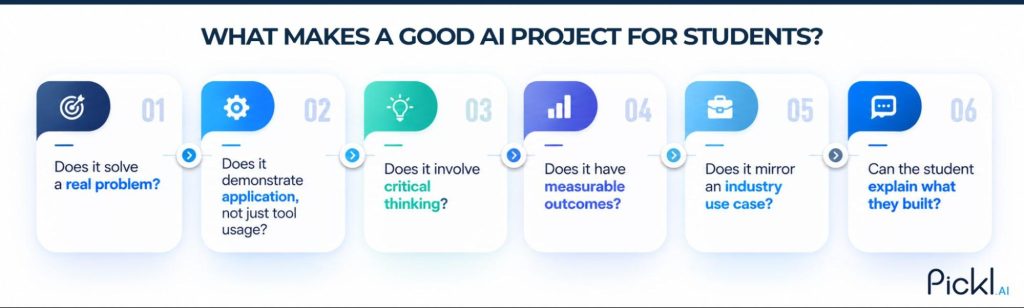
A good AI project should focus on solving the key problems that have not been addressed till now. The use of AI is more than simply writing the emails, or follow ups or creating videos. The potential is endless; a promising candidate should be able to harness the endless capacity of AI and channel it in creating workflows and solutions that can solve real-world problems.
Here are some of the key pointers you should add to the checklist before deciding on AI projects that showcase how effectively a student can turn AI capabilities into a practical, scalable and relevant solution.
Does it solve a real problem?
Is the AI project focusing on real-world problems, is the student able to identify the challenging situation at the ground level.
Does it demonstrate application, not just tool usage?
Using ChatGPT or another AI platform is not, by itself, an AI project. Students should demonstrate how they have integrated AI into a meaningful solution or workflow.
Does it involve critical thinking?
Students should be required to define the problem, evaluate possible approaches, make decisions, and justify why a particular AI approach was chosen.
Does it have measurable outcomes?
Wherever possible, projects should demonstrate improvements in efficiency, accuracy, cost, turnaround time, user experience, or another relevant metric.
Does it mirror an industry use case?
Projects based on business functions, operational challenges, or industry datasets can give students a stronger understanding of how AI moves from experimentation to implementation.
Can the student explain what they built?
The final project should enable students to clearly articulate the problem, methodology, AI tools or models used, limitations, results and potential business impact.
What are Some of the Key Flagship Capstone Projects?
They are important as they will eventually display how well the students have grasped the AI knowledge and how well they integrate their learnings into solving real-world problems.
The industry-academia partnership can be a great move to help the student actually understand the implementation part of AI learning. Pick one end-to-end project that shows problem framing, modelling, and deployment—exactly what Pickl.AI emphasises for career readiness.
Option A: Real-Time Fraud Detection with MLOps
- Problem: Classify transactions as fraud/not-fraud and serve predictions via an API with monitoring.coursera+2
- Why it fits Pickl.AI: Combines ML, APIs, containers, and monitoring—skills hiring teams look for in AI/ML roles.themlhub+1
- Tech stack: Python, scikit-learn/XGBoost, FastAPI, Docker, MLflow (optional), Prometheus/Grafana or a simple custom dashboard.coursera+2
- Dataset: Credit card fraud datasets (e.g., Kaggle European cards).
Option B: Student Performance Early-Warning System + Dashboard
- Problem: Predict at-risk students and provide a simple admin dashboard for interventions.
- Why it fits Pickl.AI: Strong education angle; easy to demo to non-technical stakeholders.
- Tech stack: Python, XGBoost/LightGBM, Streamlit/Flask, basic auth, CSV/DB ingestion.
Option C: Resume–Job Matcher with NLP + Simple UI
- Problem: Parse resumes, extract skills, and rank against job descriptions using embeddings + similarity.
- Why it fits Pickl.AI: Clear business value; great for showcasing NLP + product thinking.
- Tech stack: Python, spaCy, sentence-transformers/BERT, cosine similarity, Streamlit.
Frequently Asked Questions
What are AI projects?
AI projects are practical projects where students apply what they have learned about AI to solve real-world problems. It helps students turn theoretical knowledge into practical solutions using AI tools, techniques, and technologies.
What are some AI project ideas for college students?
Some of the AI projects on which college students can work include AI chatbot creation, recommendation systems, image analysis tools, etc. The right project depends on the student’s course, technical skills, and area of interest.
How do I choose an AI project as a college student?
While choosing AI projects, it is important to do a needs analysis. Once you are able to identify a problem, you will be able to apply the right set of tools to solve it. A good AI project should demonstrate both technical understanding and practical problem-solving.
Why should college students work on AI projects?
AI projects help students move beyond theoretical learning and gain hands-on experience. Real-world work scenario requires a mix of academic expertise and additional skills like problem-solving. These can be developed while working on a project, or during internships or by participating in datathons, etc.
How can students get real-world experience through AI projects?
Students can gain practical experience by building and publishing projects, participating in datathons and hackathons, taking up internships, and working on industry-led challenges.
Conclusion
AI projects are not an optional addition to your resume, rather it reflects the skill sets that one has gained while learning. Publishing the projects, working as interns, participating in datathons gives a real-world glimpse and prepares for the industry.
Platforms like Pickl.AI provide students with opportunities to gain industry exposure through internships, enabling them to apply their expertise to real-world cases, learn from practical experiences, and build skills that extend beyond the classroom.