
Key Components of a Successful AI Training Program in Higher Education
Summary: Universities are racing to build AI training programs that prepare students and faculty for an AI-driven job…

Summary: Universities are racing to build AI training programs that prepare students and faculty for an AI-driven job market. But not every program delivers results. This blog breaks down the key components curriculum structure, hands-on learning, faculty readiness, ethics, and continuous evaluation that separate a genuinely effective AI training program from a checkbox initiative.
Introduction
A successful AI training program has become crucial for the success of institutions. This is not just limited to AI training programs that encompass AI theories, programming language and finally wrapping it up with the project. We have witnessed a massive transformation in the placement and hiring landscape. Companies are hiring for AI literacy. This simply doesn’t mean having knowledge about the tool, but also how well they have integrated this technology into the real world.
It all started with early rule-based systems, to machine learning, to deep learning and neural networks, and now to AI that can write code, build programs from scratch, and self-improve. This pace of change is exactly why continuous learning and upskilling have become non-negotiable for long-term career growth.
It is not just limited to students, but even faculty are facing the challenge. A strong grasp of AI tools now shapes their career profile, regardless of whether they come from a technical or non-technical background. Everyone, across disciplines, is now expected to engage with AI in some form.
So, how are universities and colleges evolving in this landscape? This blog explores all the core components that make AI training programs in higher education successful.
Why Institutions Need Structured AI Training Programs
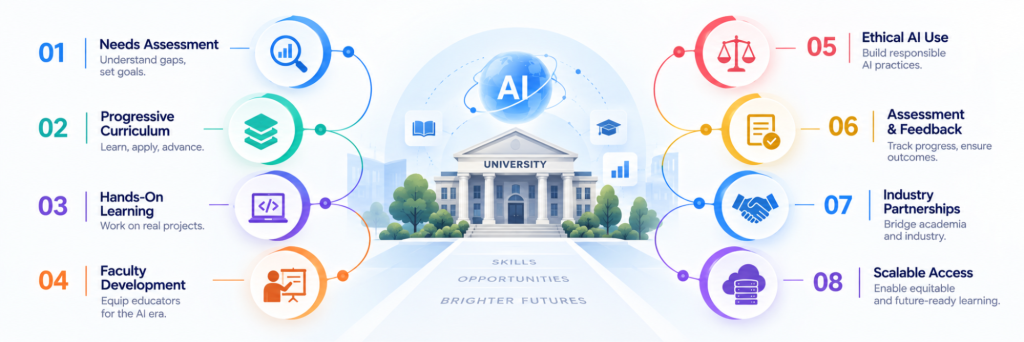
Institutions need to restructure and redesign their curriculum by embedding industry-oriented AI training programs. Developing a strong industry-academia partnership paves the way for growth that benefits both.
The traditional scattered approach: a guest lecture here, an optional elective that no longer meets industry expectations. Employers now expect graduates to walk in with complete knowledge of Gen AI literacy along with some additional expertise.
I know it may sound overwhelming, but we need to evolve with time. It begins with adopting the right changes. Integrating AI-based curriculum is one of the primary changes that needs to be done, while there are many other transformational moves that colleges and universities can adopt by incorporating industry-based curriculum, adding AI training programs led by industry experts, and many more.
1. Needs Assessment and Alignment with Institutional Goals
The work needs to be started from scratch; universities need to strike a balance between AI training programs and their current curriculum. The AI training should complement the current curriculum and improvise it. This makes the teaching and learning processes more effective.
- Current AI skill gaps among students and faculty
- Industry and recruiter expectations for graduating cohorts
- Departmental relevance (engineering AI needs differ vastly from humanities or business AI needs)
One of the key mistakes that most of the institutes do is have the one-size-fits all approach. They need to align the AI training program with their student’s requirements. The right industry-academia partnership fosters the same.
2. A Layered, Progressive Curriculum Design
Effective AI curriculum design doesn’t dump advanced tools on day one. It builds in layers:
- Foundational layer — what generative AI is, how large language models work, basic prompt literacy
- Applied layer — using AI tools for research, writing, coding, or discipline-specific tasks
- Advanced layer — building custom workflows, evaluating AI outputs critically, and understanding model limitations
This progressive structure is what separates true AI training programs from single-session awareness talks. Learners need scaffolding, not a single dose of exposure.
3. Hands-On, Experiential Learning
Theory alone doesn’t build capability. The most successful AI training programs are built around experiential learning simulations, hackathons, live projects, and case-based problem-solving where students actually use AI tools to complete real tasks. Formats like AI-powered case studies, pitch challenges, or “build-a-solution” sprints consistently outperform lecture-based formats in retention and applied skill transfer.
Practical, project-based components also give institutions something measurable to showcase completed projects, prototypes, or portfolios that prove program impact.
4. Faculty and Trainer Capability Building
An AI training program is only as strong as the people delivering it. Faculty and trainers need their own upskilling track before they can credibly teach students. This includes:
- Training faculty on prompt engineering and tool fluency
- Helping faculty map AI use cases to their specific subject area (using a framework like TPACK)
- Building internal trainer capacity so the program isn’t dependent on external vendors indefinitely
Institutions that invest in faculty readiness see far higher adoption rates than those that train students while leaving educators behind.
5. Ethical AI Literacy and Responsible Use Guidelines
No AI training program in higher education is complete without a strong ethics component. This covers:
- Academic integrity boundaries what counts as appropriate AI-assisted work
- Data privacy and student data protection (FERPA/GDPR-aligned practices)
- Bias awareness helping learners recognize and question AI-generated outputs rather than accepting them uncritically
Programs that treat ethics as an afterthought risk producing technically capable but ethically unprepared graduates, a growing concern for employers and accreditation bodies alike.
6. Continuous Assessment and Feedback Mechanisms
Strong AI training programs build in checkpoints to measure whether learning is actually happening, not just attendance. This includes:
- Pre- and post-training skill assessments
- Applied assignments graded on AI-tool proficiency, not just output quality
- Structured feedback loops where learners iterate based on trainer input
Programs that build in continuous assessment provide better completion rates, skill-gain metrics, and employer satisfaction, rather than relying on anecdotal success stories.
7. Industry Partnerships and Real-World Alignment
The best AI training programs don’t operate in isolation from industry. Partnerships with companies and analytics firms help ensure that:
- Case studies reflect current, real-world business problems
- Guest sessions and mentorship connect students to practitioners
- Program content stays current as AI tools and industry expectations evolve quickly
This alignment is what makes a credential or certificate from the program genuinely valuable on a resume, rather than a symbolic add-on.
8. Scalable Infrastructure and Equal Access
Finally, a successful AI training program requires the right infrastructure, institutional licenses for AI tools, reliable digital access, and equitable rollout across student groups that democratizes learning. Institutions should look for training programs that can be customized as per the student requirements and curriculum.
Conclusion
Summary Table: Core Components at a Glance
| Component | What It Covers | Why It Matters |
| Needs Assessment | Mapping skill gaps and goals | Keeps the program relevant, not generic |
| Layered Curriculum | Foundational → Applied → Advanced | Builds capability progressively |
| Experiential Learning | Simulations, hackathons, live projects | Converts theory into applied skill |
| Faculty Upskilling | Trainer readiness, TPACK-based training | Sustains program quality long-term |
| Ethics & Responsible Use | Integrity, privacy, bias awareness | Prevents misuse and reputational risk |
| Continuous Assessment | Pre/post testing, feedback loops | Proves measurable outcomes |
| Industry Alignment | Partnerships, live case studies | Keeps content current and credible |
| Equitable Infrastructure | Institutional licenses, equal access | Ensures fair outcomes across cohorts |
Frequently Asked Questions
What is an AI training program in higher education?
An AI training program is a structured curriculum designed to build practical AI skills, tool fluency, and ethical awareness among students and faculty, moving beyond one-off workshops toward measurable, progressive learning outcomes.
What makes an AI training program successful?
Success depends on layered curriculum design, hands-on practice, faculty readiness, strong ethical guidelines, continuous assessment, and alignment with real industry needs not any single factor alone.
Do faculty need training before teaching AI to students?
Yes. Faculty capability building is one of the most overlooked components of effective AI training programs. Educators need their own AI literacy training to credibly guide student learning.
How do universities measure the success of an AI training program?
Following the pre- and post-skill assessment is the best way to highlight how the participants have benefited from this training program.