
16 AI Careers to Explore in 2026
Summary: Artificial Intelligence is opening diverse career opportunities in cybersecurity, content creation, IT, finance and more. Hence, this…
Summary: Artificial Intelligence is opening diverse career opportunities in cybersecurity, content creation, IT, finance and more. Hence, this is the right time to step into making a career in this segment. This blog covers 16 promising career opportunities in AI, along with the key skills.
Introduction
Artificial intelligence is reshaping the industry; it is no longer limited to technology companies or research laboratories. Every industry is now integrating AI to make its processes more efficient and productive. Hence, boosting AI careers in 2026.
This has created AI career opportunities. There is a plethora of career options to explore. The rise of AI has also created new careers that were not existent a decade ago. Today, students have the option to explore careers as AI and Machine Learning Engineers to AI Product Managers, Data Scientists and AI Ethics Specialists. The huge tapestry of opportunities clearly exemplifies that career prospects are no more limited to conventional programming roles.
As per The World Economic Forum’s Future of Jobs Report 2026, AI careers are going to grow in the years to come creating 1.25 million new job opportunities. The report also identifies AI and big data as the fastest-growing skill area.
The growing numbers show promising results. It makes AI integration in conventional pedagogy vital. However, learning AI concepts in a classroom is only one part of becoming career-ready. Students also need opportunities to work with real datasets, solve practical business problems and understand how AI is applied in organisations.
Why Is This the Right Time to Build a Career in AI?
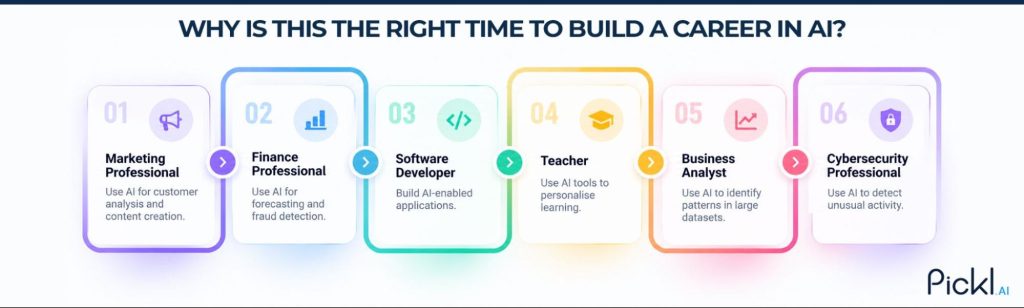
AI is changing both the nature of jobs and the skills employers require. According to the World Economic Forum, 170 million jobs could be created globally by 2030, while 92 million jobs could be displaced, resulting in a net increase of 78 million jobs. At the same time, nearly 40% of the skills required at work are expected to change.
This does not mean that every new job will have “AI” in its title. Instead, AI skills are increasingly becoming part of existing careers.
For example:
- A marketing professional may use AI for customer analysis and content creation.
- A finance professional may use AI for forecasting and fraud detection.
- A software developer may build AI-enabled applications.
- A teacher may use AI tools to personalise learning.
- A business analyst may use AI to identify patterns in large datasets.
- A cybersecurity professional may use AI to detect unusual activity.
The opportunity, therefore, is not restricted to students pursuing computer science.
16 AI Careers Students Can Explore
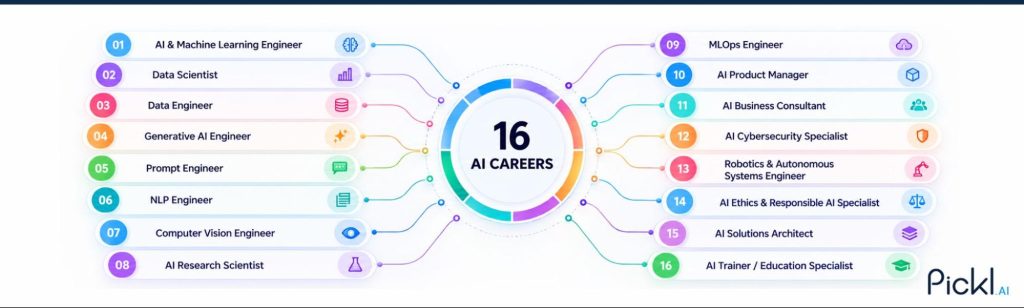
AI is a broad field with career options across engineering, data, business, product management, research, cybersecurity and responsible technology.
Here are 16 AI career paths students can consider.
1. AI and Machine Learning Engineer
An AI and Machine Learning Engineer develop systems that allow computers to learn from data and make predictions or decisions.
What do they do?
They may:
- Build machine learning models
- Train and test AI systems
- Work with structured and unstructured data
- Improve model performance
- Deploy AI solutions
Skills required
Students generally need knowledge of Python, machine learning, statistics, data structures and AI frameworks.
This is one of the core career paths for students who want a strong technical foundation in AI.
2. Data Scientist
A Data Scientist uses data, statistics and machine learning to identify patterns and support business decisions.
Data scientists can work in industries such as banking, healthcare, retail, e-commerce and manufacturing.
Key skills
- Python or R
- Statistics
- Data visualisation
- Machine learning
- SQL
- Business understanding
The role requires both technical and analytical thinking.
3. Data Engineer
AI systems require high-quality data. A Data Engineer builds and manages the systems used to collect, store, process and organise that data.
What does a Data Engineer do?
They may work on:
- Data pipelines
- Databases
- Cloud platforms
- Data warehouses
- Data processing systems
Students interested in the infrastructure behind AI can consider this career path.
4. Generative AI Engineer
Generative AI has created a growing need for professionals who can build applications using large language models and other generative AI systems.
A Generative AI Engineer may develop AI applications for text, images, audio, code or other forms of content.
Useful skills
- Python
- APIs
- Large Language Models
- Retrieval-Augmented Generation (RAG)
- Vector databases
- AI application development
- Prompt design
The role is particularly relevant for students interested in building practical applications with modern AI tools.
5. Prompt Engineer
A Prompt Engineer focuses on designing and testing instructions that help AI systems produce useful and reliable outputs.
Prompt engineering is increasingly becoming part of broader roles rather than being limited to a standalone job title.
Students can learn:
- Prompt design
- Context setting
- AI evaluation
- Structured outputs
- Model limitations
- AI workflow design
The strongest career value comes from combining prompt skills with a domain such as marketing, education, finance, technology or research.
6. Natural Language Processing Engineer
Natural Language Processing (NLP) focuses on how computers understand and process human language.
NLP professionals can work on:
- Chatbots
- Text classification
- Search systems
- Translation
- Sentiment analysis
- Speech and language applications
Students interested in languages, programming and AI can explore this specialisation.
7. Computer Vision Engineer
A Computer Vision Engineer develops AI systems that understand images and videos.
Applications include:
- Medical imaging
- Facial recognition
- Quality inspection
- Autonomous systems
- Object detection
- Retail analytics
Students interested in image processing, mathematics and programming can explore computer vision.
8. AI Research Scientist
An AI Research Scientist works on developing new methods, models, and approaches in artificial intelligence.
This career is more research-oriented and may involve:
- Developing new algorithms
- Conducting experiments
- Publishing research
- Working with advanced AI models
- Solving complex technical problems
Students interested in advanced research may pursue postgraduate education in AI, machine learning, computer science or related fields.
9. MLOps Engineer
Building an AI model is only one part of an AI project. Organisations also need systems to deploy, monitor and maintain those models.
This is where MLOps comes in.
An MLOps Engineer works at the intersection of machine learning, software engineering and operations.
Common areas of work
- Model deployment
- Automation
- Monitoring
- Cloud infrastructure
- Model versioning
- Performance management
This career is suitable for students who enjoy both software development and machine learning.
10. AI Product Manager
An AI Product Manager connects technology, customers and business objectives.
Instead of developing the model themselves, they may define what an AI product should do, understand user requirements and work with technical teams to build the product.
Important skills
- Product management
- Business strategy
- AI fundamentals
- User research
- Communication
- Analytical thinking
This is an important option for students who want to work in AI without following a purely coding-focused career.
11. AI Business Consultant
An AI Business Consultant helps organisations identify where AI can improve business processes, customer experiences or decision-making.
They need to understand both technology and business.
For example, an AI consultant may help a company identify opportunities for:
- Workflow automation
- Customer service automation
- Predictive analytics
- AI-assisted decision-making
- Process optimisation
Business, management, analytics and technology students can all explore this path.
12. AI Cybersecurity Specialist
AI is being used both to improve cybersecurity and to create new security challenges.
An AI Cybersecurity Specialist can work on detecting threats, identifying unusual patterns and protecting AI systems and data.
Relevant skills include:
- Cybersecurity fundamentals
- Machine learning
- Network security
- Threat detection
- Data analysis
As organisations increase their dependence on digital systems, the intersection of AI and cybersecurity is becoming increasingly important.
13. Robotics and Autonomous Systems Engineer
AI is also powering robots, autonomous vehicles and intelligent machines.
A Robotics and Autonomous Systems Engineer may work on systems that allow machines to perceive their surroundings, make decisions and perform tasks.
Relevant areas include:
- Robotics
- Computer vision
- Machine learning
- Sensors
- Control systems
- Programming
This career can be particularly relevant to students interested in engineering and hardware.
14. AI Ethics and Responsible AI Specialist
AI systems can create questions around privacy, bias, transparency, accountability and responsible use.
An AI Ethics or Responsible AI Specialist works on helping organisations develop and use AI responsibly.
Their work can involve:
- AI governance
- Risk assessment
- Privacy
- Bias evaluation
- Responsible AI policies
- Compliance
This is an emerging area for students interested in technology, law, policy, ethics and business.
15. AI Solutions Architect
An AI Solutions Architect designs the overall technical structure of AI solutions.
They determine how different technologies, models, databases, cloud services and applications can work together.
This role requires strong knowledge of:
- AI and machine learning
- Cloud technology
- Software architecture
- Data systems
- APIs
- Business requirements
It is generally a more advanced career path that professionals can move into after gaining technical experience.
16. AI Content and Creative Technology Specialist
AI is also changing how organisations create and manage content.
An AI Content and Creative Technology Specialist can combine content expertise with AI tools to create workflows for:
- Content creation
- Video scripting
- Personalisation
- Marketing
- Research
- Content automation
- Digital campaigns
This is particularly relevant for students from communication, media, marketing, design and humanities backgrounds who want to add AI capabilities to their existing skills.
What Skills Should Students Develop for AI Careers?
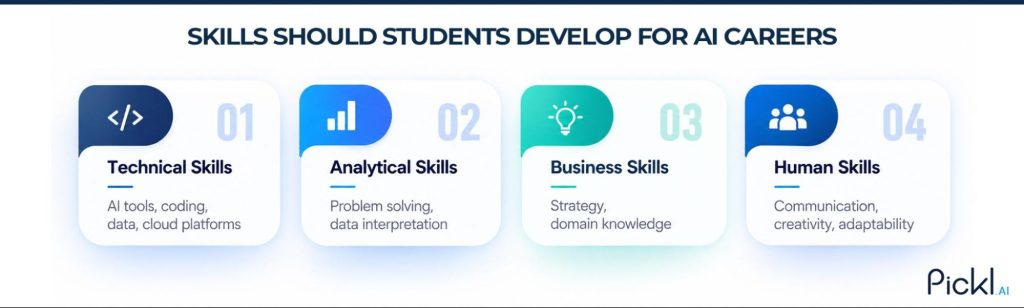
Students should avoid focusing only on learning individual AI tools. Tools will continue to change.
Instead, colleges can help students build a combination of technical, analytical, business, and human skills.
Technical skills
- Python
- SQL
- Statistics
- Machine learning
- Data analytics
- Cloud computing
- AI tools
- Generative AI
- APIs
- Data visualisation
Analytical skills
- Problem-solving
- Critical thinking
- Data interpretation
- Research
- Experimentation
Business skills
- Understanding business problems
- Project management
- Product thinking
- Industry knowledge
- Communication
Human skills
- Creativity
- Collaboration
- Presentation
- Leadership
- Adaptability
- Continuous learning
The World Economic Forum similarly highlights the growing importance of technological skills alongside creative thinking, analytical thinking, resilience, leadership and collaboration.
Frequently Asked Questions About AI Careers
1. What are the best AI careers for students?
The best AI career include AI and Machine Learning Engineer, Data Scientist, Data Engineer, Generative AI Engineer, AI Product Manager, AI Consultant, NLP Engineer, Computer Vision Engineer and several other roles.
2. Is AI a good career option in 2026?
Yes, the current market trend shows that AI is a good career opportunity. The World Economic Forum’s Future of Jobs Report 2025 identifies AI and Machine Learning Specialists and Big Data Specialists among the fastest-growing roles through 2030.
3. Do I need to study computer science to build a career in AI?
No. There are many AI careers that do not require computer science expertise like in product management, consulting, cybersecurity, business, content, governance and other areas.
A student from a non-computer-science background can build AI expertise relevant to their existing domain.
4. What skills are required for an AI career?
Technical careers may require Python, statistics, machine learning, data engineering or cloud computing. Business-oriented roles may require AI literacy, product management, communication and business analysis.
5. Is prompt engineering enough for an AI career?
Prompt engineering is a useful AI skill, but students should ideally combine it with domain knowledge, AI fundamentals and practical problem-solving. AI tools and job titles can change, so broader capabilities provide a stronger foundation.
Build AI Skills, Not Just AI Credentials
The growth of AI is creating a broader career landscape for students. However, being AI-ready is not simply about completing an AI course or collecting another certificate.
Students need opportunities to learn, practise, build, analyse and present.