
The Rise of Generative AI in University Curriculum Design
Summary: Generative AI is the new skill set that is redefining the way things work. Companies are now…
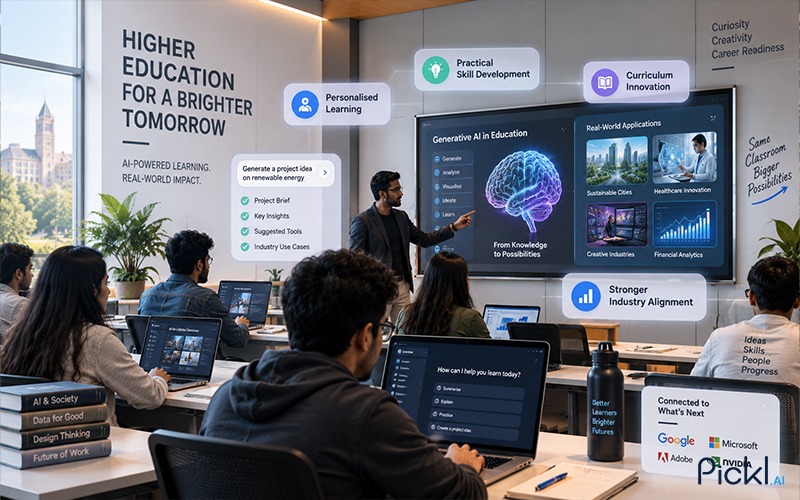
Summary: Generative AI is the new skill set that is redefining the way things work. Companies are now hiring students and professionals who are Gen AI experts. This demands for a quick change in the curriculum that prepares students for the future. This blog explores the key aspects that every institute must take into consideration while designing their curriculum.
Introduction
Generative AI is not just a tool for industry; it has the potential to transform academia. It is a storehouse of several features that can be used by students to smooth their learning curve while also educating themselves about the practical applications of the same. The rise of Generative AI in university curriculum design represents a shift toward personalized, industry-aligned learning. By synchronizing Gen AI into higher education programs, institutions are moving beyond traditional teaching models to embrace a more dynamic, data-driven pedagogical framework.
In 2026, we have moved past the initial methodology of learning from theory to a more practical and foundational development. Integrating Gen AI in higher education programs is one of the easiest ways to upscale the curriculum and make it more relevant as per the demand of the industry.
What is Generative AI and Why Does it Matter for Universities?
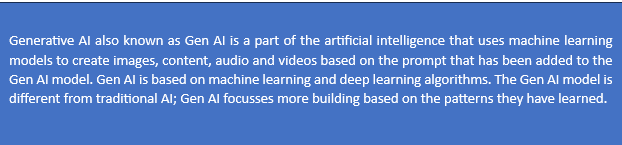
Generative AI in education is not just a passing trend; it has emerged as a co-designer that equips students, professors and teachers to brainstorm lessons, prepare lesson plans, simplify topics, and stay up-to-date with the latest changes and demand in the market. This foundational shift ensures that the information being taught is not just academic, but current.
The Evolution of AI-Based Curriculum Design
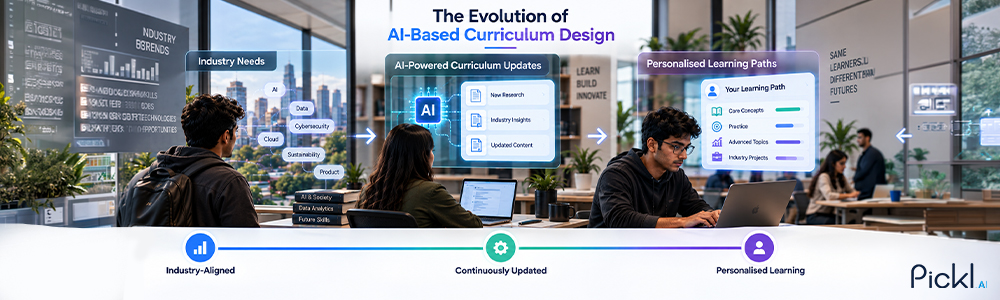
AI-based curriculum has transitioned from an experimental concept to a strategic imperative. Traditional curriculum design is often “one-size-fits-all,” but AI-based curriculum design focuses more on making it industry-aligned:
1. Mapping to Real-World Job Market Needs
Understanding the real-world market requirement is non-negotiable when it comes to designing the curriculum. Today, there is a growing demand for qualified professionals who have expertise in data, AI, and analytics. Hence, simply relying on the conventional curriculum would not suffice to meet the requirement. So, this shift towards AI-based curriculum has become a foundational pillar of modern pedagogy.
2. Automating Syllabus Updates
Generative AI allows faculty to scan the latest white papers and news cycles to refresh syllabi annually or even semesterly. This ensures that students are learning the state-of-the-art rather than the history of a subject.
3. Creating Adaptive Learning Paths
Every student learns at a different pace. Integrating Gen AI into higher education programs enables the creation of “dynamic syllabi.” If a student struggles with a specific concept in organic chemistry, the AI can reorganize the curriculum to provide more foundational content and practice problems before moving to the next level, effectively creating a personalized tutor for every student.
Real-World Gen AI Use Cases in Higher Education
The theoretical benefits of AI are impressive, but the practical Gen AI use cases are what truly transform the campus. Below is a breakdown of how these technologies are currently being implemented:
| Use Case | Description | Impact on Learning |
| Automated Feedback Loops | AI systems provide instant, formative feedback on student drafts. | Students improve their work before final submission, enhancing the learning process. |
| Virtual Teaching Assistants | 24/7 AI chatbots trained on specific course materials. | Reduces the administrative burden and also ensures quick problem resolution.. |
| Synthetic Research Data | Generating large datasets for students to practice statistical analysis. | Allows students to work on complex problems without the privacy risks of real-world sensitive data. |
| Interactive Case Studies | AI-driven simulations where students “talk” to historical figures or patients. | Boosts engagement and empathy through immersive, role-playing scenarios. |
These Gen AI use cases showcase that AI is not just a search engine; it is an interactive environment that fosters critical thinking and practical application.
The Growth of the Generative AI Course
As AI becomes ubiquitous, universities are realizing that “AI literacy” is the new digital literacy. This has led to an explosion in both specialized and cross-disciplinary Gen AI courses.
Earlier, an AI course was just a part of the curriculum, but in recent times, it has emerged as the primary subject. There has been a rise in specialized Generative AI courses in almost every faculty; from using Gen AI in creative writing to preparing presentations and business reports, there has been a steady rise in the use cases of Gen AI in every niche.
The availability of diverse Gen AI courses significantly improves student employability. Employers in 2026 are looking for candidates who don’t just know how to use AI but also understand the ethical implications and the technical limitations of these tools. A dedicated Generative AI course provides the credentialing that proves a student is “AI-ready.”
Strategic Steps for Integrating Gen AI into Higher Education Programs
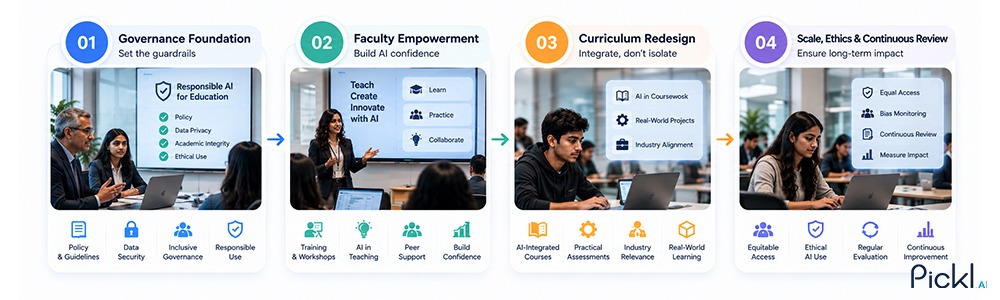
The transition to an AI-augmented campus is not without its hurdles. Success requires a strategic approach to integrating Gen AI into higher education programs that balances innovation with integrity. AI-based curriculum achieved much higher course completion rates (89.72%) as well as retention (91.44%).
To integrate Generative AI (GenAI) into higher education effectively, institutions must move beyond “experimental” pilots and toward a structured, systemic framework. Based on the CRAFT framework (Culture, Rules, Access, Familiarity, Trust) and emerging 2026 standards, here are the strategic steps for successful integration.
Phase 1: Establish the Governance Foundation
Before introducing tools into your educational pedagogy, it is important to understand the different tools and how they work. It must be defined to protect academic integrity and data privacy.
Include deans, IT specialists, legal counsel, and student representatives. This group ensures that AI strategy isn’t just a technical initiative but an academic one.
Ensure all AI tools meet FERPA/GDPR standards. Move toward “Institutional LLMs” (private instances of models like ChatGPT or Claude) to ensure student data isn’t used for training public models.
Phase 2: Faculty Empowerment & AI Literacy
Integration fails if the educators are not the primary drivers. Use the Technological Pedagogical Content Knowledge (TPACK) framework to help faculty understand how AI specifically enhances their unique discipline, rather than using it as a generic tool.
Phase 3: Curriculum & Assessment Redesign
In the third phase, it is important to meticulously redesign the course that is in synchronization with industry design; this includes adding new tools and technologies that make it more relevant in the current context.
Instead of a separate “AI Course,” integrate AI tasks into existing curriculum. (e.g., An Engineering student uses GenAI to simulate stress tests; a history student uses it to analyse patterns in 1,000 digitized documents).
Phase 4: Scaling, Ethics, and Continuous Review
Monitoring for impact and equity is necessary for long-term success. Use institutional licenses to guarantee that every student has equal access to “Pro” versions of AI products. Steer clear of a “two-tier” educational system where the best AI support is only available to affluent pupils.
Conduct routine audits of AI-generated instructional materials to make sure they don’t reinforce academic errors or cultural biases.
The Future of Learning is Generative
The rise of Generative AI in university curriculum design is an inevitable evolution, not a passing trend. As we look toward the future, the boundary between “the classroom” and “the lab” will continue to blur. We are moving toward a future where degrees are not static markers of past knowledge, but living portfolios that evolve as the technology does.
By embracing Generative AI in education, universities are doing more than just teaching technology; they are teaching students how to coexist with it. The result is a more resilient, responsive, and relevant educational system.
Frequently Asked Questions
What is Generative AI’s primary role in universities?
The primary role of Generative AI in education is to offer a personalized learning assistant to students. Besides, using Gen AI, teachers and professors can easily automate administrative tasks, provide a round the clock learning assistant, and assist in updating course materials.
How can faculty start integrating Gen AI into higher education programs?
Incorporating AI in education can start with the introduction of prompt engineering. The right prompt fetches the right results. Besides, introducing tools that can simplify tasks like preparing presentations or breaking down complex topics can be the starting steps of making learning easy with AI and also educating the students on how to use the AI tools.
Are there specific Gen AI courses available for non-technical students?
Yes, many universities now offer Gen AI courses that focus on non-technical students. AI’s impact is universal, hence students from every domain must have expertise in using AI, with a dedicated course in Gen AI for non-technical students, it becomes easier to integrate it in their work.
What makes AI-based curriculum design different from traditional methods?
Traditional design is often static and based on historical academic standards, but AI-based curriculum design is based on current industry dynamics. It focuses more on real-world case studies and projects that make learning more effective.