
Is Automation Good or Bad for the Workplace? Pros and Cons Explained
Summary: Artificial intelligence has emerged as a popular tool. Its integration in the workplace has been transformative. It…
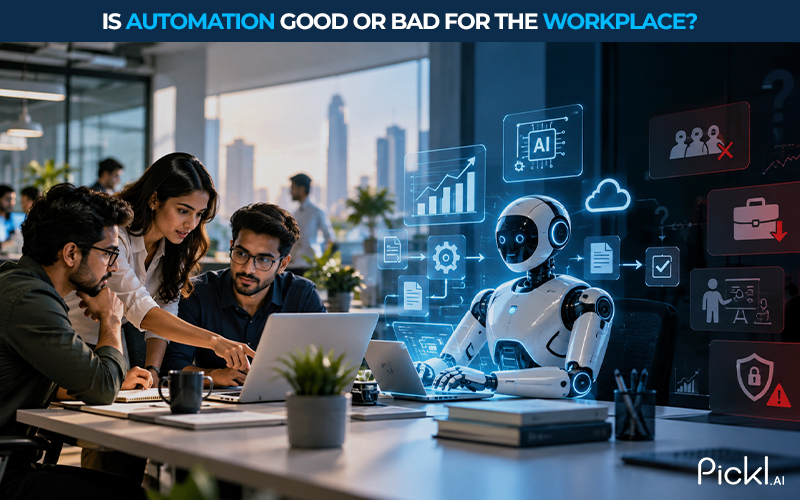
Summary: Artificial intelligence has emerged as a popular tool. Its integration in the workplace has been transformative. It helps in reducing the redundancy of work and increases work productivity. This blog covers the pros and cons of AI integration at the workplace.
Introduction
Automation in the workplace is no longer a question of if businesses will adopt it, but how they will use it effectively. We cannot undermine the relevance and growing prominence of AI across the business niche. However, people hold different perspectives on this.
For the management and business owners, Artificial Intelligence has become a productive, cost-saving and time-saving tool. On the flip side, AI integration is reshaping traditional job roles, raising important questions around workforce transformation, reskilling, and the future of employment.
As a user of AI myself, and a champion of its adoption, I would like to present the two sides of the coin. While AI integration has been a great boon for the business leading to faster workflows, smarter decisions, fewer manual errors, it has had concerns like data security, jobs being displaced and rising concern of AI replacing humans. So, before narrowing down to making the right choice, weighing both the sides is paramount.
This blog breaks down automation adoption under the light of benefits and drawbacks.
What Is Automation in the Workplace?
Workplace automation is all about automating repetitive tasks using AI tools and software. This reduces workplace redundancy and also enhances work productivity while also saving time.
Every day office workers receive at least 200 messages a day and spend about 2.5 hours reading and replying to emails. This consumes a major portion of their work daily. This is one of the many examples where monotonous tasks take a lot of time to complete. Hence, deploying the right tools that can automatically filter spam and important mails can be beneficial.
Benefits of Automation in the Workplace
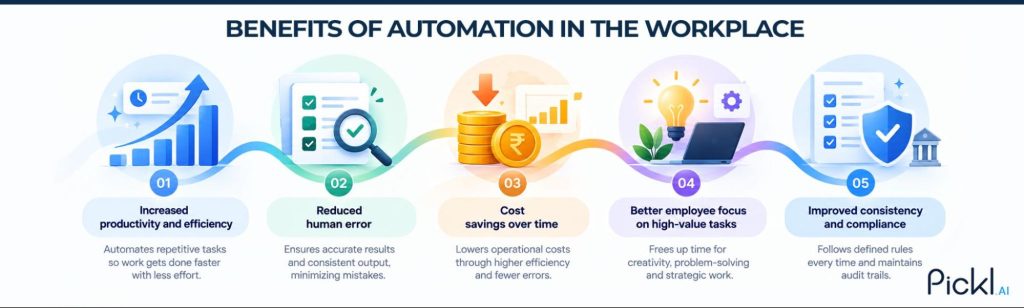
Enhanced productivity, reduced human errors, and streamlined processes are some of the key benefits of automation in the workplace. Businesses are increasingly turning to automation to eliminate repetitive tasks and free their teams to focus on work that requires creativity, judgement, and strategic thinking.
The idea of using technology to simplify work is not new. Keyboard shortcuts, calculators, computers, and software have been helping people save time and work more efficiently for decades. What has changed is the level of intelligence behind the technology. Here are some of the key benefits of automation in workplace:
Increased productivity and efficiency
Automation takes over repeatable, rule-based work so processes run faster and with less manual effort. This helps in increasing productivity. There are stats reflecting the same, as per the McKinsey Global Institute’s scenario modeling estimates automation could raise global productivity growth by 0.8 to 1.4 percent a year. mckinsey
Reduced human error
One of the examples of automation at work is reducing human error. Bots can work tirelessly, hence, there has been a growing use of chatbots and voice assistants. These work round the clock and also provide instant solutions with minimal turnaround time. Human fatigue and errors can be easily overcome by using AI and automation in the workplace.
Gartner puts the average annual cost of poor data quality at $12.9 million per organization.
Cost savings over time
AI integration at the workplace is a cost-saving initiative. Since the machines need to be trained once and they can perform the task based on the fed data. It helps in saving the training cost. Moreover, reduced errors and higher productivity also reduce costs. This makes investing in AI and automation tools a cost-saving move. Upfront investment is offset by lower per-transaction costs, and payback can be quick.
McKinsey reports that successful operations centers using RPA and related technologies cut costs by 30–60 percent while improving delivery quality.
Better employee focus on high-value tasks
The point isn’t only to cut labor. It’s to move skilled people from data entry to analysis, client work and problem-solving. A Smartsheet survey found over 40% of workers spend at least a quarter of their work week on manual, repetitive tasks, mostly email, data collection and data entry.
Improved consistency and compliance
Automated processes run the same way every time and leave an audit trail. Since the rules are defined and machines are well trained on this, it ensures consistency and compliance.
Bots follow the same sequence each time and record what they did, which suits
Challenges of Automation in the Workplace
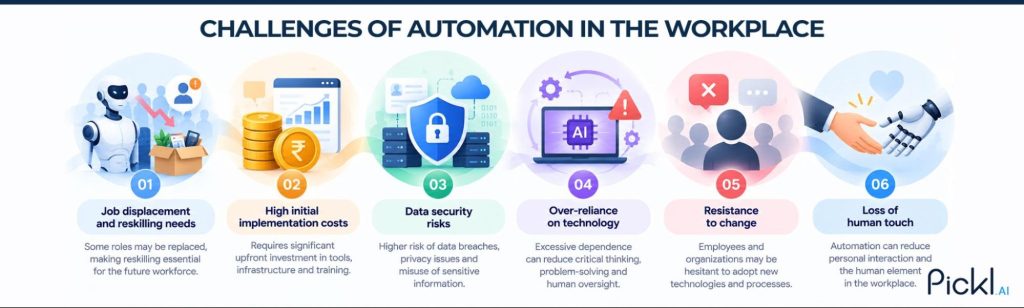
Here’s where I put my optimism aside for a second, because pretending automation is all upside would be dishonest and honestly, unhelpful to any business trying to make a real decision.
Job displacement and reskilling needs
This is the concern I hear most from teams, and it’s fair. When automation takes over routine tasks, some roles genuinely shrink. The businesses getting this right aren’t ignoring it — they’re investing in reskilling early, not after the fact.
High initial implementation costs
Automation isn’t cheap to set up properly. Between software, integration, and training, the upfront investment can catch leaders off guard if they haven’t budgeted for the full picture, not just the tool’s sticker price.
Data security risks
This one keeps me up at night more than most. The more automated and AI-driven your systems get, the more sensitive data flows through them — and the bigger the target you become. Strong governance isn’t optional here; it’s the cost of entry.
Over-reliance on technology
Systems fail. When they do, teams that have automated everything without a fallback plan can grind to a halt.
Resistance to change
Employees don’t push back on automation itself — they push back on feeling replaced. That fear of AI “taking over” is real, and it deserves a real conversation, not a memo.
Loss of human touch
In customer-facing roles especially, over-automating can make interactions feel cold exactly when a human moment mattered most.
Conclusion
If there’s one thing I want you to take from this, it’s that automation in the workplace was never meant to be all-or-nothing. The businesses that win with it are the ones that treat it as a tool to manage, not a trend to chase. Weighing the efficiency gains against real risks like data security and job displacement can help in seamless integration of AI in the workplace without fear. My honest advice? Look at your own workflow first, then decide where automation actually earns its place.
At Pickl.AI we understand that this shift has also triggered the demand for candidates who are well-versed in this technology. Through our AI learning initiatives, regular training, and workshops, we ensure that AI integration becomes easier for adoption and simple for learning.
Frequently Asked Questions
Is automation good or bad for jobs?
Automation cannot be tied between good or bad. In some cases, it has the capabilities of working error-free while enhancing productivity. One can easily shift their repetitive tasks to certain tools or software. This saves a lot of time. But data security concerns and job replacement continue to remain a point of concern. Hence its benefits and drawbacks depend on the task for which it has been deployed and how organisations manage workforce transitions.
What industries use automation the most?
Automation has been actively adopted across industries such as manufacturing, logistics, banking, healthcare, retail, IT, and customer service.
Does automation replace all human jobs?
No. Automation is more likely to replace or transform specific tasks rather than entire occupations. Jobs that require creativity, human emotions and brand customization need human intervention. However, the future of jobs looks closer towards the work of both humans and AI.
How much does workplace automation cost to implement?
The cost varies significantly based on the technology, business size, process complexity, and level of customisation. Businesses may start with affordable software solutions and scale to more advanced AI-powered automation as their requirements grow.