

Summary: This blog explores why sporadic workshops fail and how a structured Faculty Development System improves teaching quality. It introduces the Faculty Development Index (FDI) as a tool to measure success. Learn key components, strategies for designing effective programmes, and how to overcome common implementation challenges for lasting educational impact.
Introduction
In the rapidly evolving landscape of higher education, the quality of teaching is the single most significant factor influencing student success. Yet, for years, institutions have relied on sporadic workshops and disjointed training sessions to support their educators. This “one-and-done” approach is no longer sufficient.
To truly transform education, institutions must move beyond isolated events and embrace a holistic Faculty Development System. But how do you know if your efforts are working? How do you ensure that your faculty development programmes are not just checking a box but actively improving classroom outcomes?
This blog explores the shift from passive training to active, measurable development and introduces the concept of a Faculty Development Index to track real progress.
What Is a Faculty Development System?
A Faculty Development System is a structured, continuous framework designed to enhance the professional growth of educators. Unlike traditional models that focus solely on technical skills or subject matter expertise, a robust system addresses the “whole teacher.”
It integrates three core pillars:
- Instructional Development: Improving course design, delivery, and assessment techniques.
- Professional Development: Enhancing leadership, research capabilities, and career progression.
- Organizational Development: Aligning faculty goals with the institution’s mission to create a supportive teaching culture.
When these pillars work in unison, they create an ecosystem where teaching excellence is not an accident but a standard.
Why Faculty Development Matters for Teaching Quality
The correlation between faculty development and student performance is undeniable. Research shows that when educators are supported by a structured faculty development system, student engagement rates increase, and dropout rates decline.
Faculty development matters because:
- It Bridges the Gap: Many professors are subject matter experts (Ph.Ds.) with little to no formal training in pedagogy (the science of teaching).
- It Adapts to Change: From AI tools like ChatGPT to hybrid learning models, faculty need continuous support to navigate modern educational challenges.
- It Boosts Retention: Faculty who feel invested in are more satisfied, leading to lower turnover rates and a more stable learning environment for students.
Key Components of an Effective Faculty Development System
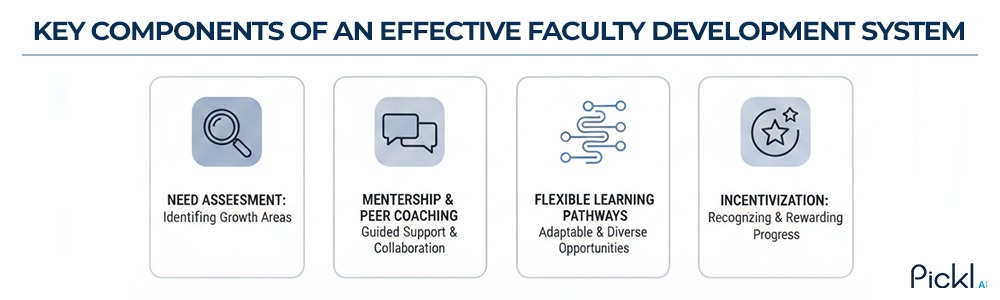
To build a system that delivers results, you need more than just a calendar of events. An effective faculty development system comprises four essential components:
Needs Assessment
Before planning a single session, use data to understand what your faculty actually needs. Are they struggling with student engagement? Or perhaps digital assessment tools?
Mentorship and Peer Coaching
Create a community of practice where senior faculty mentor junior colleagues. Peer observation is often more impactful than external training.
Flexible Learning Pathways
One size does not fit all. Offer a mix of micro-learning modules, semester-long courses, and intensive boot camps.
Incentivization
Recognition is fuel. Tie faculty development to tenure, promotion, or “Master Teacher” certifications to drive participation.
How to Measure What Truly Matters in Faculty Development
This is the challenge most institutions face: How do we prove ROI?
Traditional metrics like “number of workshops attended” or “satisfaction surveys” are vanity metrics. They tell you who showed up and if they liked the coffee, but they don’t tell you if teaching improved.
To measure what matters, we must shift our focus to the Faculty Development Index (FDI).
Designing Faculty Development Programmes That Drive Results
Effective faculty development programmes are backward-designed. Start with the desired change in teaching behavior and work backward.
For example, if the goal is to improve critical thinking in students, the faculty program shouldn’t just be a lecture on critical thinking. It should be a workshop where faculty design a new assignment that tests critical thinking, implement it, and bring the student work back for analysis. This “Apply-Review-Refine” cycle is the heartbeat of results-driven development.
Measuring the Impact on Teaching Quality
To move beyond attendance sheets, successful institutions track the “ripple effect” of their training.
- Level 1 (Reaction): Did the faculty find the training useful? (Standard survey)
- Level 2 (Learning): Did the faculty acquire new knowledge or skills? (Pre/Post-tests)
- Level 3 (Behavior): Are they using the new strategies in the classroom? (Classroom observation)
- Level 4 (Results): Is student performance improving? (Student grades, engagement surveys, retention data)
A true Faculty Development System focuses heavily on Levels 3 and 4.
How You Can Adapt the Faculty Development Index
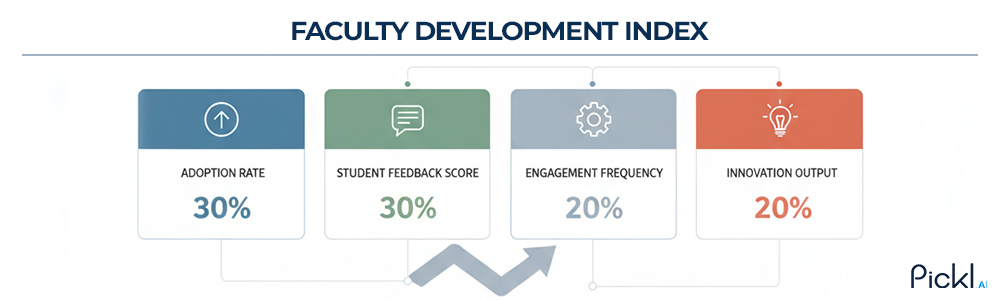
The Faculty Development Index (FDI) is a composite score that institutions can adapt to measure the health and impact of their development initiatives. It moves away from measuring inputs (hours spent) to measuring outputs (quality gained).
You can build your own FDI by assigning weightage to these factors:
- Adoption Rate (30%): Percentage of faculty applying new methods in class (verified by peer review).
- Student Feedback Score (30%): Improvement in specific student evaluation questions related to teaching effectiveness.
- Engagement Frequency (20%): How often faculty return for follow-up sessions or mentoring (indicating a culture of continuous learning).
- Innovation Output (20%): Number of new courses, research papers on pedagogy, or innovative assessments created.
By tracking this Index annually, you get a clear, quantifiable picture of how your Faculty Development System is maturing.
Challenges and How We Solved Them
Implementing a new system is never without hurdles. Here are common challenges and solutions from institutions that have successfully made the shift:
Challenge Time Constraints
Faculty are already overburdened with research and admin work.
Solution: We integrated development into the workflow. Instead of 3-hour workshops, we introduced “15-minute pedagogical tips” during department meetings and asynchronous online modules.
Challenge: Resistance to Change
“I’ve taught this way for 20 years.”
Solution: We used the FDI to show data. When resistant faculty saw that their peers using new methods had higher student ratings and lower failure rates, the skepticism turned into curiosity.
Challenge: Budget Limitations
Solution: We leveraged internal talent. “Faculty Learning Communities” allowed experts within the university to teach others, costing nothing but time while building morale.
Conclusion
It is a necessity for any institution committed to academic excellence. By moving away from sporadic training and adopting a measurable, systematic approach like the Faculty Development Index, colleges can ensure that their teachers are constantly growing.
When you invest in faculty development, you aren’t just teaching the teachers—you are directly upgrading the education of every student they will ever teach. That is a return on investment worth pursuing.
Frequently Asked Questions
What is a Faculty Development Index (FDI)?
A Faculty Development Index (FDI) is a customizable metric used by educational institutions to measure the effectiveness and impact of their faculty training. Instead of just counting attendance, it tracks the application of new skills, improvements in student feedback, and overall teaching innovation.
How does faculty development directly improve teaching quality?
Faculty development exposes educators to modern pedagogical strategies, assessment techniques, and technologies. This ensures they are not just delivering content but actively engaging students, leading to better retention, higher grades, and improved critical thinking skills.
What are the key components of a successful faculty development program?
The key components include a comprehensive needs assessment, continuous mentorship and peer coaching, flexible learning formats (online and offline), and a strong reward system that links development to career progression.
Can a faculty development system help with accreditation?
Yes, significantly. Accreditation bodies (like NAAC, NBA, or ABET) increasingly look for evidence of continuous improvement in teaching. A structured Faculty Development System that uses data (like the FDI) provides the concrete evidence needed to demonstrate a commitment to educational quality.
Author
-

Written by:
Neha Singh


