

Summary: This blog explores the transformative impact of industry-integrated data science learning. It highlights how internships and capstone projects, powered by university-industry collaboration models, provide students with essential real-world experience. Discover the benefits for students and companies, alongside future trends shaping the data science landscape to bridge the professional gap.
Introduction
In today’s digital economy, data is often called the “new oil.” However, raw data is useless without the skills to refine it. As the demand for data-driven decision-making grows, the gap between classroom theory and real-world application has become more apparent. This is where industry-integrated data science learning comes into play.
By merging academic rigor with professional practice, universities and organizations are creating a new blueprint for education. Through internships and capstone projects, students are no longer just learning from textbooks; they are solving real-world problems that impact the bottom line.
In this blog, we will explore the various models of collaboration that are shaping the next generation of data scientists and why this integration is essential for career success.
What Is Industry-Integrated Data Science Learning?

Industry-integrated data science learning is an educational approach that combines traditional academic study with practical, hands-on experience in a professional environment. Instead of studying algorithms in a vacuum, students apply them to actual business datasets and organizational challenges.
This model moves beyond “mock projects.” It involves a structured partnership where the curriculum is influenced by current industry needs. According to recent reports, the global data science market is expected to grow at a CAGR of 25% through 2030. To keep up, education must evolve to include live environments, professional mentorship, and the use of industry-standard tools like Snowflake, AWS, and advanced Python libraries.
Why Internships and Capstone Projects Matter in Data Science Education
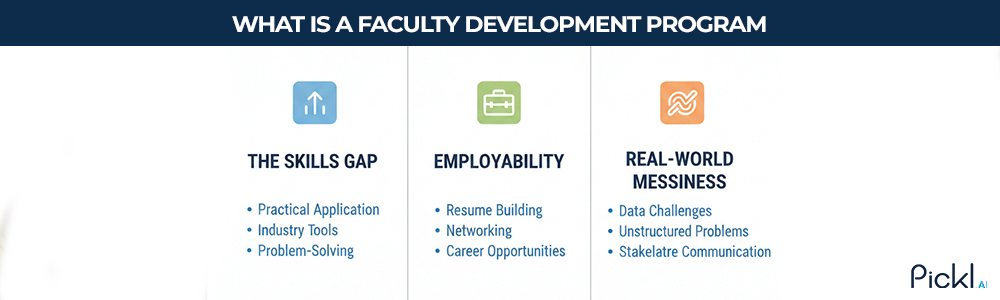
The field of data science is unique because it requires a mix of three distinct pillars: mathematics, coding, and business acumen. While universities are excellent at teaching the first two, the third—business acumen—is difficult to teach in a lecture hall.
The Statistics Speak:
The Skills Gap
A survey by the Data Literacy Index found that while 92% of business leaders believe data literacy is vital, only 34% of the global workforce feels confident in their data skills.
Employability
According to the National Association of Colleges and Employers (NACE), students who complete a paid internship are 70% more likely to receive a job offer upon graduation.
Real-World Messiness
In a classroom, data is “clean.” In the real world, 80% of a data scientist’s time is spent cleaning “dirty” data. Internships and capstones expose students to this reality early on.
Industry Collaboration for Data Science Internships
Industry collaboration for data science internships is the most direct way to bridge the gap between being a student and becoming a professional. Unlike general internships, data science internships require a high level of technical supervision.
In a collaborative internship model, companies don’t just hire a student to do basic tasks. Instead, they integrate the intern into a data team. Here, the student learns the “Full Stack” of a data project:
- Data Ingestion: How to pull data from secure servers.
- Data Governance: Understanding privacy laws like GDPR or CCPA.
- Model Deployment: Learning that a model is useless if it stays on a local laptop; it must be deployed to the cloud.
Effective industry collaboration ensures that the internship is a two-way street. The student gains a portfolio of work, and the company gains fresh perspectives and a potential full-time hire who is already onboarded to their specific tech stack.
University-Industry Collaboration Models for Capstone Projects
Capstone projects are the “final exam” of a Data Science degree. However, the most successful programs are moving away from theoretical prompts and toward university-industry collaboration models.
In these models, a company “sponsors” a project. They provide a specific problem they are facing—such as predicting customer churn or optimizing a supply chain—and provide a sanitized version of their data. A team of students then works over a semester to build a solution.
Key features of these models include
- Industry Mentors: A professional from the sponsoring company meets with the students weekly.
- Academic Oversight: A professor ensures the students are using sound statistical methods.
- Final Pitch: Students present their findings to company executives, honing their “data storytelling” skills.
Common Data Science Internship and Capstone Collaboration Models
There is no “one-size-fits-all” approach. Different organizations use different structures to facilitate industry-integrated data science learning.
The Direct Placement Model
This is the traditional internship where a student works full-time at a company during the summer.
The Co-op Model
Popular in engineering and data science, students rotate between a semester of full-time study and a semester of full-time work.
The Project-Based Consulting Model
Used primarily for capstones, where the university acts as a “consultancy” and the students act as “consultants” for a corporate client.
The Innovation Lab Model
Some universities and companies co-fund a laboratory on campus where students work on long-term R&D projects for the company year-round.
Benefits of Industry-Integrated Models for Key Stakeholders
For Students
- Portfolio Building: They graduate with proof that they can handle real-world data.
- Networking: They build relationships with professionals who can refer them for jobs.
- Soft Skills: They learn how to explain complex AI concepts to non-technical stakeholders.
For Universities
- Curriculum Relevance: Feedback from industry partners helps professors update their syllabus to include the latest tools (like Generative AI and LLMs).
- Higher Placement Rates: Programs with strong industry ties boast higher employment statistics for their graduates.
For Companies
- Talent Pipeline: It serves as a 3-to-6-month interview, reducing the risk of a “bad hire.”
- Cost-Effective R&D: Students often bring fresh, academic insights that can solve “back-burner” problems the main team hasn’t had time to address.
Future Trends in Data Science Internship and Capstone Collaboration
The landscape of industry-integrated data science learning is evolving rapidly. Here are three trends to watch:
Remote and Global Collaborations
With tools like Slack, GitHub, and Zoom, a student in India can complete a capstone project for a tech firm in Silicon Valley.
Focus on Ethical AI
Future collaborations are increasingly focusing on bias detection and AI ethics, as companies grapple with the social implications of their algorithms.
Micro-Internships
These are short-term, paid, professional assignments that allow students to work on multiple projects across different industries in a single year.
Conclusion
The era of isolated academic learning is coming to an end. Industry-integrated data science learning is now the gold standard for preparing the next generation of data professionals. Through industry collaboration for data science internships and robust university-industry collaboration models, we are ensuring that students are not just “knowledgeable” but “work-ready.”
As data continues to grow in complexity and volume, these collaborative models will be the primary engine driving innovation in both the classroom and the boardroom.
Frequently Asked Questions
1. What is industry-integrated data science learning?
It is an educational approach that blends academic theory with practical work experience. Students engage with real-world datasets, industry tools, and professional mentorship as a core part of their curriculum.
2. How do industry collaborations improve data science internships?
They ensure that internships focus on high-value tasks rather than administrative work. These collaborations provide students with access to real-world challenges, professional workflows, and specialized software used in the industry.
3. What are data science capstone projects with industry?
These are culminating academic projects where students work in teams to solve a specific problem provided by a partner company. The company provides the data and the problem, while the students provide the analysis and solution.
4. Why are university-industry collaboration models important in data science education?
They are vital because they bridge the “skills gap.” They help universities keep their curricula updated with the latest trends and provide companies with a direct pipeline of trained, vetted talent ready to contribute on day one.
Author
-

Written by:
Neha Singh