
Summary: Universities must prioritize continuous faculty development programmes to stay relevant. This post highlights the benefits of ongoing faculty training, from boosting student outcomes to improving institutional rankings. Discover strategies to implement sustainable training models that empower educators and prevent the hidden costs of academic stagnation.
Introduction
Higher education is no longer just about delivering lectures in a hall filled with students. It is a dynamic, fast-evolving ecosystem driven by technology, changing student expectations, and global industry standards. In this shifting landscape, a university is only as good as its educators.
However, a common misconception remains: that once a professor earns their PhD and enters the classroom, their learning journey is complete. Nothing could be further from the truth. To maintain academic excellence, universities must prioritize faculty training as an ongoing investment rather than a one-time event.
This blog explores why institutions must embrace continuous faculty development programmes, the tangible benefits of doing so, and the risks of falling behind.
Why Continuous Faculty Development Programmes Matter

The role of a professor has shifted from being the “sage on the stage” to the “guide on the side.” Students today have access to infinite information via the internet. They don’t need faculty to just read from textbooks; they need mentors who can facilitate critical thinking, manage diverse classrooms, and integrate technology seamlessly.
Continuous faculty development programmes matter because the tools of the trade are constantly changing.
Example: The Data Analytics Revolution
Consider the explosion of Data Analytics across sectors beyond IT, such as Marketing, Finance, and even Sociology. A decade ago, a Marketing professor might have focused solely on consumer psychology theories. Today, the industry demands that graduates know how to interpret consumer data, use tools like Tableau, or understand Google Analytics.
If a university does not provide faculty training on these specific data tools, the professor cannot teach them. The result? Students graduate with theoretical knowledge but lack the analytical skills employers desperately need. Continuous training bridges this gap, ensuring that a history professor can use data visualization or a commerce professor can teach financial analytics.
The Benefits of Investing in Faculty Training and Development
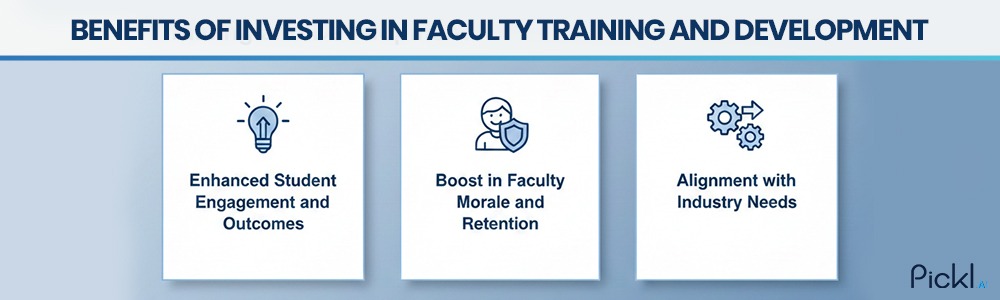
When universities treat faculty development as a strategic asset, the returns are multidimensional. It impacts the students, the institution, and the teachers themselves.
Enhanced Student Engagement and Outcomes
The primary beneficiary of better teaching is the student. Faculty training equips educators with modern pedagogical techniques—such as the “Flipped Classroom” or “Project-Based Learning.” Research consistently shows that active learning strategies lead to higher pass rates and better retention of knowledge compared to traditional passive lecturing.
Boost in Faculty Morale and Retention
Burnout is real in academia. When professors feel stagnant or unsupported, they disengage. By offering robust faculty development programmes, universities show that they value their staff’s growth. This investment acts as a powerful retention tool. Faculty members are more likely to stay at an institution that helps them upskill and advance their careers.
Alignment with Industry Needs
Industries evolve faster than textbooks. Through continuous faculty training, professors can stay updated on the latest industry trends. For instance, a computer science professor needs regular updates on cloud computing and cybersecurity to teach relevant skills. This ensures that graduates are “job-ready,” boosting the university’s placement records.
Key Components of a Modern Faculty Development Programme
A workshop once a year is not a system; it’s a formality. For faculty development programmes to be effective, they must be comprehensive and cover multiple facets of an educator’s role.
Instructional Technology
Training faculty on how to use modern educational software, data analytics to track student progress, and AI tools for personalized learning.
Research and Scholarship
Helping faculty balance teaching with research. This includes workshops on grant writing, publishing in high-impact journals, and research ethics.
Soft Skills and Mentorship
Teaching is a human-centric profession. Faculty development should include training on emotional intelligence, handling classroom conflicts, and counseling students who may be facing mental health challenges.
Leadership Training
Preparing senior faculty to take on administrative roles, such as Department Heads or Deans, ensuring the institution has a pipeline of future leaders.
Long-Term Benefits for Universities
Why should the administration sign the check for these programs? Because the long-term ROI strengthens the university’s brand.
Improved Rankings and Accreditation
Accreditation bodies (like NAAC, NBA, or AACSB) place a heavy weight on the quality of teaching and faculty research. Institutions with documented, active faculty development programmes score significantly higher in these assessments.
Higher Enrollment Rates
Reputation travels fast. Universities known for innovative teaching methods attract top-tier students.
Alumni Success
When faculty are well-trained, they produce successful graduates. These alumni become brand ambassadors, donors, and recruiters for the university in the future.
The Hidden Cost of Ignoring Faculty Training
While investing in training costs money, not investing costs more. The hidden costs of ignoring faculty training can be devastating for a university’s health.
Stagnation
Without new inputs, teaching methods become stale. This leads to bored students and disengaged classrooms.
Reputation Damage
In the age of social media, student reviews are public. If faculty are perceived as outdated or tech-illiterate, the institution’s reputation suffers instantly.
Compliance Issues
Education laws and policies (like the New Education Policy in India) change frequently. Faculty who are not trained on these updates may inadvertently cause non-compliance issues for the university.
How to Implement a Sustainable Continuous Training Model
Implementing faculty development programmes requires a shift in culture, not just a schedule of events. Here is how universities can build a sustainable model:
Conduct a Needs Assessment
Don’t guess what your faculty needs; ask them. Use surveys to identify gaps. Do they need help with online assessment tools? Or maybe they want to learn about outcome-based education (OBE)? Tailor the program to these needs.
Create a “Community of Practice”
Learning shouldn’t just come from external experts. Encourage peer-to-peer learning. Create forums where a professor who is great at using technology can teach others. This internal knowledge sharing is cost-effective and highly impactful.
Incentivize Participation
Make faculty training part of the appraisal process. Offer certifications, badges, or points toward promotion for attending and applying the learnings from these programs.
Continuous Feedback Loop
After every workshop or training module, gather feedback. Did it help? Was it practical? Use this data to refine future sessions.
Conclusion
The education sector is at a crossroads. The universities that will thrive in the next decade are those that recognize their faculty as their most valuable resource.
Investing in continuous faculty development programmes is not an expense; it is an investment in the quality of education, the reputation of the institution, and the future of the students. By ensuring that educators are constantly learning, upskilling, and evolving, universities ensure that they remain centers of excellence in a rapidly changing world.
If you want to build a world-class university, start by building a world-class faculty.
Frequently Asked Questions
What is the purpose of the faculty development program?
The purpose of a faculty development program is to improve the quality of education by enhancing the knowledge, skills, and attitudes of educators. It focuses on upskilling faculty in new teaching methods, research capabilities, technology usage, and professional leadership.
How can universities measure the effectiveness of faculty development?
Universities can measure effectiveness by tracking:
- Student feedback and satisfaction scores.
- Adoption of new tools and methods in the classroom.
- Improvements in student grades and retention rates.
- Increase in research output and publications by faculty.
What types of activities are included in faculty development programmes?
These programs typically include workshops on pedagogy, training on educational technology (EdTech), research seminars, leadership retreats, peer observation sessions, and wellness workshops for work-life balance.
Do FDPs improve teaching quality?
Yes, absolutely. Research shows that structured faculty development programmes lead to more engaging classroom environments, better assessment strategies, and higher student achievement, as teachers are better equipped to handle diverse learning needs.
Author
-

Written by:
Neha Singh