

Summary: This blog explores the world of university hackathons, explaining why students should participate to learn rapid skills and network. It highlights upcoming trends for University hackathons 2025 and opportunities for Hackathons for College students in India, serving as a launchpad for successful tech careers.
Introduction
The atmosphere is electric. Laptops are open. Energy drinks are everywhere. Teams are whispering excitedly in corners. This is the scene at university hackathons around the world. These events have become a staple of higher education. They are no longer just for computer science geeks. Today, they are global phenomena where the future is built in a weekend.
For students, university hackathons are more than just a competition. They are a training ground. They are networking hubs. Most importantly, they are a place to turn crazy ideas into reality. Whether you are a coder, a designer, or a business student, these events offer something for everyone.
What Exactly is a University Hackathon?
A hackathon is an invention marathon. It is an event where people come together to solve problems. University hackathons are hosted by colleges or student organizations. They usually last between 24 to 48 hours.
The premise is simple. You start with an idea. You form a team. You build a working prototype by the end of the time limit. You do not need to build a perfect product. You just need a “Minimum Viable Product” (MVP). At the end, you pitch your solution to a panel of judges.
These events are intense. Participants often sleep in sleeping bags on the floor. They eat free pizza provided by sponsors. But the exhaustion is worth it. It is a unique experience of rapid learning and teamwork that you cannot replicate in a classroom.
Why You Should Participate
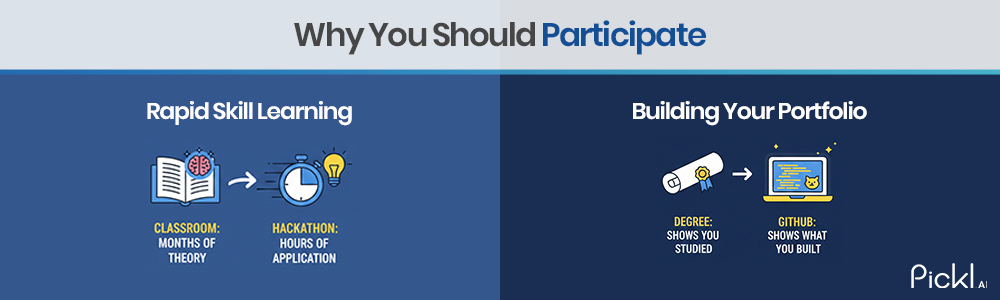
You might ask, “Why should I lose sleep to code for free?” The benefits are massive.
Rapid Skill Learning
In a classroom, you learn theory over months. At university hackathons, you learn application in hours. You might need to learn a new coding language or a new API on the fly. This forces you to learn fast. It builds “learning agility,” a skill employers love.
Building Your Portfolio
A degree tells employers you studied. A GitHub link from a hackathon shows them what you built. Projects created during university hackathons are great resume boosters. They prove you can build real things.
Networking with Industry
Big companies sponsor these events. Google, Microsoft, and local tech startups often set up booths. They send recruiters to scout talent. If you perform well, you might leave the event with an internship offer.
The Landscape of Hackathons for College Students in India
India has become a global hotspot for coding competitions. The demand for Hackathons for College students in India is exploding. The Indian tech ecosystem is young and hungry.
The most famous example is the Smart India Hackathon (SIH). This is a nationwide initiative. It brings together thousands of students to solve problems faced by government ministries. It is the world’s biggest open innovation model. Students solve issues ranging from water management to digital security.
Top institutions like IIT Bombay, IIT Delhi, and BITS Pilani host massive annual events. For example, Techfest at IIT Bombay often features high-stakes coding battles. However, it is not just the elite colleges. Private universities across Bangalore, Pune, and Hyderabad are hosting incredible events. They partner with platforms like HackerRank or Unstop to manage these competitions.
For Indian students, these events are a gateway. They bridge the gap between academic pressure and industry creativity.
How to Prepare for Your First Hackathon
Entering your first hackathon can be scary. Here is how to get ready.
Form a Balanced Team
Do not just group up with four coders. You need diversity. You need a “Hacker” (backend coder), a “Hipster” (designer/frontend), and a “Hustler” (the pitcher/business person). A team that can code well but cannot sell their idea will lose.
Focus on the Problem, Not the Tech
Many teams fail because they want to use a cool new technology. Instead, focus on a real problem. Judges award points for impact. If your app solves a painful problem for users, you will score high.
Plan Your Time
A 24-hour hackathon goes by fast. Spend the first two hours brainstorming. Spend the next 20 hours building. Save the last two hours for your pitch. Do not code until the last minute. If your demo fails during the presentation, all your hard work is lost.
The Role of Corporate Sponsors
University hackathons cannot happen without money. This is where industry partners come in. Companies provide the prize money, the food, and the swag (t-shirts and stickers).
In return, companies get access to top talent. For example, a data science company like Pickl.AI might sponsor a hackathon to promote their curriculum. They might offer a challenge statement related to data analytics. Students who solve it get noticed by the company.
This symbiotic relationship drives the ecosystem. It connects the academic world with the corporate world. For students, it is a chance to use professional tools. For companies, it is the ultimate recruiting ground.
Examples of Innovation
History is full of hackathon success stories. Did you know that major features of Facebook (like the “Like” button) were created during internal hackathons?
In the university space, apps like “GroupMe” started at a hackathon. Students identified a problem: group messaging was hard. They built a solution in a weekend. Later, it was sold for millions.
In India, students at a hackathon recently developed a smart glove for the visually impaired. It used sensors to detect obstacles. This project started as a 24-hour prototype and is now a funded startup. These stories prove that university hackathons are launchpads for entrepreneurship.
Conclusion
University hackathons are a defining part of the modern college experience. They teach resilience, teamwork, and innovation. They force you to step out of your comfort zone.
Whether you are looking for Hackathons for College students in India or preparing for global University hackathons 2025, the advice is the same: just show up. You do not need to be an expert. You just need to be curious. The skills you gain in those sleepless 24 hours will serve you for the rest of your career. So, grab your laptop, find a team, and start building.
Frequently Asked Questions
What are university hackathons?
University hackathons are competitive events hosted by colleges. Students form teams to build software or hardware projects within a limited time, usually 24 to 48 hours. They compete for prizes and recognition.
Do I need to know how to code to join?
No, not necessarily. While coding is important, teams also need designers, project managers, and presenters. University hackathons welcome students from all backgrounds to contribute different skills.
What are the trends for University hackathons 2025?
The major trends for University hackathons 2025 include Generative AI, sustainability (Green Tech), and Web3/Blockchain solutions. There is also a growing focus on using no-code tools to allow non-technical students to participate.
Where can I find Hackathons for College students in India?
You can find Hackathons for College students in India on platforms like Unstop (formerly Dare2Compete), HackerEarth, and Devfolio. Major events like the Smart India Hackathon are also announced through official government channels and university notice boards.
How do hackathons help with placements?
Hackathons help you build a portfolio of real projects. They also allow you to interact directly with recruiters who sponsor the events. Winning or even participating in a hackathon shows employers you are proactive and skilled.
Author
-

Written by:
Neha Singh