
Why Universities Need Industry Instructors to Strengthen Data Science and AI Teaching
Strengthen teaching with industry instructors in data science and AI for job-ready student success today.
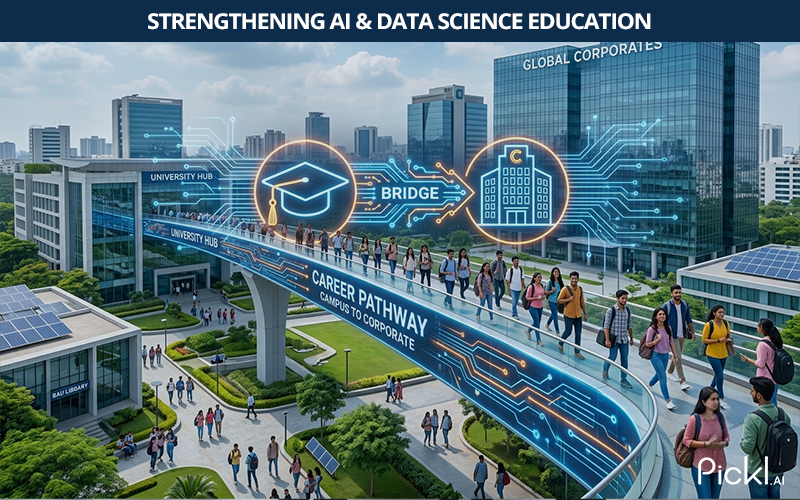
Summary: Universities must integrate industry instructors in data science and AI to tackle the skills gap. Through industry-supported AI education, students gain real-world insights. Industry experts in AI education, supported by Pickl.AI’s faculty development programs, ensure a modern curriculum that prepares graduates for the evolving job market effectively and efficiently.
Introduction
The world of technology is moving faster than ever before. Every day, new algorithms are developed, and Artificial Intelligence (AI) is being integrated into everything from healthcare to finance. While universities are the traditional centers of learning, the rapid pace of the AI revolution has created a unique challenge. Textbooks written two years ago are often already outdated.
To bridge this gap, higher education institutions must look beyond the classroom. The integration of industry instructors in data science and AI is no longer just an option; it is a necessity. By bringing professionals from the field into the lecture hall, universities can ensure that their students are not just getting a degree, but are becoming truly job-ready.
The Role of Industry Instructors in Data Science and AI

Industry instructors in data science and AI are professionals who work daily with large datasets, machine learning models, and complex coding environments. Unlike traditional professors who may focus primarily on theoretical research, these instructors focus on “what works” in the real world.
Their role is to act as a bridge. They translate complex mathematical theories into practical business solutions. For example, while a textbook might explain the math behind a recommendation engine, an industry instructor can explain how Netflix or Amazon actually scales that engine to serve millions of users in real-time.
They bring knowledge of current tools like Docker, Kubernetes, and advanced cloud platforms that are often missing from standard academic syllabi.
The Skills Gap in Data Science and AI Education
There is a growing “skills gap” in the tech industry. Companies are desperate for AI talent, yet many graduates find it difficult to land their first job. Why? Because there is a difference between knowing how an algorithm works and knowing how to deploy it.
Standard university curricula often focus on “clean” data. In the real world, data is messy, incomplete, and biased. Without the guidance of industry experts in AI education, students may enter the workforce unprepared for the chaotic nature of real-world data. They might know the theory of neural networks but struggle to explain the ROI (Return on Investment) of an AI project to a business stakeholder. This gap is what industry-led teaching aims to close.
Why Universities Need Industry Experts in AI Education
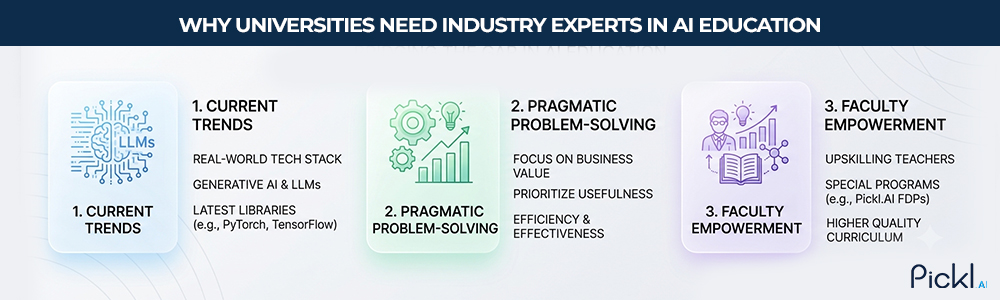
Universities are excellent at teaching foundational logic, ethics, and mathematics. However, industry experts in AI education bring three critical elements that are hard to replicate in a purely academic setting:
Current Trends
Industry experts are at the forefront of the Generative AI and Large Language Model (LLM) revolution. They know which libraries (like PyTorch or TensorFlow) are being used in top tech firms right now.
Problem-Solving Mindset
In business, a model doesn’t have to be 100% accurate; it has to be useful. Industry instructors teach students how to prioritize efficiency and business value.
Faculty Empowerment
It is not just students who need help. University professors also need to stay updated. This is where organizations like Pickl.AI come into play. They provides specialized faculty development programs (FDPs) that help university teachers upgrade their own skills. When faculty members are trained by industry leaders, the entire quality of the university’s curriculum rises.
How Industry-Supported AI Education Improves Learning Outcomes
Industry-supported AI education shifts the focus from rote memorization to project-based learning. When a curriculum is designed with the help of industry partners, students work on “live” case studies.
For instance, instead of a generic final project, students might work on a dataset provided by a logistics company to optimize delivery routes. This hands-on approach ensures that students understand the lifecycle of a Data Science project—from data cleaning and feature engineering to model deployment and monitoring.
Furthermore, industry-supported AI education often includes mentorship. Having a mentor who works at a top tech firm gives students a window into the corporate world, helping them understand professional expectations and the “soft skills” required to succeed in a team.
Key Benefits of Industry-Supported AI Education
The advantages of integrating industry instructors in data science and AI are numerous:
Job Readiness
Students graduate with a portfolio of real-world projects, making them much more attractive to recruiters.
Networking Opportunities
Industry instructors often serve as a direct link to internships and job openings.
Up-to-Date Curriculum
With input from experts, universities can update their courses every semester rather than every few years.
Access to Modern Tools
Industry partnerships often provide students with access to expensive proprietary software or cloud credits that they wouldn’t have otherwise.
Improved Faculty Knowledge
As mentioned with the Pickl.AI example, faculty development programs ensure that the teachers themselves are confident in teaching the latest technologies.
Challenges and How Universities Can Address Them
Despite the benefits, bringing industry experts into academia has challenges. There can be bureaucratic hurdles, or a mismatch between academic grading systems and industry’s fast-paced nature. To address this, universities should:
Adopt Hybrid Models
Use traditional professors for foundational theory and industry instructors for practical labs and capstone projects.
Invest in Faculty Development
Don’t just hire outsiders; empower the existing staff. Programs like those offered by Pickl.AI are essential for upgrading the internal knowledge base of an institution.
Flexible Scheduling
Many industry experts work full-time. Universities can offer evening masterclasses or weekend workshops to accommodate their schedules.
Collaborative Curriculum Design
Universities should form advisory boards consisting of tech leaders to review their Data Science and AI programs annually.
Conclusion
The goal of education is to prepare the next generation for the challenges of the future. In the context of the AI era, this cannot be done in isolation. Universities need the practical insights, real-world experience, and technical currency that only industry instructors in data science and AI can provide.
By embracing industry-supported AI education, institutions can transform from theoretical halls of learning into engines of innovation. Whether it is through direct teaching or through faculty development programs like those from Pickl.AI, the collaboration between industry and academia is the only way to ensure that the data scientists of tomorrow are ready to lead today.
Frequently Asked Questions
Who are industry instructors in data science and AI?
Industry instructors are working professionals—such as Data Scientists, AI Researchers, or Machine Learning Engineers—who take time to teach at universities. They bring practical experience from their daily work in the corporate or tech sector into the classroom.
Why do universities need industry experts in AI education?
Universities need these experts because the field of AI changes too quickly for traditional textbooks to keep up. Industry experts help update the curriculum, teach students how to use the latest tools, and provide insights into the current job market that academic research alone cannot provide.
How does industry-supported AI education benefit students?
It benefits students by making them “job-ready.” They learn to solve real-world problems using messy data, gain experience with modern tech stacks, and often get better networking opportunities. It bridges the gap between knowing the theory of AI and being able to build an AI product.