
How to Build an AI Portfolio Before You Graduate
Summary: Portfolio building is crucial to showcase your skill set. Recruiters are not simply relying on academic excellence,…
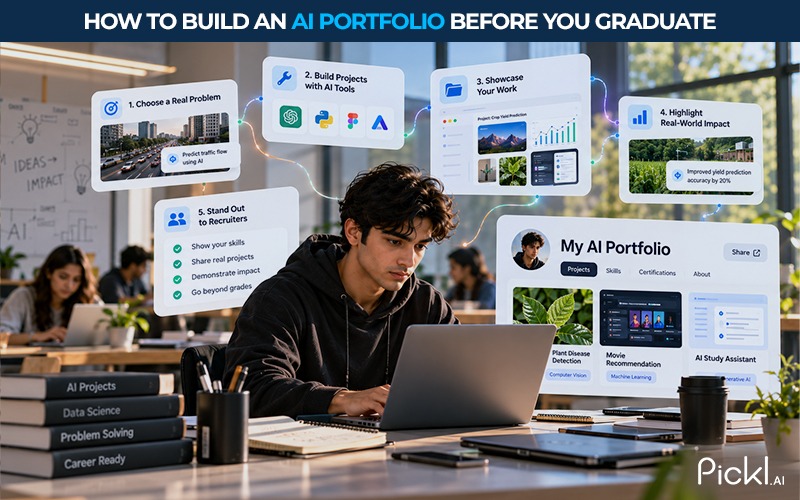
Summary: Portfolio building is crucial to showcase your skill set. Recruiters are not simply relying on academic excellence, but are looking for candidates who have practically implemented their learnings in the real world. Hence, AI portfolio building becomes integral. This blog covers all the key aspects to take into consideration while building an AI portfolio.
Introduction
One of the simplest ways to land in a high-paying job after graduation is to build a strong AI portfolio. Ask any recruiter what they want from a fresh graduate today, and you will hear the same thing: show me what you can do. Nowadays, companies are following evidence-based hiring and not simply relying on a degree tells them you studied. A portfolio shows them you can build.
If you are in college right now, you have a real advantage. You have time, free tools and plenty of problems to solve. This guide explains how to build an AI portfolio before you graduate, step by step, in plain language.
What Is an AI Portfolio?
An AI portfolio is a collection of projects that prove your AI skills. Think of it as a showcase of your best work. Each project shows a problem you picked, the tools you used, and the result you got.
It is not only for coders. Marketing, finance, HR and design students can also build one. For example, you could use AI to study customer reviews or to automate a boring report. What matters is that you solved something real.
Why Do You Need an AI Portfolio in 2026?
Because employers now care about skills as much as degrees. The numbers say a lot:
- Microsoft and LinkedIn’s 2024 Work Trend Index reported that 66% of business leaders would not hire someone without AI skills. It also found that 71% would pick a less experienced candidate with AI skills over a more experienced one without them.
- PwC’s 2025 Global AI Jobs Barometer found that jobs needing AI skills pay around 56% more than similar jobs that do not.
- The World Economic Forum’s Future of Jobs Report 2025 expects about 39% of core job skills to change by 2030. AI and big data are among the fastest-growing skills.
In simple words, AI skills are no longer a bonus. They are becoming a basic need. A portfolio is the easiest way to prove you have them.
How to Build an AI Portfolio: 7 Simple Steps
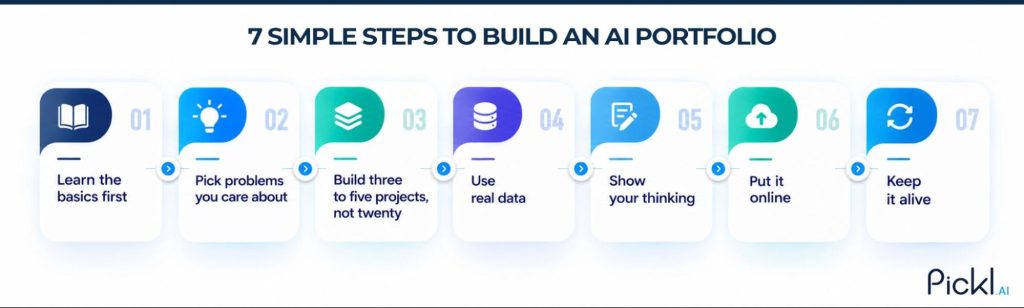
Step 1: Learn the basics first
You do not need a PhD. You need a clear base. Start with what AI, machine learning, and generative AI actually mean. Then pick one path:
- Technical path: Python, data handling, and basic machine learning.
- Business path: prompt writing, AI tools, and workflow automation.
Free courses on Coursera, Kaggle Learn, Google’s AI courses and YouTube are enough to begin. Give yourself 30 days of steady learning before you build anything big.
Step 2: Pick problems you care about
The best projects start with a question, not a tool. Ask yourself: what annoys me? What do I wish was faster? Maybe your college library has long queues. Your hostel mess wastes food. Maybe you follow cricket and love stats.
When you care about the problem, you will finish the project. And your story will sound real in interviews.
Step 3: Build three to five projects, not twenty
Quality beats quantity. Recruiters spend very little time on each portfolio, so a few strong projects work better than a long list of half-done ones. Aim for variety:
- One project that uses data (prediction, analysis or dashboards).
- One project that uses generative AI (a chatbot, summariser or content tool).
- One project that solves a business or social problem.
Step 4: Use real data
Avoid projects that only copy a tutorial. Everyone has built the Titanic survival model. Use fresh data instead. You can find it on Kaggle, government open data portals, or by collecting your own through surveys. Real data is messy. That is good, because cleaning it shows real skill.
Step 5: Show your thinking
This step is where most students lose marks. Do not just upload code or a screenshot. Write a short case study for each project. Cover these points:
- What problem did you solve?
- Why did you pick this approach?
- What went wrong, and how did you fix it?
- What was the result?
- What would you improve next time?
Keep it to 300 to 500 words. Honest notes about your mistakes make you look more credible, not less.
Step 6: Put it online
A portfolio nobody can see does not help you. Publish your work in places recruiters already look:
- GitHub for code, with a clear README for each project.
- LinkedIn for short posts and a Featured section with your best work.
- Kaggle or Hugging Face for notebooks and demos.
- A simple personal website to bring everything together in one link.
Use one name and one photo everywhere, so people can find you easily.
Step 7: Keep it alive
AI changes fast. A portfolio that was last updated two years ago looks old. Set a reminder to add or improve one project every quarter. Also share what you learn in small posts. Consistency builds trust.
What Projects Should Go in a Student AI Portfolio?
It is important to choose projects that solve real-world problems. If you are running short of ideas, here are a few innovative AI project ideas that can boost your resume.
- A resume screening tool that ranks CVs against a job description.
- A sentiment analyser for product reviews or movie ratings.
- A study buddy chatbot trained on your own class notes.
- A sales or demand forecast using public data.
- A dashboard that tracks air quality in your city.
- A content assistant that turns long articles into short summaries.
- A fake news or spam message detector.
Pick one that matches the career you want. If you want a marketing job, build a campaign analysis tool. If you want a data job, build a prediction model.
Common Mistakes to Avoid
Choosing an AI project simply because it seems interesting or popular, without considering how well it aligns with your skills, may not be the best approach. Instead, choose a project that demonstrates your expertise in a specific AI skill and aligns with your learning or career goals. Here are some common mistakes to avoid when selecting an AI project:
Do not copy the projects
Copying tutorials without adding value Use tutorials to learn the basics, but take your project further by adding your own ideas, using different datasets, or solving a real-world problem.
Ignoring the clear problem
Ignoring the story behind your project Writing code is only part of the process. Document the problem you wanted to solve, your approach, the tools you used, and what you learned along the way.
Overstating your expertise
Be honest about your skills and contributions. Interviewers may ask you to explain your decisions, so make sure you understand the work you showcase.
Frequently Asked Questions
Can I build an AI portfolio with no coding experience?
Yes. You can use no-code and low-code AI tools to build chatbots, automations and analysis projects. Just explain the problem, your steps and the result clearly. Learning basic Python later will help, but it is not a must to begin.
How long does it take to build an AI portfolio?
Most students can build a solid starter portfolio in three to six months. Spend the first month learning, the next two building, and the rest polishing and publishing.
How many projects should an AI portfolio have?
Three to five strong projects are enough. Each one should show a different skill.
Do employers really check portfolios?
Many do, especially for roles in data, analytics, technology and digital marketing. Even when they do not, a link to your work gives you something real to talk about in interviews.
Where can I host my AI portfolio for free?
GitHub Pages, Kaggle, Hugging Face Spaces and LinkedIn are all free and widely used.
Final Thoughts
An AI portfolio is tangible proof of your skills and your ability to apply them to real-world problems. Internships offer another valuable opportunity to work on practical use cases, gain industry experience, and strengthen your portfolio.
So, pick one problem this week. Learn what you need to get started, build a solution, explain your approach, and share your work. By the time you graduate, you won’t just claim to know AI but you will have projects that demonstrates what you can actually do.
Ready to start? Choose one idea from the list above and begin today.