
Why Outcome-Based Education is the Catalyst for University Growth and Global Rankings
Summary: Universities and colleges are experiencing a shift in the admission process. The university rankings are a result…
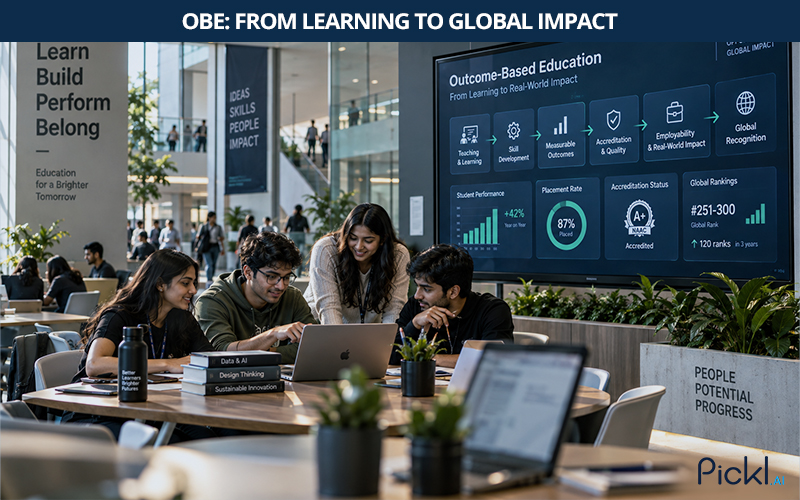
Summary: Universities and colleges are experiencing a shift in the admission process. The university rankings are a result of how it is transforming itself in modern times. Today, outcome-based education that provides visible results like placement percentage, AI-integrated curriculum, and efforts in the direction of student preparedness for placement plays a crucial role in improving the university ranking. This blog explores some of the key factors in this domain.
Introduction
The growing competitiveness in the higher education domain has triggered the change of curricula. Adhering to the legacy teaching methodology doesn’t drive verifiable results, consequently, the focus has now shifted to outcome-based education (OBE). Adopting this mode of education is not just an option, but a mandatory initiative that can help universities stand ahead of the league.
OBE serves as a strategic driver of institutional growth. It focuses on continuous improvement, strengthening accreditation and uplifting educational quality. Academic output is not the primary factor influencing university ranking, global ranking systems now influence by learning outcomes, tangible results and the real impact that education pedagogy is creating.
What is Outcome-Based Education (OBE)?
In simple words, it means that every course mapped to a measurable programme outcome (PO), Course Outcome (CO), or Programme Educational Objective (PEO). Attainment of these outcomes is then tracked, analysed, and reported — both for accreditation bodies and for continuous curriculum improvement. Focusing on this aspect becomes vital since the accreditation bodies and ranking agencies are not simply looking at the breadth of the syllabus, but are equally weighing the job-readiness of the graduates.
The learning outcome-based curriculum framework operates on three core levels:
- Program Educational Objectives (PEOs): What graduates are expected to achieve 3-5 years after graduation.
- Program Outcomes (POs): The skills and knowledge students should possess upon graduation.
- Course Outcomes (COs): Specific competencies gained at the end of each module.
Importance of Outcome-Based Education in Higher Education
The importance of outcome-based education lies in its ability to bridge the employability gap. As per the World Economic Forum’s Future of Jobs Report, 50% of all employees will need reskilling because of the faster adoption of newer technologies. Universities that fail to adapt their curriculum to these shifting demands risk becoming redundant.
Enhancing Graduate Employability
In the case of outcome-based learning, there has been a paradigm shift in the focus of education. It’s not simply about “what was taught” to “what was mastered.” When universities have excelled in this domain, they are able to prepare their students for real-world scenarios. It also becomes a magnet for top-tier recruiters.
Accountability and Transparency
OBE provides a clear roadmap for stakeholders. Parents and students—the primary investors in education—now look for “Return on Investment” (ROI). A well-defined outcome-based learning framework provides the data necessary to prove that an investment in your institution yields tangible career growth.
Implementing the Learning Outcome-Based Curriculum Framework
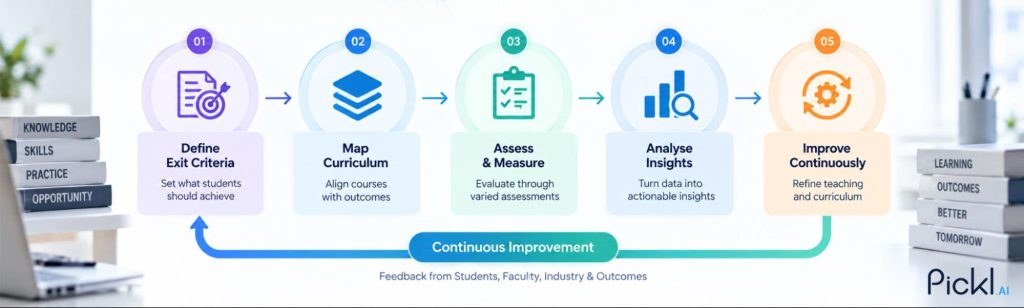
Transitioning to outcome-based education in higher education requires a structural restructuring. It isn’t just about changing the syllabus; it’s about “Backward Design.”
Step 1: Defining the Exit Criteria
The first step to establishing an outcome-based curriculum framework is to collaborate with platforms that integrate advanced technologies, ensuring the coursework remains relevant to current industry demands. This framework should balance technical proficiency with essential soft skills and ethical considerations.
Step 2: Curriculum Mapping
The learning outcome-based curriculum framework requires clear mapping of every lecture, assignment, and exam back to a specific Program Outcome. The objective here is to analyse if we are aptly implementing the OBE structure.
Step 3: Continuous Quality Improvement (CQI)
OBE is not a “set it and forget it” system. It relies on a feedback loop where assessment data is used to improve the next cycle of teaching. This is the hallmark of a high-growth university.
The Shift Toward Skill-Based Education
The global economy is moving toward a skill-based education model. Giants like Google, Apple, and IBM have famously removed degree requirements for many roles, focusing instead on “demonstrable skills.”
Outcome-based learning aligns perfectly with this trend. By focusing on competencies such as data literacy, critical thinking, and digital fluency, universities can ensure their degrees remain the “gold standard” of professional readiness.
The Role of Technology and Data
To manage OBE effectively, universities need data-oriented solutions. Tracking the progress of 10,000+ students across 500+ courses manually is impossible. This is where digital transformation and strategic partnerships become vital.
The Challenges: Why Universities Struggle with OBE Implementation
Despite its benefits, many institutions struggle with the outcome-based education framework due to:
- Faculty Resistance: Moving from traditional teaching to outcome-oriented facilitation requires extensive upskilling.
- Industry-Academia Gap: Faculty often lack insights into the latest industry tools and trends (e.g., Generative AI, Advanced Data Analytics).
- Assessment Silos: Assessments often focus on rote memorization rather than the application of knowledge.
Transforming Challenges into Growth: The Pickl.AI Advantage
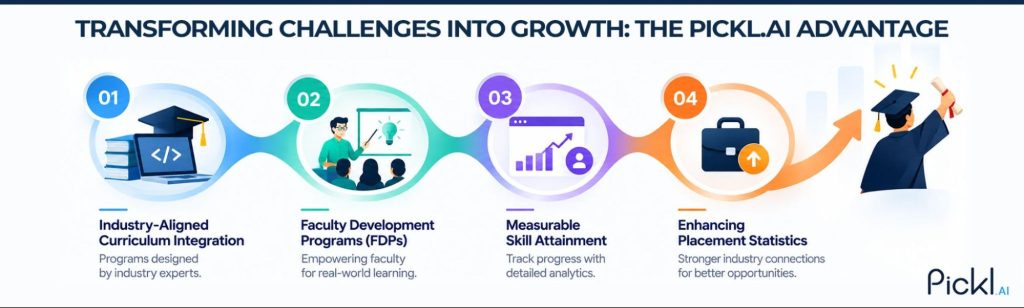
This is where Pickl.AI steps in as a strategic partner for forward-thinking universities. We understand that senior management needs more than just a software tool; they need a holistic ecosystem that integrates skill-based education into the existing academic fabric.
Industry-Aligned Curriculum Integration
Our data science and AI programs are designed by practicing industry experts. By integrating Pickl.AI’s modules into your learning outcome-based curriculum framework, you ensure that your students are learning tools (like Python, SQL, and Machine Learning) as they are used at top tech firms today.
Faculty Development Programs (FDPs)
We don’t just teach students; we empower faculty. Our FDPs focus on bridging the gap between academic theory and industry practice, helping professors become mentors in an outcome-based learning environment.
Measurable Skill Attainment
Pickl.AI provides detailed analytics on student performance. We track “skill mastery” through real-world capstone projects, providing deans and VCs with the “attainment data” needed for university ranking submissions and accreditation reports.
Enhancing Placement Statistics
By collaborating with Pickl.AI, your institution gains access to our network of industry partners. This directly impacts your “Graduate Outcomes” and “Employer Reputation” scores, propelling your university up the global leaderboards.
Data Points for Senior Management: The ROI of OBE
- 15% Increase in Enrolment: Institutions that market themselves as “Outcome-Focused” see a significant rise in high-quality applications.
- Higher Median Packages: Universities implementing robust skill-based education report a 25-40% increase in the median salary of placed students. (Trained professionals are earning 25-40 per cent higher than untrained professionals across the globe.)
- Streamlined Accreditation: Universities using data-driven OBE frameworks reduce the time spent on NAAC/NBA documentation by nearly 60%.
The Path Forward for Visionary Leadership
The transition to outcome-based education is not merely a pedagogical shift; it is a brand-building exercise. For a university to grow in the 21st century, it must move beyond the role of a “degree granter” and become a “competency builder.”
By adopting a rigorous outcome-based education framework, your institution can secure higher university rankings, attract prestigious faculty, and produce graduates who are not just “degree holders” but “industry leaders.”
The journey to academic excellence requires a partner who understands the pulse of the industry. Pickl.AI is committed to helping universities navigate the complexities of outcome-based education in higher education.
Frequently Asked Questions
Why is Outcome-Based Education (OBE) important for university rankings?
Outcome-based learning impacts university rankings as it is more results-oriented. OBE ensures students gain measurable skills that employers value, directly improving these scores, this eventually starts reflecting on the university rankings.
How does a learning outcome-based curriculum framework differ from traditional models?
Traditional models focus on inputs (what the teacher covers), whereas the learning outcome-based curriculum framework focuses on outputs (what the student can actually do). It uses “backward design” to align every lesson with a specific professional competency.
What are the benefits of skill-based education for faculty?
Skill-based education allows faculty to move from being lecturers to mentors. It provides them with clear rubrics for assessment and helps them stay updated with industry trends, increasing their own professional relevance and research impact.