
How Universities Can Develop Faculty Leaders in Data Science and AI With Industry Support
Empower educators through industry-led faculty development in data science and AI for future-ready university leadership.
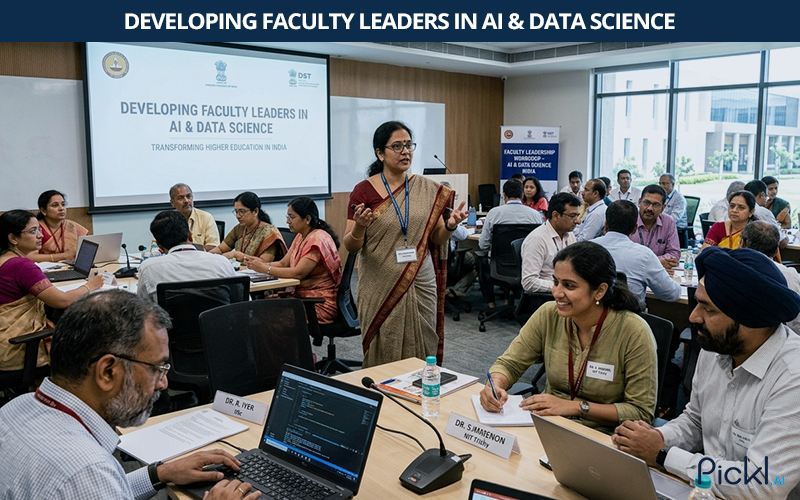
Summary: This blog explores the importance of faculty development in data science and AI. By leveraging industry partnerships for faculty development, universities can bridge the skills gap. Through specialized faculty development programs like Pickl.AI, educators gain real-world expertise, ensuring students are prepared for the rapidly evolving tech job market effectively.
Introduction
The rapid rise of Artificial Intelligence (AI) and Data Science has transformed the global economy. From healthcare to finance, every sector is looking for experts who can harness the power of data. However, for universities to produce these experts, they first need leaders within their own walls. This is where faculty development in data science and AI becomes the most important investment a university can make.
Teaching AI is not like teaching history or basic mathematics. The tools used today might be replaced by better ones in six months. To keep up, professors cannot rely solely on academic journals. They need direct insights from the tech world. By fostering industry partnerships for faculty development, universities can turn their professors into visionary leaders who don’t just teach theory but prepare students for the future.
Understanding Faculty Development in Data Science and AI
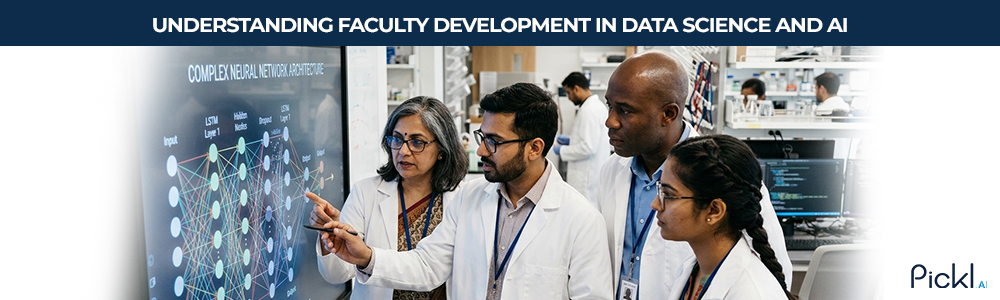
Faculty development in data science and AI refers to the continuous process of training university teachers to master new technologies, teaching methodologies, and industry tools. It is about moving beyond traditional lectures and embracing a hands-on, project-based approach.
In the context of AI, faculty development involves learning how to use Large Language Models (LLMs), understanding the ethics of automated decision-making, and mastering programming languages like Python and R at an advanced level. When faculty members are empowered, they become “Faculty Leaders”experts who can design modern curricula and mentor students through complex technical challenges.
Why Faculty Development Programs Must Be Industry-Supported
The biggest challenge in tech education is the “shelf life” of knowledge. A study by IBM suggested that the half-life of a learned skill in the tech industry is now only about five years. This means that without constant updates, a professor’s knowledge can become obsolete very quickly.
Faculty development programs that are supported by the industry are more effective because:
They use real data
Industry partners provide “dirty” data that mimics real-world scenarios, unlike the “clean” datasets found in textbooks.
They focus on deployment
Industry-led programs teach not just how to build a model, but how to deploy it into a cloud environment like AWS or Azure.
They highlight demand
Companies know which skills are in demand. By partnering with industry, faculty can focus their teaching on the most relevant topics.
The Critical Need for Faculty Development in Data Science and AI
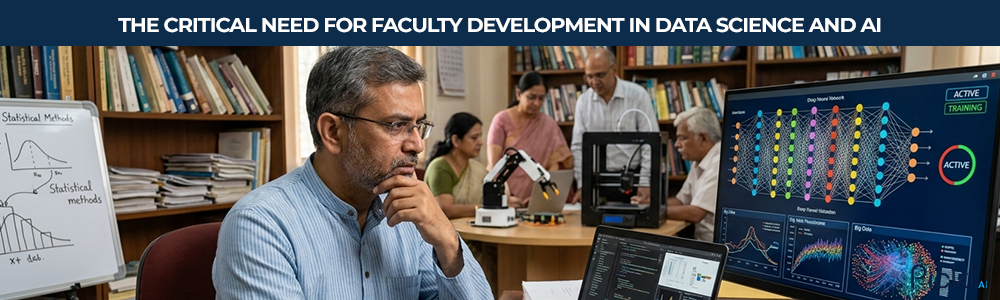
According to the World Economic Forum, AI and automation are expected to create 97 million new roles by 2025. However, there is a massive shortage of qualified talent to fill these roles. This “skills gap” starts at the university level.
If faculty members are not trained in the latest AI trends, students graduate with outdated skills. This leads to lower employability rates and hurts the university’s reputation. Furthermore, stats show that nearly 40% of academic faculty feel they lack the resources to teach AI effectively. This highlights the critical need for structured faculty development programs that bring industry expertise into the academic fold.
Key Ways Industry Partnerships Build Faculty Leaders in Data Science & AI
Industry partnerships act as a catalyst for growth, and hence have become a key choice for all colleges and universities that claim to offer employability. Here is how they help build faculty leaders:
Access to Cutting-Edge Tools
Companies often grant faculty access to proprietary software and high-powered computing resources that universities might find too expensive.
Co-Teaching Opportunities
In many industry partnerships for faculty development, industry veterans and professors co-teach a module. This allows the professor to learn “on the job.”
Joint Research Projects
Faculty leaders can work with companies on commercial R&D projects, bringing those insights back to the classroom.
Case Study Sharing
Industry partners provide real-life business problems (like predicting customer churn for a telecom company) that faculty can use as teaching materials.
Building an Industry-Supported Faculty Development Framework
To create a successful framework, universities should follow a structured path:
Needs Assessment
Identify where the faculty’s knowledge gaps lie (e.g., Deep Learning, NLP, or Big Data).
Partnership Selection
Collaborate with organizations like Pickl.AI, which specializes in faculty development in data science and AI. Pickl.AI provides Faculty Development Programs (FDPs) designed to help teachers master Python, Machine Learning, and Data Visualization.
Hands-on Workshops
Move away from webinars. Leadership is built through “doing.” Intensive coding bootcamps for faculty are essential.
Certification
Provide faculty with industry-recognized certifications to validate their expertise.
Feedback Loop
Regularly update the training framework based on new tech releases, like the latest updates in Generative AI.
Role of Industry in Accelerating Faculty Leadership
Industry does not just provide information; it provides a “leadership mindset.” In the tech world, leadership is about agility and problem-solving. When faculty interact with industry leads, they adopt these traits.
Programs like Pickl.AI’s faculty development program are specifically designed to bridge the gap. By training faculty on how to use industry-standard tools and workflows, these programs turn teachers into mentors. The industry’s role is to act as a “North Star,” ensuring that the faculty’s roadmap aligns with where the world is heading.
Benefits of Industry Partnerships for Faculty Development
The advantages of industry partnerships go beyond the classroom:
Higher Student Placement
When faculty are trained by the industry, their students are better prepared, leading to a 20-30% increase in job placement rates for some institutions.
Institutional Prestige
One of the key reasons universities are now focussing on faculty development program is that it helps them attract better talent and more funding.
Curriculum Agility
Faculty leaders can update their course syllabi in weeks rather than years, keeping the university at the cutting edge.
Enhanced Research
In order to keep pace with the growing competition, universities and colleges not only need to update their curriculum, but at the same time, they also need to ensure the knowledge upgrade of the professors. Faculty with industry ties are more likely to receive corporate grants for their research projects.
Common Challenges Universities Face (and How to Solve Them)
Building these partnerships isn’t always easy. While the constant struggle is to find the right program providers, there are some in-house challenges that act as an obstacle for the seamless integration of the faculty development programs. Here are common hurdles:
Resistance to Change
One of the key challenges is the resistance to adopting and adjusting to the change. Some faculty may be hesitant to learn new, difficult technologies.
Solution: Incentivize participation through promotions or research grants.
Budget Constraints
Small universities may lack the funds for massive training. This can be a potential roadblock to adopt such programs.
Solution: Partner with affordable, specialized providers like Pickl.AI that offer scalable faculty development programs.
Time Management
Professors are busy with teaching and administration.
Solution: Integrate FDPs during semester breaks or offer “micro-learning” modules that can be completed over time.
The Future of Faculty Leadership in Data Science & AI
The future of education is hybrid. We will see a world where the boundary between a “tech office” and a “university classroom” becomes thin. Faculty leaders will be the ones who navigate both worlds comfortably.
They will use AI to personalize learning for their students and rely on industry mentors to keep their own skills sharp. As AI continues to evolve, the demand for faculty development in data science and AI will only grow, making it the backbone of modern higher education.
Conclusion
Developing faculty leaders is the most sustainable way for universities to thrive in the AI era. By leveraging industry partnerships for faculty development, universities can ensure their teaching staff remains relevant, inspired, and capable of leading the next generation.
Organizations like Pickl.AI are already paving the way by offering specialized faculty development programs that turn academic expertise into industry-ready leadership. The time to bridge the gap is now.
Frequently Asked Questions
Why is faculty development in data science and AI crucial for universities?
AI moves too fast for traditional learning. Faculty development ensures that professors stay updated with the latest tools and industry trends, which in turn ensures that students receive a relevant and modern education.
How does industry involvement help universities improve student outcomes?
Industry involvement provides faculty with real-world case studies and technical skills. This allows faculty to teach students exactly what companies are looking for, significantly improving the students’ chances of getting hired.
What skills do faculty leaders in AI and data science need?
Beyond basic coding (Python, R), they need skills in Machine Learning deployment, Data Visualization, AI ethics, and the ability to work with cloud-based AI platforms.
What are faculty development programs in AI?
These are specialized training sessions, such as those offered by Pickl.AI, designed to upgrade the technical and pedagogical skills of university teachers. They focus on practical applications of AI rather than just theoretical concepts.